

Appendix: All Solutions to the Problems
819
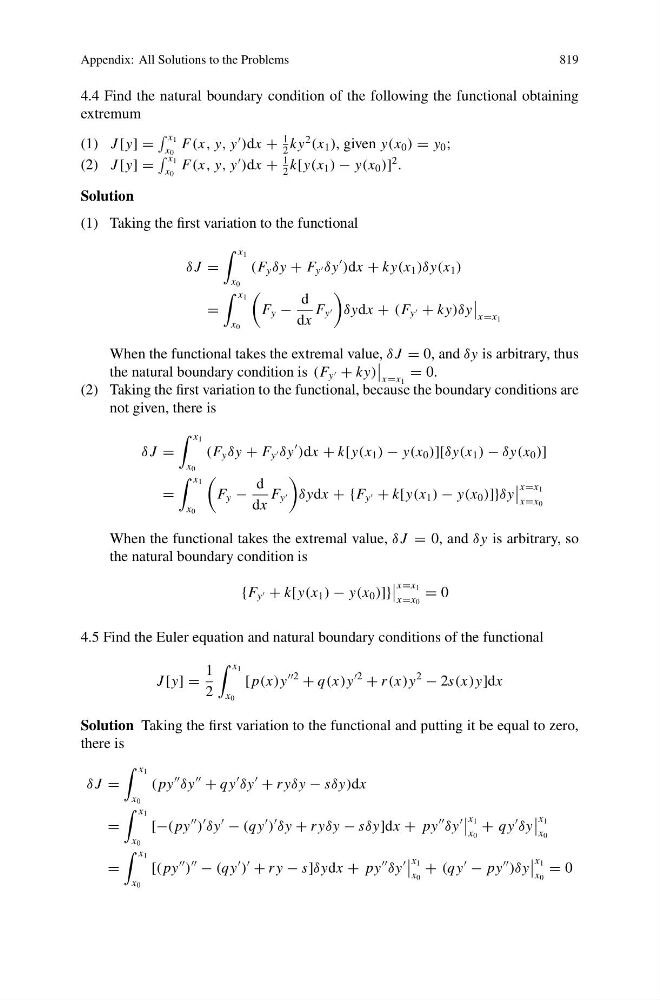
4.4 Find the natural boundary condition of the following the functional obtaining
extremum
(1) J [y] =
x 1
x 0
F(x, y, y
)dx +
1
2
ky
2
(x 1 ), given y(x 0 ) = y 0 ;
(2) J [y] =
x 1
x 0
F(x, y, y
)dx +
1
2
k[y(x 1 ) − y(x 0 )]
2 .
Solution
(1) Taking the first variation to the functional
δ J =
x 1
x 0
(F y δy + F y δy
)dx + ky(x 1 )δy(x 1 )
=
x 1
x 0
F y −
d
dx
F y
δydx + (F y + ky)δy
x=x 1
When the functional takes the extremal value, δ J = 0, and δy is arbitrary, thus
the natural boundary condition is (F y + ky)
x=x 1
= 0.
(2) Taking the first variation to the functional, because the boundary conditions are
not given, there is
δ J =
x 1
x 0
(F y δy + F y δy
)dx + k[y(x 1 ) − y(x 0 )][δy(x 1 ) − δy(x 0 )]
=
x 1
x 0
F y −
d
dx
F y
δydx + {F y + k[y(x 1 ) − y(x 0 )]}δy
x=x 1
x=x 0
When the functional takes the extremal value, δ J = 0, and δy is arbitrary, so
the natural boundary condition is
{F y + k[y(x 1 ) − y(x 0 )]}
x=x 1
x=x 0
= 0
4.5 Find the Euler equation and natural boundary conditions of the functional
J [y] =
1
2
x 1
x 0
[ p(x)y
2
+ q(x)y
2
+ r (x)y
2
− 2s(x)y]dx
Solution Taking the first variation to the functional and putting it be equal to zero,
there is
δ J =
x 1
x 0
( py
δy
+ qy
δy
+ r yδy − sδy)dx
=
x 1
x 0
[−( py
)
δy
− (qy
)
δy + r yδy − sδy]dx + py
δy
x 1
x 0
+ qy
δy
x 1
x 0
=
x 1
x 0
[( py
)
− (qy
)
+ r y − s]δydx + py
δy
x 1
x 0
+ (qy
− py
)δy
x 1
x 0
= 0