

818
Appendix: All Solutions to the Problems
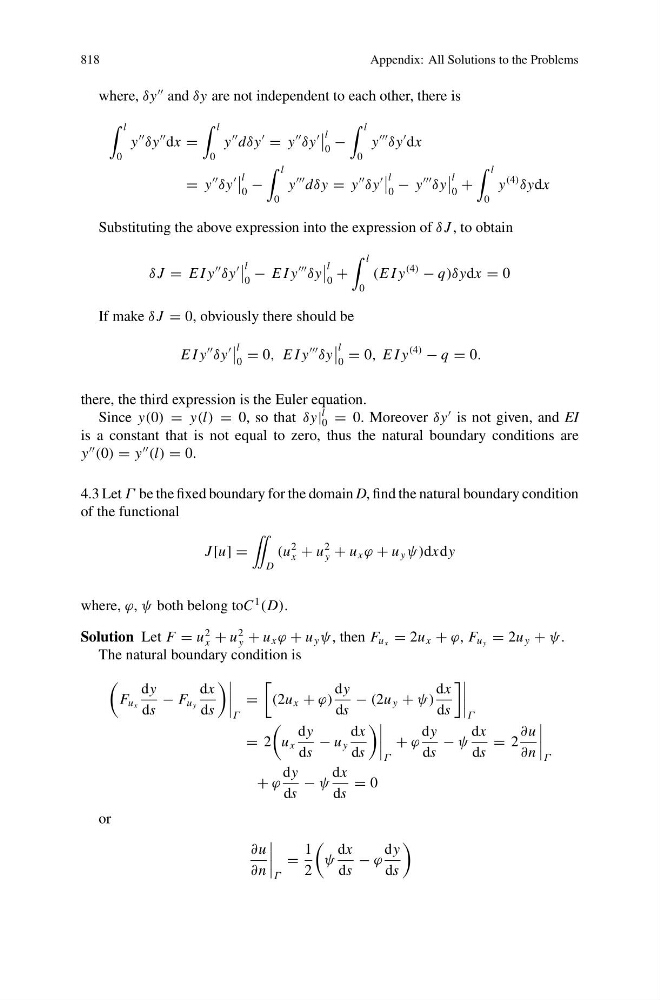
where, δy
and δy are not independent to each other, there is
l
0
y
δy
dx =
l
0
y
dδy
= y
δy
l
0
−
l
0
y
δy
dx
= y
δy
l
0
−
l
0
y
dδy = y
δy
l
0
− y
δy
l
0
+
l
0
y
(4)
δydx
Substituting the above expression into the expression of δ J , to obtain
δ J = E I y
δy
l
0
− E I y
δy
l
0
+
l
0
(E I y
(4)
− q)δydx = 0
If make δ J = 0, obviously there should be
E I y
δy
l
0
= 0, E I y
δy
l
0
= 0, E I y
(4)
− q = 0.
there, the third expression is the Euler equation.
Since y(0) = y(l) = 0, so that δy|
l
0 = 0. Moreover δy
is not given, and EI
is a constant that is not equal to zero, thus the natural boundary conditions are
y
(0) = y
(l) = 0.
4.3 Let Γ be the fixed boundary for the domain D, find the natural boundary condition
of the functional
J [u] =
¨
D
(u
2
x + u
2
y + u x ϕ + u y ψ)dxdy
where, ϕ, ψ both belong toC
1
(D).
Solution Let F = u
2
x + u
2
y + u x ϕ + u y ψ, then F u x = 2u x + ϕ, F u y = 2u y + ψ.
The natural boundary condition is
F u x
dy
ds
− F u y
dx
ds
Γ
=
(2u x + ϕ)
dy
ds
− (2u y + ψ)
dx
ds
Γ
= 2
u x
dy
ds
− u y
dx
ds
Γ
+ ϕ
dy
ds
− ψ
dx
ds
= 2
∂u
∂n
Γ
+ ϕ
dy
ds
− ψ
dx
ds
= 0
or
∂u
∂n
Γ
=
1
2
ψ
dx
ds
− ϕ
dy
ds