

790
Appendix: All Solutions to the Problems
x 1
x 0
[( py
)
+ qy + (sy
)
]δydx + J
x 1
x 0
r yδydx = 0
or
( py
)
+ (q + Jr)y + (sy
)
= 0
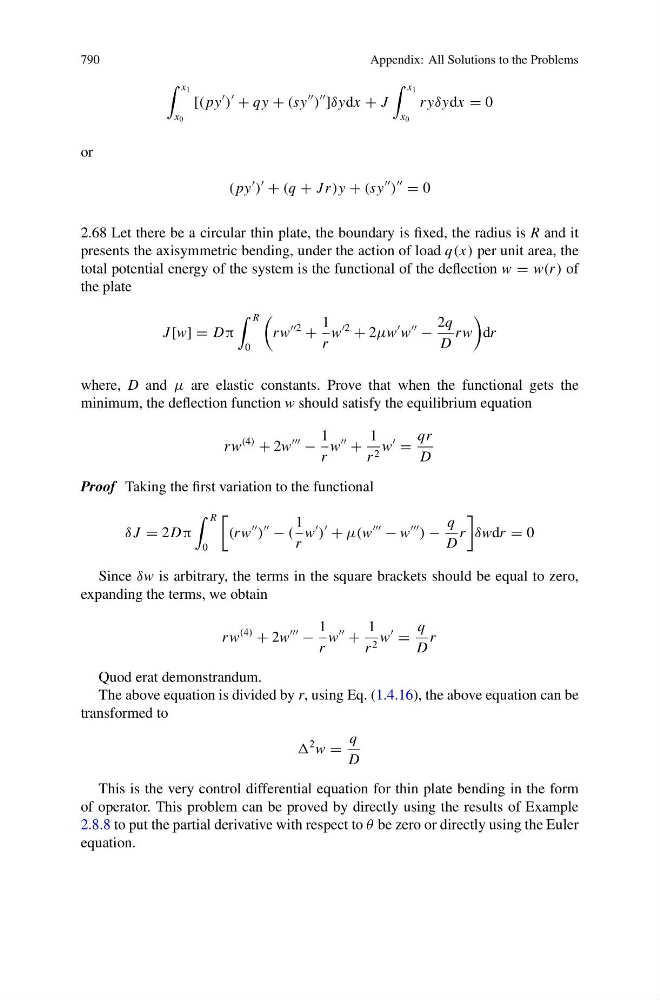
2.68 Let there be a circular thin plate, the boundary is fixed, the radius is R and it
presents the axisymmetric bending, under the action of load q(x) per unit area, the
total potential energy of the system is the functional of the deflection w = w(r ) of
the plate
J [w] = Dπ
R
0
rw
2
+
1
r
w
2
+ 2μw
w
−
2q
D
rw
dr
where, D and μ are elastic constants. Prove that when the functional gets the
minimum, the deflection function w should satisfy the equilibrium equation
rw
(4)
+ 2w
−
1
r
w
+
1
r 2 w
=
qr
D
Proof Taking the first variation to the functional
δ J = 2Dπ
R
0
(rw
)
− (
1
r
w
)
+ μ(w
− w
) −
q
D
r
δwdr = 0
Since δw is arbitrary, the terms in the square brackets should be equal to zero,
expanding the terms, we obtain
rw
(4)
+ 2w
−
1
r
w
+
1
r 2 w
=
q
D
r
Quod erat demonstrandum.
The above equation is divided by r, using Eq. (1.4.16), the above equation can be
transformed to
2 w =
q
D
This is the very control differential equation for thin plate bending in the form
of operator. This problem can be proved by directly using the results of Example
2.8.8 to put the partial derivative with respect to θ be zero or directly using the Euler
equation.