

Appendix: All Solutions to the Problems
789
y = (c 1 x + c 2 )e
x
+ (c 3 x + c 4 )e
−x
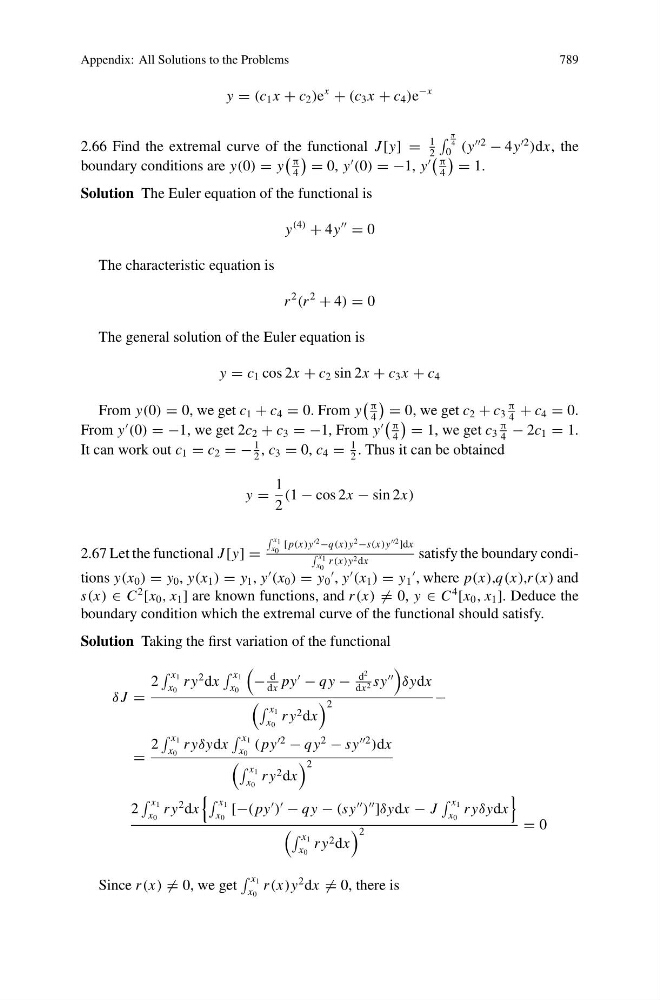
2.66 Find the extremal curve of the functional J [y] =
1
2
π
4
0 (y
2
− 4y
2
)dx, the
boundary conditions are y(0) = y
π
4
= 0, y
(0) = −1, y
π
4
= 1.
Solution The Euler equation of the functional is
y
(4)
+ 4y
= 0
The characteristic equation is
r
2
(r
2
+ 4) = 0
The general solution of the Euler equation is
y = c 1 cos 2x + c 2 sin 2x + c 3 x + c 4
From y(0) = 0, we get c 1 + c 4 = 0. From y
π
4
= 0, we get c 2 + c 3
π
4
+ c 4 = 0.
From y
(0) = −1, we get 2c 2 + c 3 = −1, From y
π
4
= 1, we get c 3
π
4
− 2c 1 = 1.
It can work out c 1 = c 2 = −
1
2
, c 3 = 0, c 4 =
1
2
. Thus it can be obtained
y =
1
2
(1 − cos 2x − sin 2x)
2.67 Let the functional J [y] =
x 1
x 0
[ p(x)y
2 −q(x)y
2 −s(x)y
2 ]dx
x 1
x 0
r (x)y 2 dx
satisfy the boundary conditions y(x 0 ) = y 0 , y(x 1 ) = y 1 , y
(x 0 ) = y 0
, y
(x 1 ) = y 1
, where p(x),q(x),r (x) and
s(x) ∈ C
2
[x 0 , x 1 ] are known functions, and r (x) = 0, y ∈ C
4
[x 0 , x 1 ]. Deduce the
boundary condition which the extremal curve of the functional should satisfy.
Solution Taking the first variation of the functional
δ J =
2
x 1
x 0
r y
2 dx
x 1
x 0
−
d
dx
py
− qy −
d
2
dx 2 sy
δydx
x 1
x 0
r y 2 dx
2
−
=
2
x 1
x 0
r yδydx
x 1
x 0
( py
2
− qy
2
− sy
2
)dx
x 1
x 0
r y 2 dx
2
2
x 1
x 0
r y
2 dx
x 1
x 0
[−( py
)
− qy − (sy
)
]δydx − J
x 1
x 0
r yδydx
x 1
x 0
r y 2 dx
2
= 0
Since r (x) = 0, we get
x 1
x 0
r (x)y
2 dx = 0, there is