

782
Appendix: All Solutions to the Problems
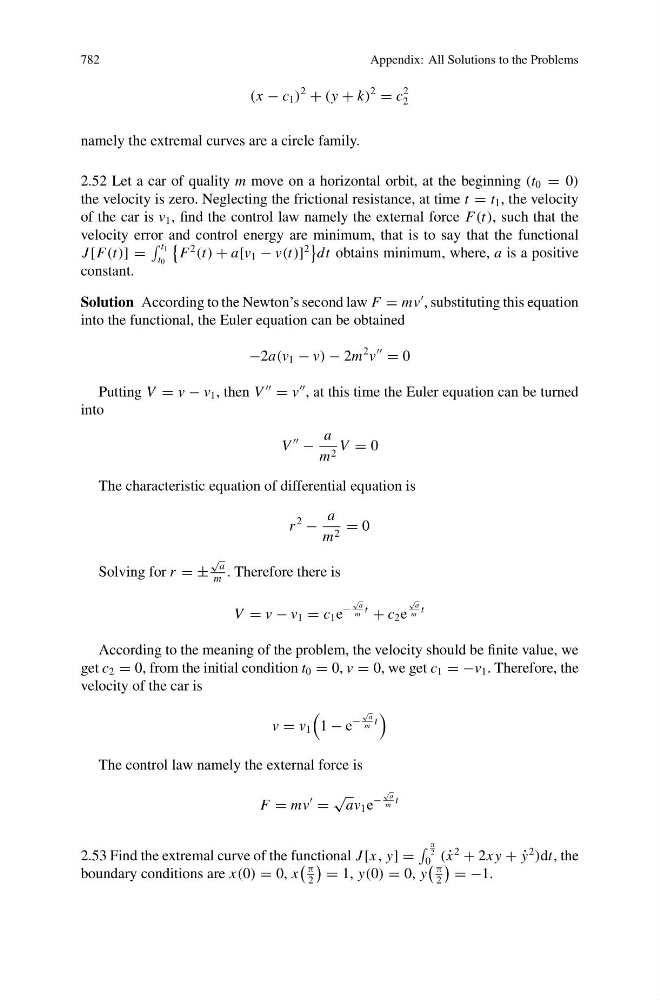
(x − c 1 )
2
+ (y + k)
2
= c
2
2
namely the extremal curves are a circle family.
2.52 Let a car of quality m move on a horizontal orbit, at the beginning (t 0 = 0)
the velocity is zero. Neglecting the frictional resistance, at time t = t 1 , the velocity
of the car is v 1 , find the control law namely the external force F(t), such that the
velocity error and control energy are minimum, that is to say that the functional
J [F(t)] =
t 1
t 0
F
2
(t) + a[v 1 − v(t)]
2
dt obtains minimum, where, a is a positive
constant.
Solution According to the Newton’s second law F = mv
, substituting this equation
into the functional, the Euler equation can be obtained
−2a(v 1 − v) − 2m
2 v
= 0
Putting V = v − v 1 , then V
= v
, at this time the Euler equation can be turned
into
V
−
a
m 2 V = 0
The characteristic equation of differential equation is
r
2
−
a
m 2 = 0
Solving for r = ±
√
a
m
. Therefore there is
V = v − v 1 = c 1 e
−
√
a
m t
+ c 2 e
√
a
m t
According to the meaning of the problem, the velocity should be finite value, we
get c 2 = 0, from the initial condition t 0 = 0, v = 0, we get c 1 = −v 1 . Therefore, the
velocity of the car is
v = v 1
1 − e
−
√
a
m t
The control law namely the external force is
F = mv
=
√
av 1 e
−
√
a
m t
2.53 Find the extremal curve of the functional J [x, y] =
π
2
0 ( ˙
x
2
+ 2x y + ˙
y
2
)dt, the
boundary conditions are x(0) = 0, x
π
2
= 1, y(0) = 0, y
π
2
= −1.