

Appendix: All Solutions to the Problems
781
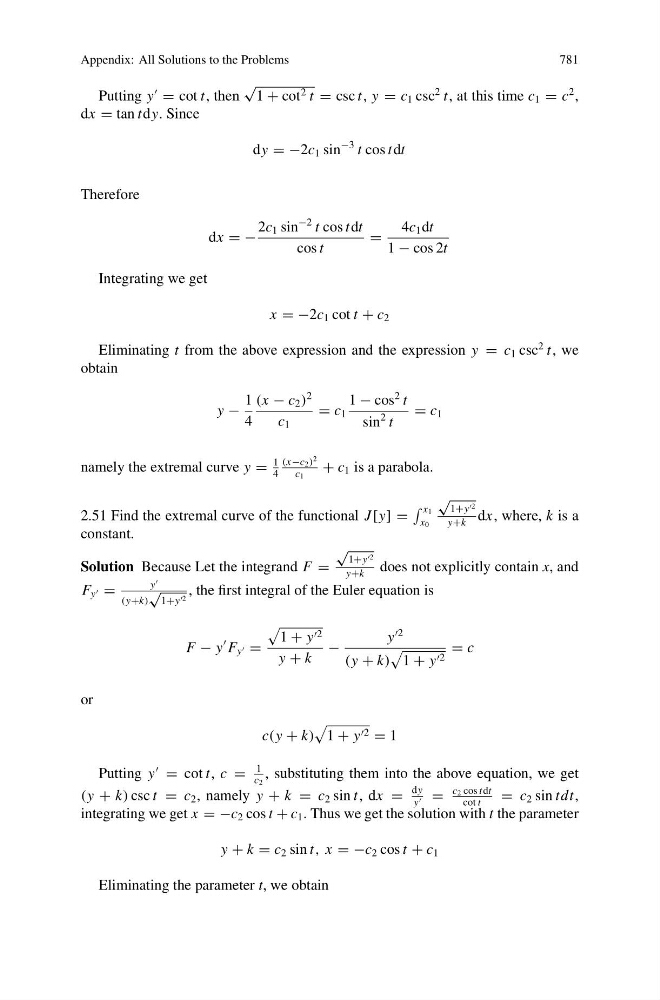
Putting y
= cot t, then
√
1 + cot 2 t = csc t, y = c 1 csc
2 t, at this time c 1 = c
2 ,
dx = tan tdy. Since
dy = −2c 1 sin
−3 t cos tdt
Therefore
dx = −
2c 1 sin
−2 t cos tdt
cos t
=
4c 1 dt
1 − cos 2t
Integrating we get
x = −2c 1 cot t + c 2
Eliminating t from the above expression and the expression y = c 1 csc
2 t, we
obtain
y −
1
4
(x − c 2 )
2
c 1
= c 1
1 − cos
2 t
sin
2 t
= c 1
namely the extremal curve y =
1
4
(x−c 2 )
2
c 1
+ c 1 is a parabola.
2.51 Find the extremal curve of the functional J [y] =
x 1
x 0
√
1+y 2
y+k
dx, where, k is a
constant.
Solution Because Let the integrand F =
√
1+y 2
y+k
does not explicitly contain x, and
F y =
y
(y+k)
√
1+y 2
, the first integral of the Euler equation is
F − y
F y =
1 + y 2
y + k
−
y
2
(y + k)
1 + y 2
= c
or
c(y + k)
1 + y 2 = 1
Putting y
= cot t, c =
1
c 2
, substituting them into the above equation, we get
(y + k) csc t = c 2 , namely y + k = c 2 sin t, dx =
dy
y =
c 2 cos tdt
cot t
= c 2 sin tdt,
integrating we get x = −c 2 cos t + c 1 . Thus we get the solution with t the parameter
y + k = c 2 sin t, x = −c 2 cos t + c 1
Eliminating the parameter t, we obtain