

776
Appendix: All Solutions to the Problems
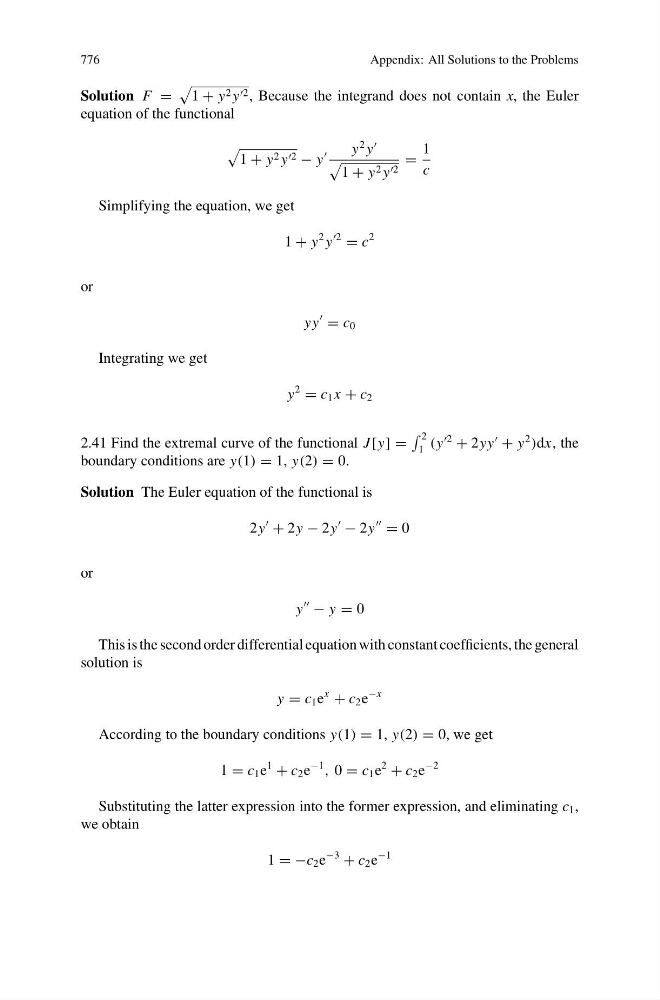
Solution F =
1 + y 2 y 2 , Because the integrand does not contain x, the Euler
equation of the functional
1 + y 2 y 2 − y
y
2 y
1 + y 2 y 2
=
1
c
Simplifying the equation, we get
1 + y
2 y
2
= c
2
or
yy
= c 0
Integrating we get
y
2
= c 1 x + c 2
2.41 Find the extremal curve of the functional J [y] =
2
1 (y
2
+ 2yy
+ y
2
)dx, the
boundary conditions are y(1) = 1, y(2) = 0.
Solution The Euler equation of the functional is
2y
+ 2y − 2y
− 2y
= 0
or
y
− y = 0
This is the second order differential equation with constant coefficients, the general
solution is
y = c 1 e
x
+ c 2 e
−x
According to the boundary conditions y(1) = 1, y(2) = 0, we get
1 = c 1 e
1
+ c 2 e
−1
, 0 = c 1 e
2
+ c 2 e
−2
Substituting the latter expression into the former expression, and eliminating c 1 ,
we obtain
1 = −c 2 e
−3
+ c 2 e
−1