

Appendix: All Solutions to the Problems
775
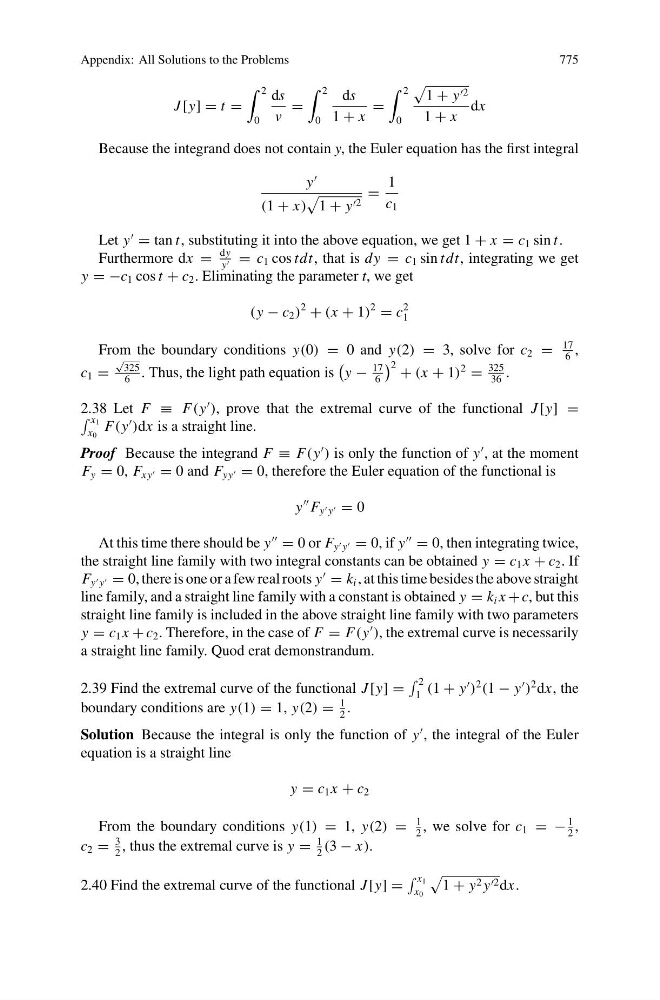
J [y] = t =
2
0
ds
v
=
2
0
ds
1 + x
=
2
0
1 + y 2
1 + x
dx
Because the integrand does not contain y, the Euler equation has the first integral
y
(1 + x)
1 + y 2
=
1
c 1
Let y
= tan t, substituting it into the above equation, we get 1 + x = c 1 sin t.
Furthermore dx =
dy
y = c 1 cos tdt, that is dy = c 1 sin tdt, integrating we get
y = −c 1 cos t + c 2 . Eliminating the parameter t, we get
(y − c 2 )
2
+ (x + 1)
2
= c
2
1
From the boundary conditions y(0) = 0 and y(2) = 3, solve for c 2 =
17
6
,
c 1 =
√
325
6
. Thus, the light path equation is
y −
17
6
2 + (x + 1)
2
=
325
36
.
2.38 Let F ≡ F(y
), prove that the extremal curve of the functional J [y] =
x 1
x 0
F(y
)dx is a straight line.
Proof Because the integrand F ≡ F(y
) is only the function of y
, at the moment
F y = 0, F xy = 0 and F yy = 0, therefore the Euler equation of the functional is
y
F y y = 0
At this time there should be y
= 0 or F y y = 0, if y
= 0, then integrating twice,
the straight line family with two integral constants can be obtained y = c 1 x + c 2 . If
F y y = 0, there is one or a few real roots y
= k i , at this time besides the above straight
line family, and a straight line family with a constant is obtained y = k i x + c, but this
straight line family is included in the above straight line family with two parameters
y = c 1 x + c 2 . Therefore, in the case of F = F(y
), the extremal curve is necessarily
a straight line family. Quod erat demonstrandum.
2.39 Find the extremal curve of the functional J [y] =
2
1 (1 + y
)
2
(1 − y
)
2 dx, the
boundary conditions are y(1) = 1, y(2) =
1
2
.
Solution Because the integral is only the function of y
, the integral of the Euler
equation is a straight line
y = c 1 x + c 2
From the boundary conditions y(1) = 1, y(2) =
1
2
, we solve for c 1 = −
1
2
,
c 2 =
3
2
, thus the extremal curve is y =
1
2
(3 − x).
2.40 Find the extremal curve of the functional J [y] =
x 1
x 0
1 + y 2 y 2 dx.