

770
Appendix: All Solutions to the Problems
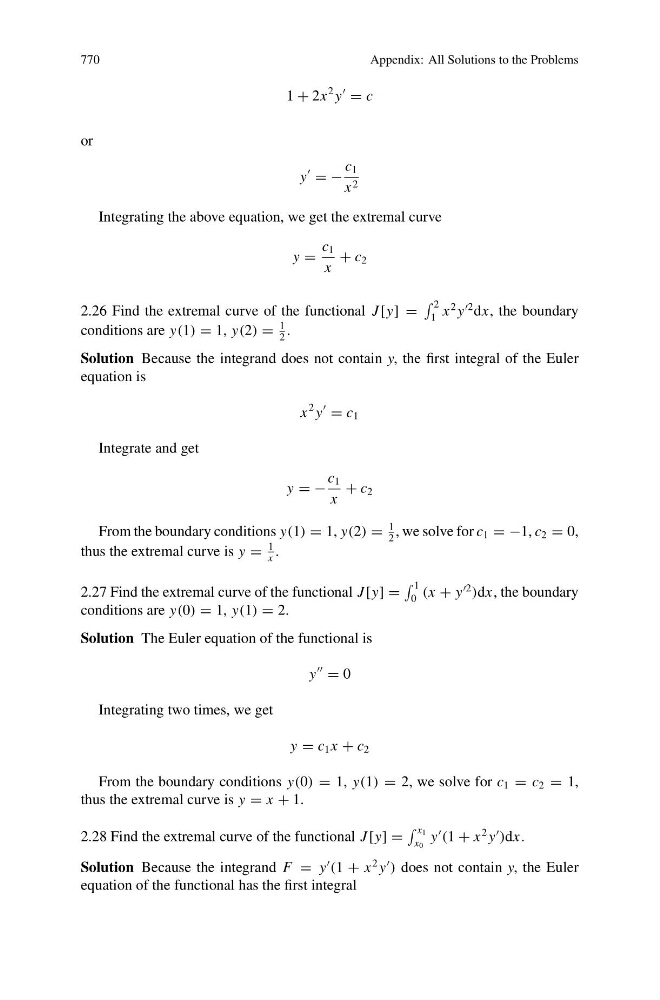
1 + 2x
2 y
= c
or
y
= −
c 1
x 2
Integrating the above equation, we get the extremal curve
y =
c 1
x
+ c 2
2.26 Find the extremal curve of the functional J [y] =
2
1 x
2 y
2 dx, the boundary
conditions are y(1) = 1, y(2) =
1
2
.
Solution Because the integrand does not contain y, the first integral of the Euler
equation is
x
2 y
= c 1
Integrate and get
y = −
c 1
x
+ c 2
From the boundary conditions y(1) = 1, y(2) =
1
2
, we solve for c 1 = −1, c 2 = 0,
thus the extremal curve is y =
1
x
.
2.27 Find the extremal curve of the functional J [y] =
1
0 (x + y
2
)dx, the boundary
conditions are y(0) = 1, y(1) = 2.
Solution The Euler equation of the functional is
y
= 0
Integrating two times, we get
y = c 1 x + c 2
From the boundary conditions y(0) = 1, y(1) = 2, we solve for c 1 = c 2 = 1,
thus the extremal curve is y = x + 1.
2.28 Find the extremal curve of the functional J [y] =
x 1
x 0
y
(1 + x
2 y
)dx.
Solution Because the integrand F = y
(1 + x
2 y
) does not contain y, the Euler
equation of the functional has the first integral