

736
10 Variational Problems of Functionals with Vector, Tensor …
⎧
⎪ ⎪ ⎪ ⎪ ⎪ ⎪ ⎪ ⎪ ⎪ ⎪ ⎪ ⎪ ⎪ ⎪ ⎪ ⎪ ⎪ ⎪ ⎪ ⎪ ⎪ ⎪ ⎪ ⎪ ⎨
⎪ ⎪ ⎪ ⎪ ⎪ ⎪ ⎪ ⎪ ⎪ ⎪ ⎪ ⎪ ⎪ ⎪ ⎪ ⎪ ⎪ ⎪ ⎪ ⎪ ⎪ ⎪ ⎪ ⎪ ⎩
∂ F
∂u +
⎛
⎜
⎝
∂ F
∂u A m
×
B
−
∂ F
∂∇u A m
×
B
· ∇ −
∂ F
∂∇·u A m
×
B
∇ +
∂ F
∂∇×u A m
×
B
× ∇
⎞
⎟
⎠ n
· A m
× B = 0
∂ F
∂ A + (−1) m u
⎡
⎢
⎢
⎣
⎛
⎜
⎝
∂ F
∂u A m
×
B
⎞
⎟
⎠
m
m
× B T
⎛
⎜
⎝
∂ F
∂u A m
×
B
⎞
⎟
⎠
m+1,n
−
⎛
⎜
⎝
∂ F
∂∇u A m
×
B
· ∇
⎞
⎟
⎠
m
m
× B T
⎛
⎜
⎝
∂ F
∂∇u A m
×
B
· ∇
⎞
⎟
⎠
m+1,n
−
⎛
⎜
⎝
∂ F
∂∇·u A m
×
B
∇
⎞
⎟
⎠
m
m
× B T
⎛
⎜
⎝
∂ F
∂∇·u A m
×
B
∇
⎞
⎟
⎠
m+1,n
+
⎛
⎜
⎝
∂ F
∂∇×u A m
×
B
× ∇
⎞
⎟
⎠
m
m
× B T
⎛
⎜
⎝
∂ F
∂∇×u A m
×
B
× ∇
⎞
⎟
⎠
m+1,n
⎤
⎥
⎥
⎦ = 0
∂ F
∂ B + (−1) m A (n − m)·
m×
⎛
⎜
⎝
∂ F
∂u A m
×
B
−
∂ F
∂∇u A m
×
B
· ∇ −
∂ F
∂∇·u A m
×
B
∇ +
∂ F
∂∇×u A m
×
B
× ∇
⎞
⎟
⎠ = 0
(8)
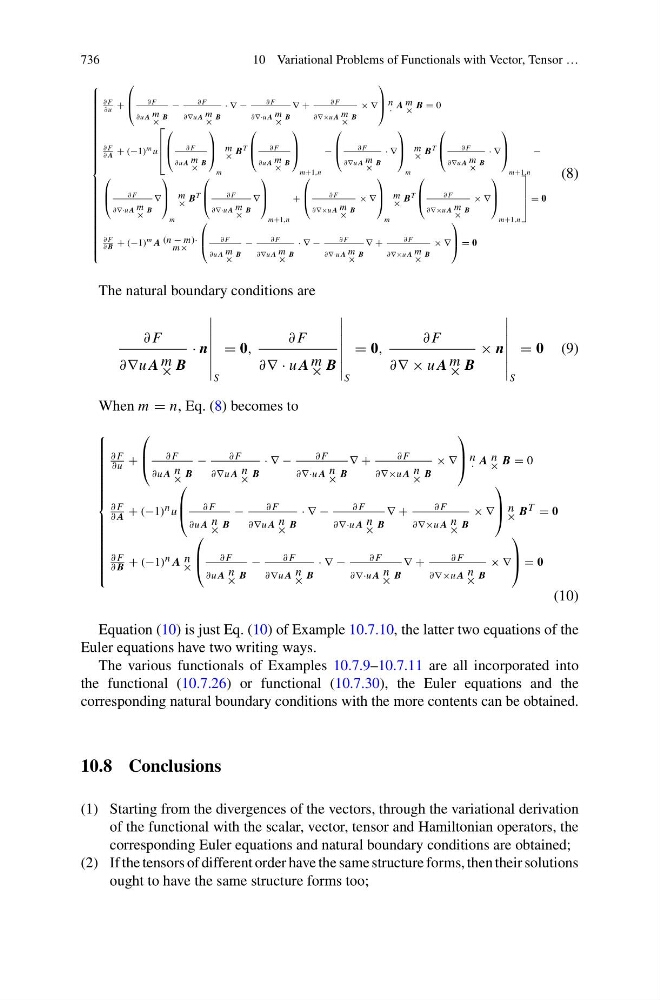
The natural boundary conditions are
∂ F
∂∇u A m
× B
· n
S
= 0,
∂ F
∂∇ · u A m
× B
S
= 0,
∂ F
∂∇ × u A m
× B
× n
S
= 0 (9)
When m = n, Eq. (8) becomes to
⎧
⎪ ⎪ ⎪ ⎪ ⎪ ⎪ ⎪ ⎪ ⎪ ⎪ ⎪ ⎪ ⎪ ⎪ ⎪ ⎨
⎪ ⎪ ⎪ ⎪ ⎪ ⎪ ⎪ ⎪ ⎪ ⎪ ⎪ ⎪ ⎪ ⎪ ⎪ ⎩
∂ F
∂u +
⎛
⎜
⎝
∂ F
∂u A n
×
B
−
∂ F
∂∇u A n
×
B
· ∇ −
∂ F
∂∇·u A n
×
B
∇ +
∂ F
∂∇×u A n
×
B
× ∇
⎞
⎟
⎠ n
· A n
× B = 0
∂ F
∂ A + (−1) n u
⎛
⎜
⎝
∂ F
∂u A n
×
B
−
∂ F
∂∇u A n
×
B
· ∇ −
∂ F
∂∇·u A n
×
B
∇ +
∂ F
∂∇×u A n
×
B
× ∇
⎞
⎟
⎠ n
× B T = 0
∂ F
∂ B + (−1) n A n
×
⎛
⎜
⎝
∂ F
∂u A n
×
B
−
∂ F
∂∇u A n
×
B
· ∇ −
∂ F
∂∇·u A n
×
B
∇ +
∂ F
∂∇×u A n
×
B
× ∇
⎞
⎟
⎠ = 0
(10)
Equation (10) is just Eq. (10) of Example 10.7.10, the latter two equations of the
Euler equations have two writing ways.
The various functionals of Examples 10.7.9–10.7.11 are all incorporated into
the functional (10.7.26) or functional (10.7.30), the Euler equations and the
corresponding natural boundary conditions with the more contents can be obtained.
10.8 Conclusions
(1) Starting from the divergences of the vectors, through the variational derivation
of the functional with the scalar, vector, tensor and Hamiltonian operators, the
corresponding Euler equations and natural boundary conditions are obtained;
(2) If the tensors of different order have the same structure forms, then their solutions
ought to have the same structure forms too;