

10.6 Variational Problems of Functionals with Parallel-Type Inner …
703
⎧
⎨
⎩
∇ · σ + F = 0
dU 0 (ε)
dε
= σ
ε =
1
2
(∇u + u∇)
(2)
The natural boundary conditions are
(u − u)| S u = 0
(σ · n − X)
S σ
= 0
(3)
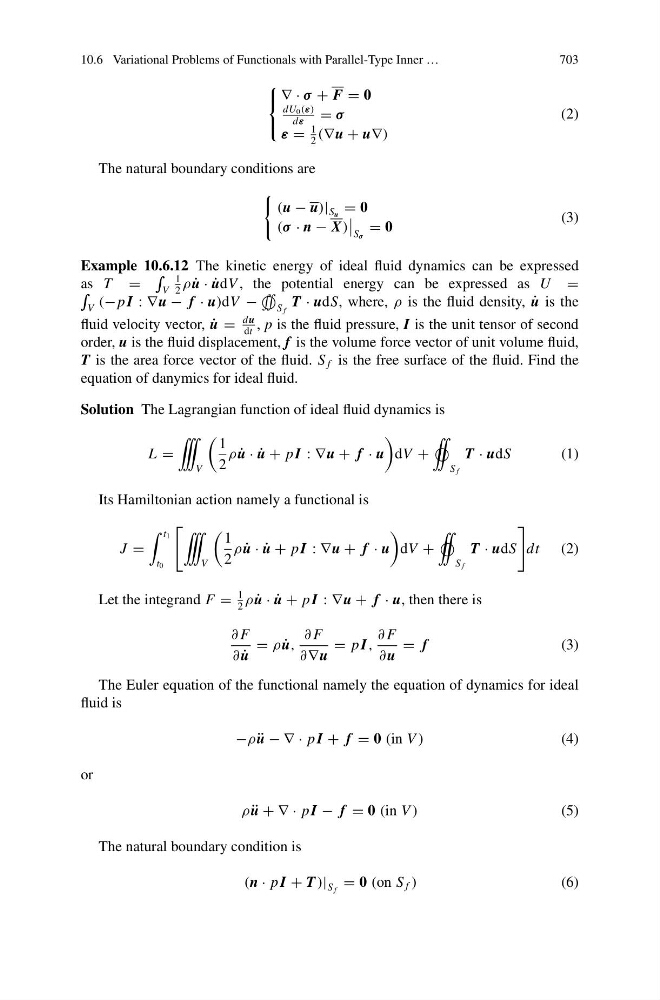
Example 10.6.12 The kinetic energy of ideal fluid dynamics can be expressed
as T =
V
1
2
ρ ˙
u · ˙
udV , the potential energy can be expressed as U =
V (− p I : ∇u − f · u)dV −
S f T · udS, where, ρ is the fluid density, ˙
u is the
fluid velocity vector, ˙
u =
du
dt
, p is the fluid pressure, I is the unit tensor of second
order, u is the fluid displacement, f is the volume force vector of unit volume fluid,
T is the area force vector of the fluid. S f is the free surface of the fluid. Find the
equation of danymics for ideal fluid.
Solution The Lagrangian function of ideal fluid dynamics is
L =
V
1
2
ρ ˙
u · ˙
u + p I : ∇u + f · u
dV +
S f
T · udS
(1)
Its Hamiltonian action namely a functional is
J =
t 1
t 0
V
1
2
ρ ˙
u · ˙
u + p I : ∇u + f · u
dV +
S f
T · udS
dt (2)
Let the integrand F =
1
2
ρ ˙
u · ˙
u + p I : ∇u + f · u, then there is
∂ F
∂ ˙
u
= ρ ˙
u,
∂ F
∂∇u
= p I,
∂ F
∂ u
= f
(3)
The Euler equation of the functional namely the equation of dynamics for ideal
fluid is
−ρ ¨
u − ∇ · p I + f = 0 (in V )
(4)
or
ρ ¨
u + ∇ · p I − f = 0 (in V )
(5)
The natural boundary condition is
(n · p I + T )| S f = 0 (on S f )
(6)