

702
10 Variational Problems of Functionals with Vector, Tensor …
If the tensor in a functional is expressed by the index notation, it needs to be
converted to the direct form before using the Euler formula, such as the following
two examples.
Example 10.6.10 Find the Euler equations and natural boundary conditions of the
functional (9.8.14).
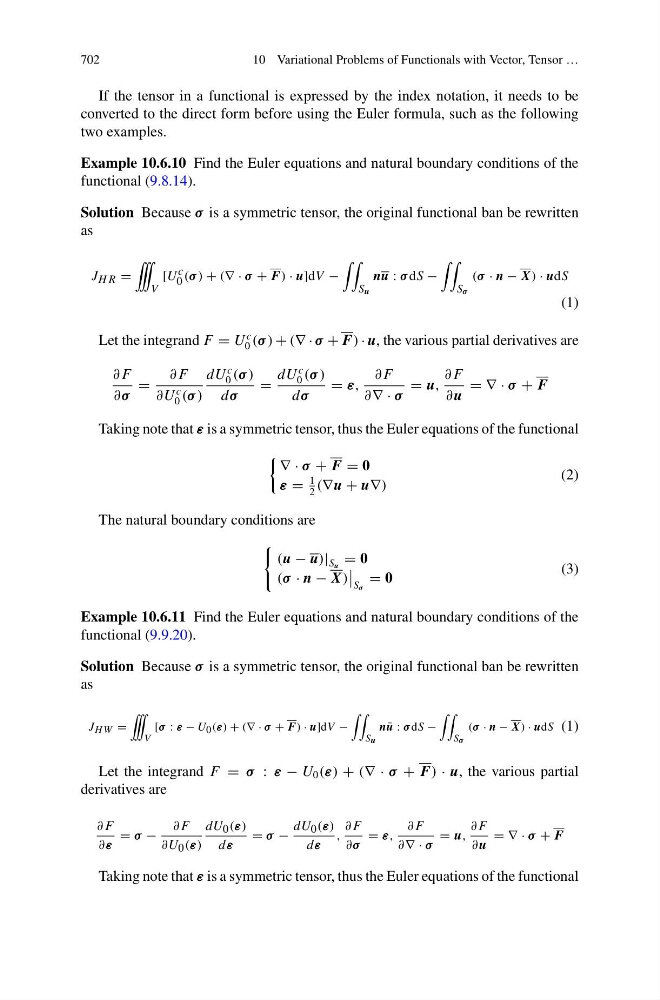
Solution Because σ is a symmetric tensor, the original functional ban be rewritten
as
J H R =
V
[U c
0 (σ ) + (∇ · σ + F) · u]dV −
S u
nu : σ dS −
S σ
(σ · n − X) · udS
(1)
Let the integrand F = U
c
0 (σ ) + (∇ · σ + F) · u, the various partial derivatives are
∂ F
∂σ
=
∂ F
∂U
c
0 (σ )
dU
c
0 (σ )
dσ
=
dU
c
0 (σ )
dσ
= ε,
∂ F
∂∇ · σ
= u,
∂ F
∂ u
= ∇ · σ + F
Taking note that ε is a symmetric tensor, thus the Euler equations of the functional
∇ · σ + F = 0
ε =
1
2
(∇u + u∇)
(2)
The natural boundary conditions are
(u − u)| S u = 0
(σ · n − X)
S σ
= 0
(3)
Example 10.6.11 Find the Euler equations and natural boundary conditions of the
functional (9.9.20).
Solution Because σ is a symmetric tensor, the original functional ban be rewritten
as
J H W =
V
[σ : ε − U 0 (ε) + (∇ · σ + F) · u]dV −
S u
n ¯
u : σ dS −
S σ
(σ · n − X) · udS (1)
Let the integrand F = σ : ε − U 0 (ε) + (∇ · σ + F) · u, the various partial
derivatives are
∂ F
∂ε
= σ −
∂ F
∂U 0 (ε)
dU 0 (ε)
dε
= σ −
dU 0 (ε)
dε
,
∂ F
∂σ
= ε,
∂ F
∂∇ · σ
= u,
∂ F
∂ u
= ∇ · σ + F
Taking note that ε is a symmetric tensor, thus the Euler equations of the functional