

10.6 Variational Problems of Functionals with Parallel-Type Inner …
693
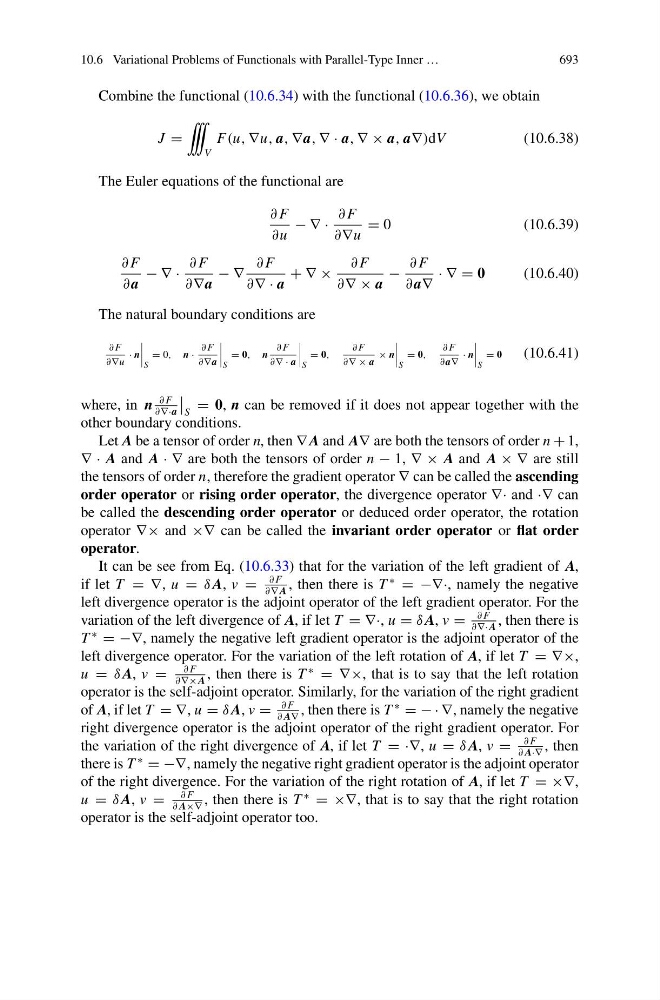
Combine the functional (10.6.34) with the functional (10.6.36), we obtain
J =
V
F(u, ∇u, a, ∇ a, ∇ · a, ∇ × a, a∇)dV
(10.6.38)
The Euler equations of the functional are
∂ F
∂u
− ∇ ·
∂ F
∂∇u
= 0
(10.6.39)
∂ F
∂ a
− ∇ ·
∂ F
∂∇ a
− ∇
∂ F
∂∇ · a
+ ∇ ×
∂ F
∂∇ × a
−
∂ F
∂ a∇
· ∇ = 0
(10.6.40)
The natural boundary conditions are
∂ F
∂∇u
· n
S
= 0, n ·
∂ F
∂∇ a
S
= 0, n
∂ F
∂∇ · a
S
= 0,
∂ F
∂∇ × a
× n
S
= 0,
∂ F
∂ a∇
· n
S
= 0
(10.6.41)
where, in n
∂ F
∂∇·a
S
= 0, n can be removed if it does not appear together with the
other boundary conditions.
Let A be a tensor of order n, then ∇ A and A∇ are both the tensors of order n + 1,
∇ · A and A · ∇ are both the tensors of order n − 1, ∇ × A and A × ∇ are still
the tensors of order n, therefore the gradient operator ∇ can be called the ascending
order operator or rising order operator, the divergence operator ∇· and ·∇ can
be called the descending order operator or deduced order operator, the rotation
operator ∇× and ×∇ can be called the invariant order operator or flat order
operator.
It can be see from Eq. (10.6.33) that for the variation of the left gradient of A,
if let T = ∇, u = δ A, v =
∂ F
∂∇ A
, then there is T
∗
= −∇·, namely the negative
left divergence operator is the adjoint operator of the left gradient operator. For the
variation of the left divergence of A, if let T = ∇·, u = δ A, v =
∂ F
∂∇· A
, then there is
T
∗
= −∇, namely the negative left gradient operator is the adjoint operator of the
left divergence operator. For the variation of the left rotation of A, if let T = ∇×,
u = δ A, v =
∂ F
∂∇× A
, then there is T
∗
= ∇×, that is to say that the left rotation
operator is the self-adjoint operator. Similarly, for the variation of the right gradient
of A, if let T = ∇, u = δ A, v =
∂ F
∂ A∇
, then there is T
∗
= − · ∇, namely the negative
right divergence operator is the adjoint operator of the right gradient operator. For
the variation of the right divergence of A, if let T = ·∇, u = δ A, v =
∂ F
∂ A·∇
, then
there is T
∗
= −∇, namely the negative right gradient operator is the adjoint operator
of the right divergence. For the variation of the right rotation of A, if let T = ×∇,
u = δ A, v =
∂ F
∂ A×∇
, then there is T
∗
= ×∇, that is to say that the right rotation
operator is the self-adjoint operator too.