

692
10 Variational Problems of Functionals with Vector, Tensor …
+
V
∇ ·
∂ F
∂∇ A
n
·
δ A + δ A n − 1
·
∂ F
∂∇ · A
−
∂ F
∂∇ × A
×
(n − 1)·
δ A + δ A n
·
∂ F
∂ A∇
+
∂ F
∂ A · ∇
n − 1
·
δ A − δ A (n − 1)·
×
∂ F
∂ A × ∇
dV
=
V
∂ F
∂ A
+
∂ F
∂ A
T
− ∇ ·
∂ F
∂∇ A
− ∇
∂ F
∂∇ · A
+ ∇ ×
∂ F
∂∇ × A
−
∂ F
∂ A∇
· ∇ −
∂ F
∂ A · ∇
∇ +
∂ F
∂ A × ∇
× ∇
n
·
δ AdV
+
S
∂ F
∂∇ A
n
·
δ A + δ A n − 1
·
∂ F
∂∇ · A
−
∂ F
∂∇ × A
×
(n − 1)·
δ A + δ A n
·
∂ F
∂ A∇
+
∂ F
∂ A · ∇
n − 1
·
δ A − δ A (n − 1)·
×
∂ F
∂ A × ∇
· ndS
=
V
∂ F
∂ A
+
∂ F
∂ A
T
− ∇ ·
∂ F
∂∇ A
− ∇
∂ F
∂∇ · A
+ ∇ ×
∂ F
∂∇ × A
−
∂ F
∂ A∇
· ∇ −
∂ F
∂ A · ∇
∇ +
∂ F
∂ A × ∇
× ∇
n
·
δ AdV
+
S
n ·
∂ F
∂∇ A
+ n
∂ F
∂∇ · A
− n ×
∂ F
∂∇ × A
+
∂ F
∂ A∇
· n +
∂ F
∂ A · ∇
n −
∂ F
∂ A × ∇
× n
n
·
δ AdS = 0
(10.6.33)
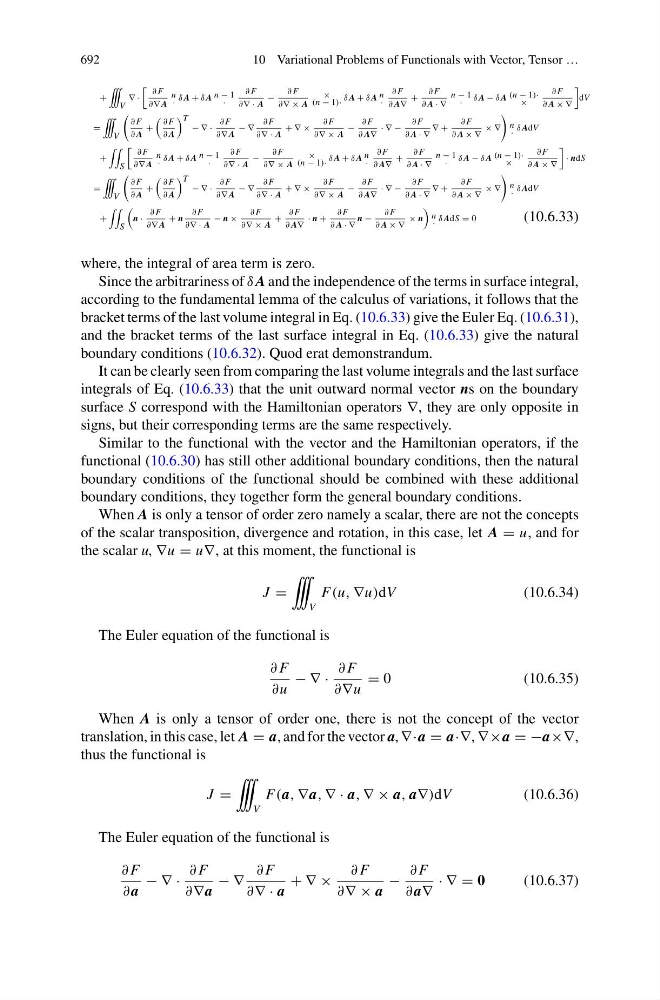
where, the integral of area term is zero.
Since the arbitrariness of δ A and the independence of the terms in surface integral,
according to the fundamental lemma of the calculus of variations, it follows that the
bracket terms of the last volume integral in Eq. (10.6.33) give the Euler Eq. (10.6.31),
and the bracket terms of the last surface integral in Eq. (10.6.33) give the natural
boundary conditions (10.6.32). Quod erat demonstrandum.
It can be clearly seen from comparing the last volume integrals and the last surface
integrals of Eq. (10.6.33) that the unit outward normal vector ns on the boundary
surface S correspond with the Hamiltonian operators ∇, they are only opposite in
signs, but their corresponding terms are the same respectively.
Similar to the functional with the vector and the Hamiltonian operators, if the
functional (10.6.30) has still other additional boundary conditions, then the natural
boundary conditions of the functional should be combined with these additional
boundary conditions, they together form the general boundary conditions.
When A is only a tensor of order zero namely a scalar, there are not the concepts
of the scalar transposition, divergence and rotation, in this case, let A = u, and for
the scalar u, ∇u = u∇, at this moment, the functional is
J =
V
F(u, ∇u)dV
(10.6.34)
The Euler equation of the functional is
∂ F
∂u
− ∇ ·
∂ F
∂∇u
= 0
(10.6.35)
When A is only a tensor of order one, there is not the concept of the vector
translation, in this case, let A = a, and for the vector a, ∇·a = a·∇, ∇×a = −a×∇,
thus the functional is
J =
V
F(a, ∇ a, ∇ · a, ∇ × a, a∇)dV
(10.6.36)
The Euler equation of the functional is
∂ F
∂ a
− ∇ ·
∂ F
∂∇ a
− ∇
∂ F
∂∇ · a
+ ∇ ×
∂ F
∂∇ × a
−
∂ F
∂ a∇
· ∇ = 0
(10.6.37)