

644
10 Variational Problems of Functionals with Vector, Tensor …
J =
V
F
a, b, c, d, ∇
a · b
c · d
dV
(1)
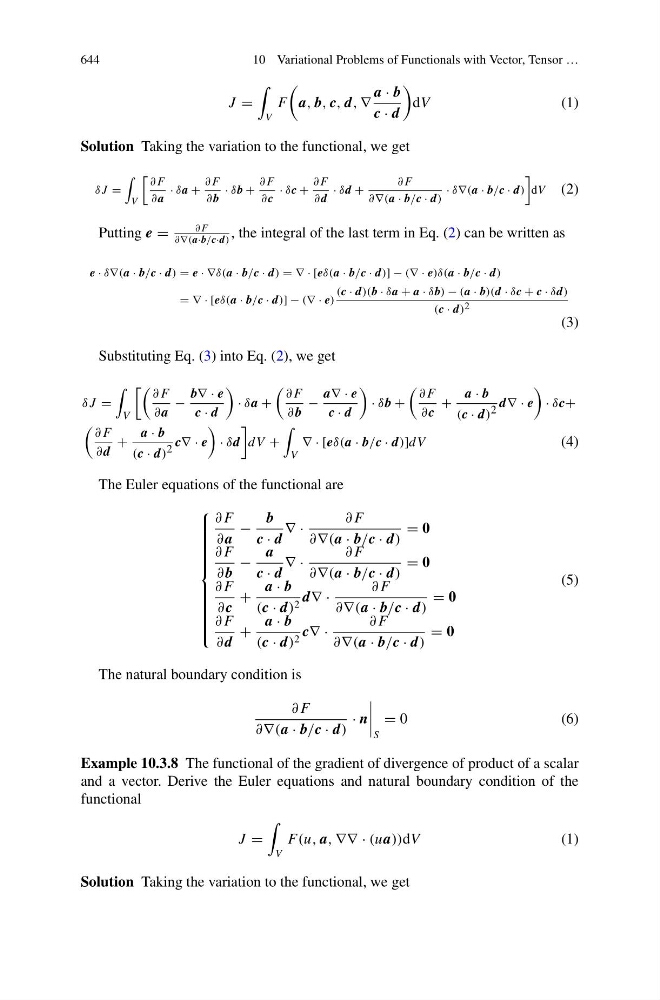
Solution Taking the variation to the functional, we get
δ J =
V
∂ F
∂ a
· δa +
∂ F
∂ b
· δb +
∂ F
∂ c
· δc +
∂ F
∂ d
· δd +
∂ F
∂∇(a · b/c · d)
· δ∇(a · b/c · d)
dV (2)
Putting e =
∂ F
∂∇(a·b/c·d)
, the integral of the last term in Eq. (2) can be written as
e · δ∇(a · b/c · d) = e · ∇δ(a · b/c · d) = ∇ · [eδ(a · b/c · d)] − (∇ · e)δ(a · b/c · d)
= ∇ · [eδ(a · b/c · d)] − (∇ · e)
(c · d)(b · δa + a · δb) − (a · b)(d · δc + c · δd)
(c · d) 2
(3)
Substituting Eq. (3) into Eq. (2), we get
δ J =
V
∂ F
∂ a
−
b∇ · e
c · d
· δa +
∂ F
∂ b
−
a∇ · e
c · d
· δb +
∂ F
∂ c
+
a · b
(c · d) 2 d∇ · e
· δc+
∂ F
∂ d
+
a · b
(c · d) 2 c∇ · e
· δd
dV +
V
∇ · [eδ(a · b/c · d)]dV
(4)
The Euler equations of the functional are
⎧
⎪ ⎪ ⎪ ⎪ ⎪ ⎪ ⎪ ⎪ ⎪ ⎨
⎪ ⎪ ⎪ ⎪ ⎪ ⎪ ⎪ ⎪ ⎪ ⎩
∂ F
∂ a
−
b
c · d
∇ ·
∂ F
∂∇(a · b/c · d)
= 0
∂ F
∂ b
−
a
c · d
∇ ·
∂ F
∂∇(a · b/c · d)
= 0
∂ F
∂ c
+
a · b
(c · d) 2 d∇ ·
∂ F
∂∇(a · b/c · d)
= 0
∂ F
∂ d
+
a · b
(c · d) 2 c∇ ·
∂ F
∂∇(a · b/c · d)
= 0
(5)
The natural boundary condition is
∂ F
∂∇(a · b/c · d)
· n
S
= 0
( 6 )
Example 10.3.8 The functional of the gradient of divergence of product of a scalar
and a vector. Derive the Euler equations and natural boundary condition of the
functional
J =
V
F(u, a, ∇∇ · (ua))dV
(1)
Solution Taking the variation to the functional, we get