

632
10 Variational Problems of Functionals with Vector, Tensor …
Equations (2) are called the time-dependent conjugate Schrödinger equations.
Let ˆ
H = −
2
2m
+V =
1
2m
i
∇ ·
i
∇ +V =
1
2m
ˆ
p· ˆ
p+V , where, ˆ
p =
i
∇ = −i∇,
then ˆ
H is called the Hamilton operator or Hamiltonian operator of the microsystem, ˆ
p is the momentum operator of the particle. Thus, Eq. (2) can be written
in the more concise form as
ˆ
H ψ = iψ t
ˆ
H ψ
∗
= −iψ
∗
t
(3)
Equation (3) are the Schrödinger equations represented by the Hamiltonian
operator of the micro-system.
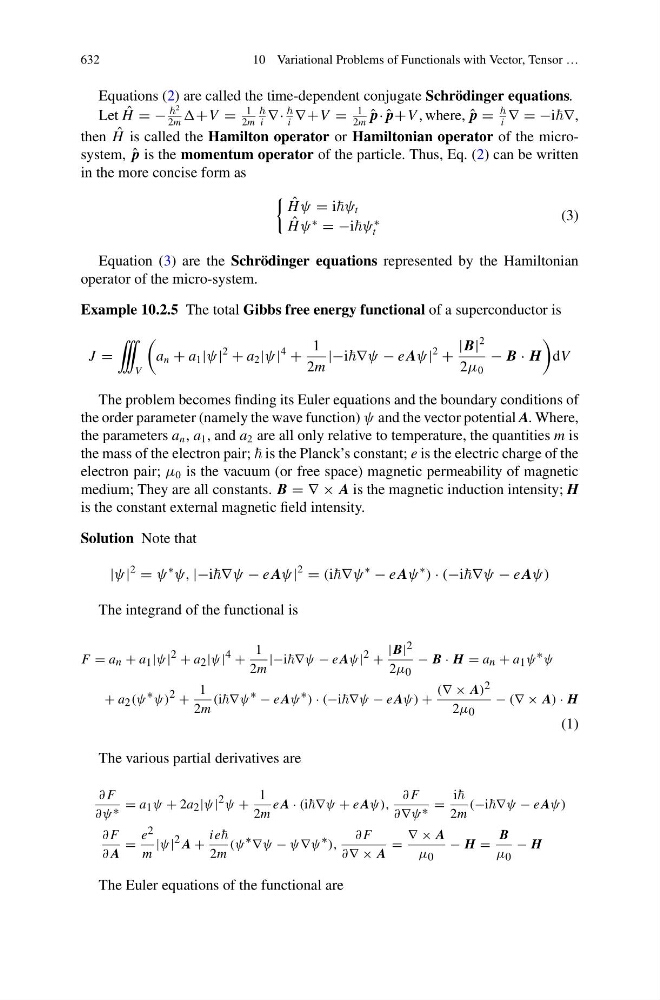
Example 10.2.5 The total Gibbs free energy functional of a superconductor is
J =
V
a n + a 1 |ψ|
2
+ a 2 |ψ|
4
+
1
2m
|−i∇ψ − e Aψ|
2
+
|B|
2
2μ 0
− B · H
dV
The problem becomes finding its Euler equations and the boundary conditions of
the order parameter (namely the wave function) ψ and the vector potential A. Where,
the parameters a n , a 1 , and a 2 are all only relative to temperature, the quantities m is
the mass of the electron pair; is the Planck’s constant; e is the electric charge of the
electron pair; μ 0 is the vacuum (or free space) magnetic permeability of magnetic
medium; They are all constants. B = ∇ × A is the magnetic induction intensity; H
is the constant external magnetic field intensity.
Solution Note that
|ψ|
2
= ψ
∗
ψ, |−i∇ψ − e Aψ|
2
= (i∇ψ
∗
− e Aψ
∗
) · (−i∇ψ − e Aψ)
The integrand of the functional is
F = a n + a 1 |ψ| 2 + a 2 |ψ| 4 +
1
2m
|−i∇ψ − e Aψ| 2 +
|B| 2
2μ 0
− B · H = a n + a 1 ψ ∗ ψ
+ a 2 (ψ ∗ ψ) 2 +
1
2m
(i∇ψ ∗ − e Aψ ∗ ) · (−i∇ψ − e Aψ) +
(∇ × A) 2
2μ 0
− (∇ × A) · H
(1)
The various partial derivatives are
∂ F
∂ψ ∗ = a 1 ψ + 2a 2 |ψ| 2 ψ +
1
2m
e A · (i∇ψ + e Aψ),
∂ F
∂∇ψ ∗ =
i
2m
(−i∇ψ − e Aψ)
∂ F
∂ A
=
e 2
m
|ψ| 2 A +
ie
2m
(ψ ∗ ∇ψ − ψ∇ψ ∗ ),
∂ F
∂∇ × A
=
∇ × A
μ 0
− H =
B
μ 0
− H
The Euler equations of the functional are