

624
10 Variational Problems of Functionals with Vector, Tensor …
It can be seen from comparing the volume integrals and the surface integrals of
Eq. (10.2.36) that if the unit outward normal vector n s on the boundary surface S
and the Hamiltonian operators ∇ s are laid on the same place, then they are only
opposite in signs, but their corresponding terms are the same respectively.
According to Eqs. (26) and (43), there are the following inner products
Combining the above mentioned theorem with the Theorem 2.9.2, the following
corollary can be obtained.
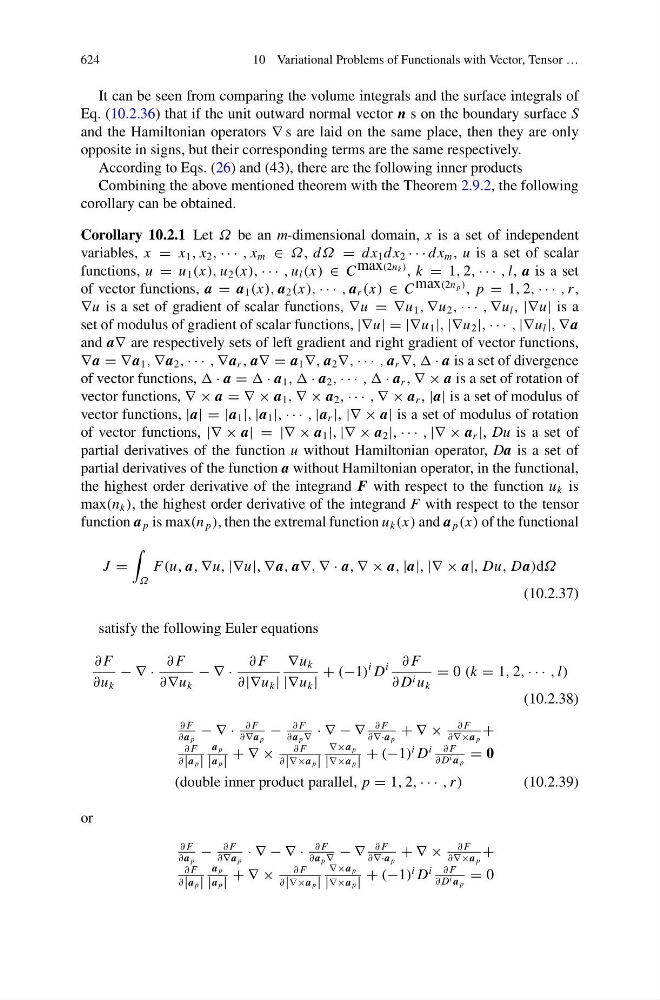
Corollary 10.2.1 Let Ω be an m-dimensional domain, x is a set of independent
variables, x = x 1 , x 2 , · · · , x m ∈ Ω, dΩ = dx 1 dx 2 · · · dx m , u is a set of scalar
functions, u = u 1 (x), u 2 (x), · · · , u l (x) ∈ C max(2n k ) , k = 1, 2, · · · , l, a is a set
of vector functions, a = a 1 (x), a 2 (x), · · · , a r (x) ∈ C max(2n p ) , p = 1, 2, · · · , r ,
∇u is a set of gradient of scalar functions, ∇u = ∇u 1 , ∇u 2 , · · · , ∇u l , |∇u| is a
set of modulus of gradient of scalar functions, |∇u| = |∇u 1 |, |∇u 2 |, · · · , |∇u l |, ∇ a
and a∇ are respectively sets of left gradient and right gradient of vector functions,
∇ a = ∇a 1 , ∇ a 2 , · · · , ∇ a r , a∇ = a 1 ∇, a 2 ∇, · · · , a r ∇, · a is a set of divergence
of vector functions, · a = · a 1 , , · a 2 , · · · , , · a r , ∇ × a is a set of rotation of
vector functions, ∇ × a = ∇ × a 1 , ∇ × a 2 , · · · , ∇ × a r , |a| is a set of modulus of
vector functions, |a| = |a 1 |, |a 1 |, · · · , |a r |, |∇ × a| is a set of modulus of rotation
of vector functions, |∇ × a| = |∇ × a 1 |, |∇ × a 2 |, · · · , |∇ × a r |, Du is a set of
partial derivatives of the function u without Hamiltonian operator, Da is a set of
partial derivatives of the function a without Hamiltonian operator, in the functional,
the highest order derivative of the integrand F with respect to the function u k is
max(n k ), the highest order derivative of the integrand F with respect to the tensor
function a p is max(n p ), then the extremal function u k (x) and a p (x) of the functional
J =
Ω
F(u, a, ∇u, |∇u|, ∇ a, a∇, ∇ · a, ∇ × a, |a|, |∇ × a|, Du, Da)dΩ
(10.2.37)
satisfy the following Euler equations
∂ F
∂u k
− ∇ ·
∂ F
∂∇u k
− ∇ ·
∂ F
∂|∇u k |
∇u k
|∇u k |
+ (−1)
i D
i ∂ F
∂ D i u k
= 0 (k = 1, 2, · · · , l)
(10.2.38)
∂ F
∂ a p
− ∇ ·
∂ F
∂∇ a p
−
∂ F
∂ a p ∇
· ∇ − ∇
∂ F
∂∇·a p
+ ∇ ×
∂ F
∂∇×a p
+
∂ F
∂|a p |
a p
|ap| + ∇ ×
∂ F
∂|∇×a p |
∇×a p
|∇×ap| + (−1)
i D
i ∂ F
∂ D i a p
= 0
(double inner product parallel, p = 1, 2, · · · , r )
(10.2.39)
or
∂ F
∂ a p
−
∂ F
∂∇ a p
· ∇ − ∇ ·
∂ F
∂ a p ∇
− ∇
∂ F
∂∇·a p
+ ∇ ×
∂ F
∂∇×a p
+
∂ F
∂|a p |
a p
|ap| + ∇ ×
∂ F
∂|∇×a p |
∇×a p
|∇×ap| + (−1)
i D
i ∂ F
∂ D i a p
= 0