

592
9 Variational Principles in Mechanics and Their Applications
(9.9.20) has actually only three groups of independent functions, or σ i j , σ i j, j and u i ,
or ε i j , σ i j, j and u i . The functional (9.9.19) is a kind of generalized expression of total
potential energy of an elastic body, it is called the generalized potential energy of
three groups of independent functions or variables of the three kinds. The functional
(9.9.20) is a kind of generalized expression of total complementary energy of an
elastic body, it is called the generalized complementary energy of three groups of
independent functions or variables of the three kinds.
Below to discuss the relationships beteem the Hellinger-Reissner generalized variational principle and the Hu Haichang-Kyuichiro Washizu generalized variational
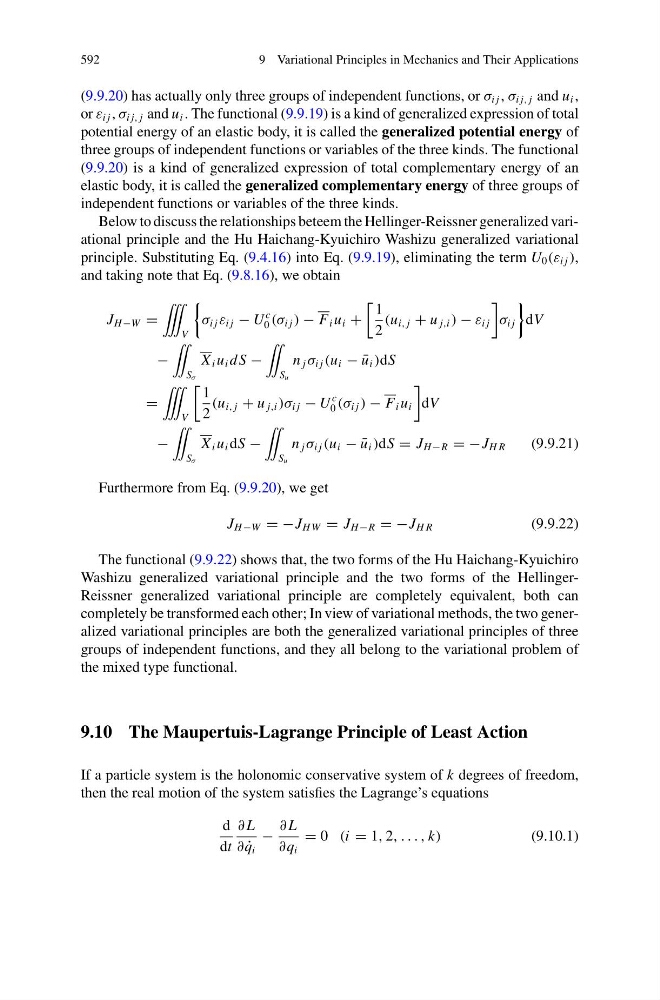
principle. Substituting Eq. (9.4.16) into Eq. (9.9.19), eliminating the term U 0 (ε i j ),
and taking note that Eq. (9.8.16), we obtain
J H −W =
˚
V
σ i j ε i j − U
c
0 (σ i j ) − F i u i +
1
2
(u i, j + u j,i ) − ε i j
σ i j
dV
−
¨
S σ
X i u i d S −
¨
S u
n j σ i j (u i − ¯
u i )dS
=
˚
V
1
2
(u i, j + u j,i )σ i j − U
c
0 (σ i j ) − F i u i
dV
−
¨
S σ
X i u i dS −
¨
S u
n j σ i j (u i − ¯
u i )dS = J H −R = −J H R
(9.9.21)
Furthermore from Eq. (9.9.20), we get
J H −W = −J H W = J H −R = −J H R
(9.9.22)
The functional (9.9.22) shows that, the two forms of the Hu Haichang-Kyuichiro
Washizu generalized variational principle and the two forms of the HellingerReissner generalized variational principle are completely equivalent, both can
completely be transformed each other; In view of variational methods, the two generalized variational principles are both the generalized variational principles of three
groups of independent functions, and they all belong to the variational problem of
the mixed type functional.
9.10 The Maupertuis-Lagrange Principle of Least Action
If a particle system is the holonomic conservative system of k degrees of freedom,
then the real motion of the system satisfies the Lagrange’s equations
d
dt
∂ L
∂ ˙
q i
−
∂ L
∂q i
= 0 (i = 1, 2, . . . , k)
(9.10.1)
9 Variational Principles in Mechanics and Their Applications
(9.9.20) has actually only three groups of independent functions, or σ i j , σ i j, j and u i ,
or ε i j , σ i j, j and u i . The functional (9.9.19) is a kind of generalized expression of total
potential energy of an elastic body, it is called the generalized potential energy of
three groups of independent functions or variables of the three kinds. The functional
(9.9.20) is a kind of generalized expression of total complementary energy of an
elastic body, it is called the generalized complementary energy of three groups of
independent functions or variables of the three kinds.
Below to discuss the relationships beteem the Hellinger-Reissner generalized variational principle and the Hu Haichang-Kyuichiro Washizu generalized variational
principle. Substituting Eq. (9.4.16) into Eq. (9.9.19), eliminating the term U 0 (ε i j ),
and taking note that Eq. (9.8.16), we obtain
J H −W =
˚
V
σ i j ε i j − U
c
0 (σ i j ) − F i u i +
1
2
(u i, j + u j,i ) − ε i j
σ i j
dV
−
¨
S σ
X i u i d S −
¨
S u
n j σ i j (u i − ¯
u i )dS
=
˚
V
1
2
(u i, j + u j,i )σ i j − U
c
0 (σ i j ) − F i u i
dV
−
¨
S σ
X i u i dS −
¨
S u
n j σ i j (u i − ¯
u i )dS = J H −R = −J H R
(9.9.21)
Furthermore from Eq. (9.9.20), we get
J H −W = −J H W = J H −R = −J H R
(9.9.22)
The functional (9.9.22) shows that, the two forms of the Hu Haichang-Kyuichiro
Washizu generalized variational principle and the two forms of the HellingerReissner generalized variational principle are completely equivalent, both can
completely be transformed each other; In view of variational methods, the two generalized variational principles are both the generalized variational principles of three
groups of independent functions, and they all belong to the variational problem of
the mixed type functional.
9.10 The Maupertuis-Lagrange Principle of Least Action
If a particle system is the holonomic conservative system of k degrees of freedom,
then the real motion of the system satisfies the Lagrange’s equations
d
dt
∂ L
∂ ˙
q i
−
∂ L
∂q i
= 0 (i = 1, 2, . . . , k)
(9.10.1)