

9.7 The Hamilton’s Canonical Equations
581
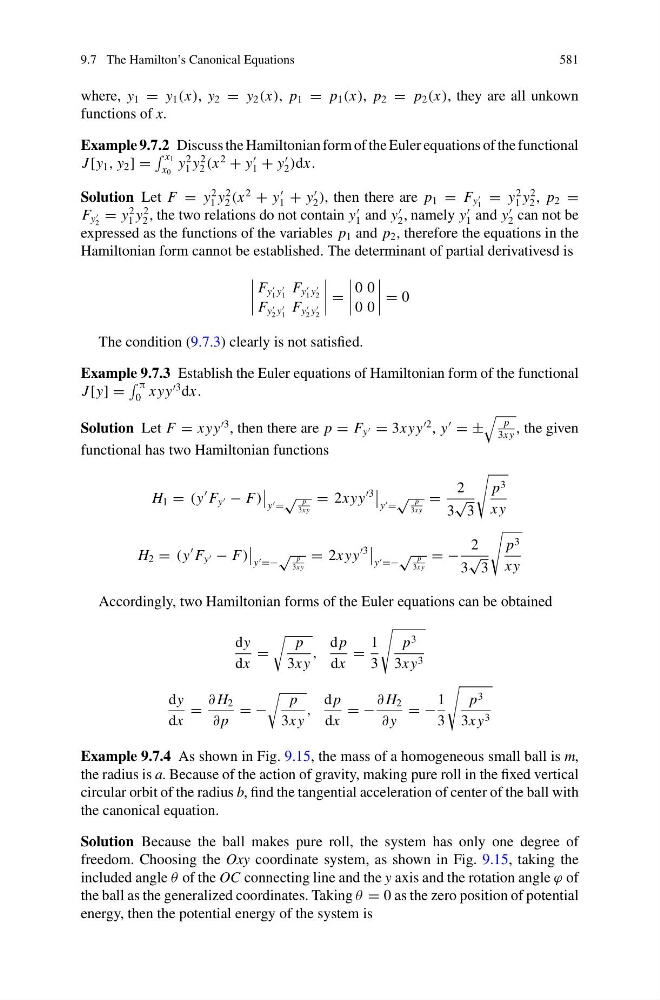
where, y 1 = y 1 (x), y 2 = y 2 (x), p 1 = p 1 (x), p 2 = p 2 (x), they are all unkown
functions of x.
Example 9.7.2 Discuss the Hamiltonian form of the Euler equations of the functional
J [y 1 , y 2 ] =
x 1
x 0
y
2
1 y
2
2 (x
2
+ y
1 + y
2 )dx.
Solution Let F = y
2
1 y
2
2 (x
2
+ y
1 + y
2 ), then there are p 1 = F y
1
= y
2
1 y
2
2 , p 2 =
F y
2
= y
2
1 y
2
2 , the two relations do not contain y
1 and y
2 , namely y
1 and y
2 can not be
expressed as the functions of the variables p 1 and p 2 , therefore the equations in the
Hamiltonian form cannot be established. The determinant of partial derivativesd is
F y
1 y
1
F y
1 y
2
F y
2 y
1
F y
2 y
2
=
0 0
0 0
= 0
The condition (9.7.3) clearly is not satisfied.
Example 9.7.3 Establish the Euler equations of Hamiltonian form of the functional
J [y] =
π
0 x yy
3 dx.
Solution Let F = x yy
3 , then there are p = F y = 3x yy
2 , y
= ±
p
3xy
, the given
functional has two Hamiltonian functions
H 1 = (y
F y − F)
y =
√ p
3xy
= 2x yy
3
y =
√ p
3xy
=
2
3
√
3
p 3
x y
H 2 = (y
F y − F)
y =−
√ p
3xy
= 2x yy
3
y =−
√ p
3xy
= −
2
3
√
3
p 3
x y
Accordingly, two Hamiltonian forms of the Euler equations can be obtained
dy
dx
=
p
3x y
,
d p
dx
=
1
3
p 3
3x y 3
dy
dx
=
∂ H 2
∂ p
= −
p
3x y
,
d p
dx
= −
∂ H 2
∂ y
= −
1
3
p 3
3x y 3
Example 9.7.4 As shown in Fig. 9.15, the mass of a homogeneous small ball is m,
the radius is a. Because of the action of gravity, making pure roll in the fixed vertical
circular orbit of the radius b, find the tangential acceleration of center of the ball with
the canonical equation.
Solution Because the ball makes pure roll, the system has only one degree of
freedom. Choosing the Oxy coordinate system, as shown in Fig. 9.15, taking the
included angle θ of the OC connecting line and the y axis and the rotation angle ϕ of
the ball as the generalized coordinates. Taking θ = 0 as the zero position of potential
energy, then the potential energy of the system is
581
where, y 1 = y 1 (x), y 2 = y 2 (x), p 1 = p 1 (x), p 2 = p 2 (x), they are all unkown
functions of x.
Example 9.7.2 Discuss the Hamiltonian form of the Euler equations of the functional
J [y 1 , y 2 ] =
x 1
x 0
y
2
1 y
2
2 (x
2
+ y
1 + y
2 )dx.
Solution Let F = y
2
1 y
2
2 (x
2
+ y
1 + y
2 ), then there are p 1 = F y
1
= y
2
1 y
2
2 , p 2 =
F y
2
= y
2
1 y
2
2 , the two relations do not contain y
1 and y
2 , namely y
1 and y
2 can not be
expressed as the functions of the variables p 1 and p 2 , therefore the equations in the
Hamiltonian form cannot be established. The determinant of partial derivativesd is
F y
1 y
1
F y
1 y
2
F y
2 y
1
F y
2 y
2
=
0 0
0 0
= 0
The condition (9.7.3) clearly is not satisfied.
Example 9.7.3 Establish the Euler equations of Hamiltonian form of the functional
J [y] =
π
0 x yy
3 dx.
Solution Let F = x yy
3 , then there are p = F y = 3x yy
2 , y
= ±
p
3xy
, the given
functional has two Hamiltonian functions
H 1 = (y
F y − F)
y =
√ p
3xy
= 2x yy
3
y =
√ p
3xy
=
2
3
√
3
p 3
x y
H 2 = (y
F y − F)
y =−
√ p
3xy
= 2x yy
3
y =−
√ p
3xy
= −
2
3
√
3
p 3
x y
Accordingly, two Hamiltonian forms of the Euler equations can be obtained
dy
dx
=
p
3x y
,
d p
dx
=
1
3
p 3
3x y 3
dy
dx
=
∂ H 2
∂ p
= −
p
3x y
,
d p
dx
= −
∂ H 2
∂ y
= −
1
3
p 3
3x y 3
Example 9.7.4 As shown in Fig. 9.15, the mass of a homogeneous small ball is m,
the radius is a. Because of the action of gravity, making pure roll in the fixed vertical
circular orbit of the radius b, find the tangential acceleration of center of the ball with
the canonical equation.
Solution Because the ball makes pure roll, the system has only one degree of
freedom. Choosing the Oxy coordinate system, as shown in Fig. 9.15, taking the
included angle θ of the OC connecting line and the y axis and the rotation angle ϕ of
the ball as the generalized coordinates. Taking θ = 0 as the zero position of potential
energy, then the potential energy of the system is