

9.6 The Hamilton Principles and Their Applications
557
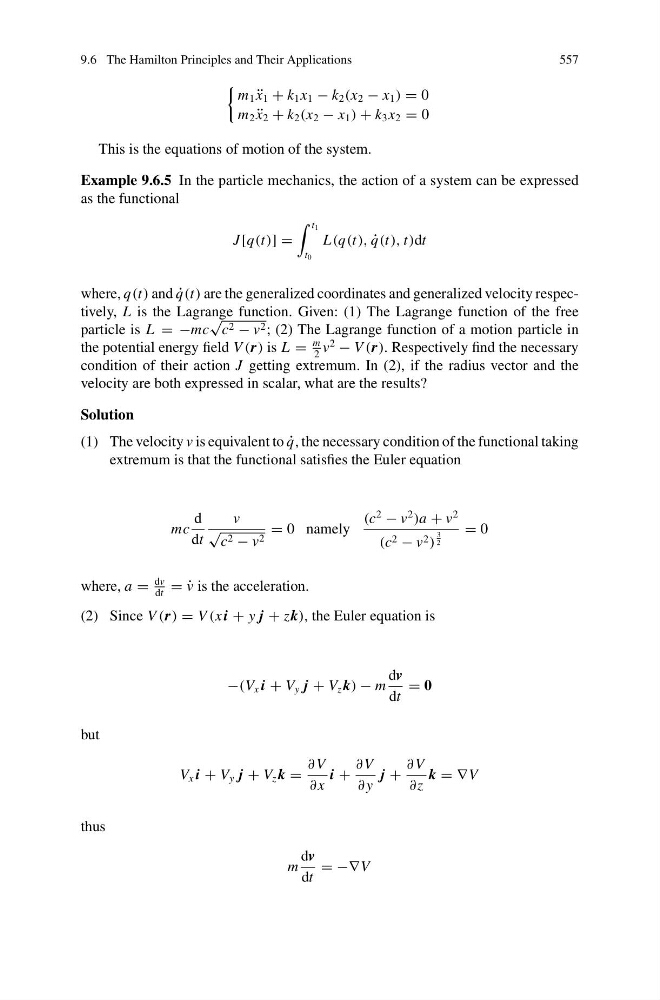
m 1 ¨
x 1 + k 1 x 1 − k 2 (x 2 − x 1 ) = 0
m 2 ¨
x 2 + k 2 (x 2 − x 1 ) + k 3 x 2 = 0
This is the equations of motion of the system.
Example 9.6.5 In the particle mechanics, the action of a system can be expressed
as the functional
J [q(t)] =
t 1
t 0
L(q(t), ˙
q(t), t)dt
where, q(t) and ˙
q(t) are the generalized coordinates and generalized velocity respectively, L is the Lagrange function. Given: (1) The Lagrange function of the free
particle is L = −mc
√
c 2 − v 2 ; (2) The Lagrange function of a motion particle in
the potential energy field V (r) is L =
m
2
v
2
− V (r). Respectively find the necessary
condition of their action J getting extremum. In (2), if the radius vector and the
velocity are both expressed in scalar, what are the results?
Solution
(1) The velocity v is equivalent to ˙
q, the necessary condition of the functional taking
extremum is that the functional satisfies the Euler equation
mc
d
dt
v
√
c 2 − v 2
= 0 namely
(c
2
− v
2
)a + v
2
(c 2 − v 2 )
3
2
= 0
where, a =
dv
dt
= ˙
v is the acceleration.
(2) Since V (r) = V (x i + y j + zk), the Euler equation is
−(V x i + V y j + V z k) − m
dv
dt
= 0
but
V x i + V y j + V z k =
∂ V
∂ x
i +
∂ V
∂ y
j +
∂ V
∂z
k = ∇V
thus
m
dv
dt
= −∇V
557
m 1 ¨
x 1 + k 1 x 1 − k 2 (x 2 − x 1 ) = 0
m 2 ¨
x 2 + k 2 (x 2 − x 1 ) + k 3 x 2 = 0
This is the equations of motion of the system.
Example 9.6.5 In the particle mechanics, the action of a system can be expressed
as the functional
J [q(t)] =
t 1
t 0
L(q(t), ˙
q(t), t)dt
where, q(t) and ˙
q(t) are the generalized coordinates and generalized velocity respectively, L is the Lagrange function. Given: (1) The Lagrange function of the free
particle is L = −mc
√
c 2 − v 2 ; (2) The Lagrange function of a motion particle in
the potential energy field V (r) is L =
m
2
v
2
− V (r). Respectively find the necessary
condition of their action J getting extremum. In (2), if the radius vector and the
velocity are both expressed in scalar, what are the results?
Solution
(1) The velocity v is equivalent to ˙
q, the necessary condition of the functional taking
extremum is that the functional satisfies the Euler equation
mc
d
dt
v
√
c 2 − v 2
= 0 namely
(c
2
− v
2
)a + v
2
(c 2 − v 2 )
3
2
= 0
where, a =
dv
dt
= ˙
v is the acceleration.
(2) Since V (r) = V (x i + y j + zk), the Euler equation is
−(V x i + V y j + V z k) − m
dv
dt
= 0
but
V x i + V y j + V z k =
∂ V
∂ x
i +
∂ V
∂ y
j +
∂ V
∂z
k = ∇V
thus
m
dv
dt
= −∇V