

556
9 Variational Principles in Mechanics and Their Applications
x
A
B
k 1
k 2
k 3
m 1
m 2
x 1
x 2
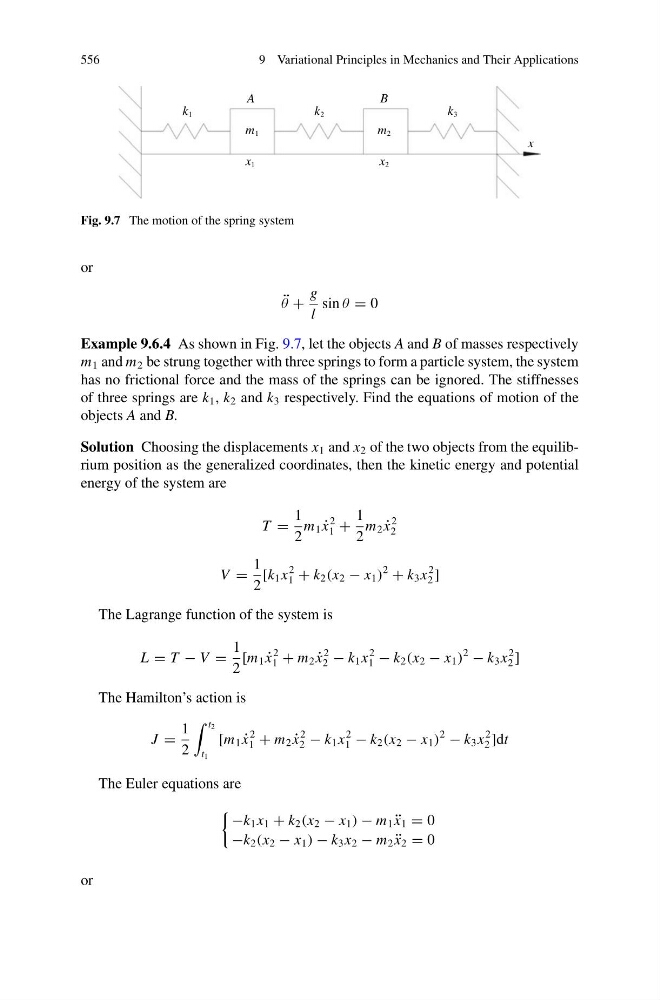
Fig. 9.7 The motion of the spring system
or
¨
θ +
g
l
sin θ = 0
Example 9.6.4 As shown in Fig. 9.7, let the objects A and B of masses respectively
m 1 and m 2 be strung together with three springs to form a particle system, the system
has no frictional force and the mass of the springs can be ignored. The stiffnesses
of three springs are k 1 , k 2 and k 3 respectively. Find the equations of motion of the
objects A and B.
Solution Choosing the displacements x 1 and x 2 of the two objects from the equilibrium position as the generalized coordinates, then the kinetic energy and potential
energy of the system are
T =
1
2
m 1 ˙
x
2
1 +
1
2
m 2 ˙
x
2
2
V =
1
2
[k 1 x
2
1 + k 2 (x 2 − x 1 )
2
+ k 3 x
2
2 ]
The Lagrange function of the system is
L = T − V =
1
2
[m 1 ˙
x
2
1 + m 2 ˙
x
2
2 − k 1 x
2
1 − k 2 (x 2 − x 1 )
2
− k 3 x
2
2 ]
The Hamilton’s action is
J =
1
2
t 2
t 1
[m 1 ˙
x
2
1 + m 2 ˙
x
2
2 − k 1 x
2
1 − k 2 (x 2 − x 1 )
2
− k 3 x
2
2 ]dt
The Euler equations are
−k 1 x 1 + k 2 (x 2 − x 1 ) − m 1 ¨
x 1 = 0
−k 2 (x 2 − x 1 ) − k 3 x 2 − m 2 ¨
x 2 = 0
or
9 Variational Principles in Mechanics and Their Applications
x
A
B
k 1
k 2
k 3
m 1
m 2
x 1
x 2
Fig. 9.7 The motion of the spring system
or
¨
θ +
g
l
sin θ = 0
Example 9.6.4 As shown in Fig. 9.7, let the objects A and B of masses respectively
m 1 and m 2 be strung together with three springs to form a particle system, the system
has no frictional force and the mass of the springs can be ignored. The stiffnesses
of three springs are k 1 , k 2 and k 3 respectively. Find the equations of motion of the
objects A and B.
Solution Choosing the displacements x 1 and x 2 of the two objects from the equilibrium position as the generalized coordinates, then the kinetic energy and potential
energy of the system are
T =
1
2
m 1 ˙
x
2
1 +
1
2
m 2 ˙
x
2
2
V =
1
2
[k 1 x
2
1 + k 2 (x 2 − x 1 )
2
+ k 3 x
2
2 ]
The Lagrange function of the system is
L = T − V =
1
2
[m 1 ˙
x
2
1 + m 2 ˙
x
2
2 − k 1 x
2
1 − k 2 (x 2 − x 1 )
2
− k 3 x
2
2 ]
The Hamilton’s action is
J =
1
2
t 2
t 1
[m 1 ˙
x
2
1 + m 2 ˙
x
2
2 − k 1 x
2
1 − k 2 (x 2 − x 1 )
2
− k 3 x
2
2 ]dt
The Euler equations are
−k 1 x 1 + k 2 (x 2 − x 1 ) − m 1 ¨
x 1 = 0
−k 2 (x 2 − x 1 ) − k 3 x 2 − m 2 ¨
x 2 = 0
or