

9.6 The Hamilton Principles and Their Applications
553
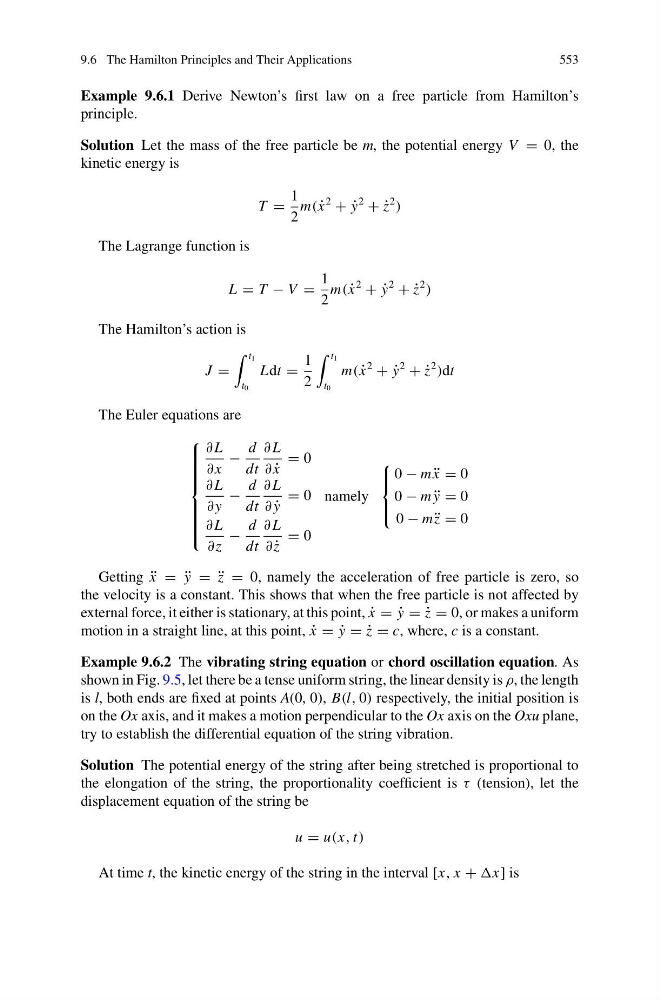
Example 9.6.1 Derive Newton’s first law on a free particle from Hamilton’s
principle.
Solution Let the mass of the free particle be m, the potential energy V = 0, the
kinetic energy is
T =
1
2
m( ˙
x
2
+ ˙
y
2
+ ˙
z
2
)
The Lagrange function is
L = T − V =
1
2
m( ˙
x
2
+ ˙
y
2
+ ˙
z
2
)
The Hamilton’s action is
J =
t 1
t 0
Ldt =
1
2
t 1
t 0
m( ˙
x
2
+ ˙
y
2
+ ˙
z
2
)dt
The Euler equations are
⎧
⎪ ⎪ ⎪ ⎪ ⎪ ⎪ ⎨
⎪ ⎪ ⎪ ⎪ ⎪ ⎪ ⎩
∂ L
∂ x
−
d
dt
∂ L
∂ ˙
x
= 0
∂ L
∂ y
−
d
dt
∂ L
∂ ˙
y
= 0
∂ L
∂z
−
d
dt
∂ L
∂ ˙
z
= 0
namely
⎧
⎪ ⎨
⎪ ⎩
0 − m ¨
x = 0
0 − m ¨
y = 0
0 − m ¨
z = 0
Getting ¨
x = ¨
y = ¨
z = 0, namely the acceleration of free particle is zero, so
the velocity is a constant. This shows that when the free particle is not affected by
external force, it either is stationary, at this point, ˙
x = ˙
y = ˙
z = 0, or makes a uniform
motion in a straight line, at this point, ˙
x = ˙
y = ˙
z = c, where, c is a constant.
Example 9.6.2 The vibrating string equation or chord oscillation equation. As
shown in Fig. 9.5, let there be a tense uniform string, the linear density is ρ, the length
is l, both ends are fixed at points A(0, 0), B(l, 0) respectively, the initial position is
on the Ox axis, and it makes a motion perpendicular to the Ox axis on the Oxu plane,
try to establish the differential equation of the string vibration.
Solution The potential energy of the string after being stretched is proportional to
the elongation of the string, the proportionality coefficient is τ (tension), let the
displacement equation of the string be
u = u(x, t)
At time t, the kinetic energy of the string in the interval [x, x + x] is
553
Example 9.6.1 Derive Newton’s first law on a free particle from Hamilton’s
principle.
Solution Let the mass of the free particle be m, the potential energy V = 0, the
kinetic energy is
T =
1
2
m( ˙
x
2
+ ˙
y
2
+ ˙
z
2
)
The Lagrange function is
L = T − V =
1
2
m( ˙
x
2
+ ˙
y
2
+ ˙
z
2
)
The Hamilton’s action is
J =
t 1
t 0
Ldt =
1
2
t 1
t 0
m( ˙
x
2
+ ˙
y
2
+ ˙
z
2
)dt
The Euler equations are
⎧
⎪ ⎪ ⎪ ⎪ ⎪ ⎪ ⎨
⎪ ⎪ ⎪ ⎪ ⎪ ⎪ ⎩
∂ L
∂ x
−
d
dt
∂ L
∂ ˙
x
= 0
∂ L
∂ y
−
d
dt
∂ L
∂ ˙
y
= 0
∂ L
∂z
−
d
dt
∂ L
∂ ˙
z
= 0
namely
⎧
⎪ ⎨
⎪ ⎩
0 − m ¨
x = 0
0 − m ¨
y = 0
0 − m ¨
z = 0
Getting ¨
x = ¨
y = ¨
z = 0, namely the acceleration of free particle is zero, so
the velocity is a constant. This shows that when the free particle is not affected by
external force, it either is stationary, at this point, ˙
x = ˙
y = ˙
z = 0, or makes a uniform
motion in a straight line, at this point, ˙
x = ˙
y = ˙
z = c, where, c is a constant.
Example 9.6.2 The vibrating string equation or chord oscillation equation. As
shown in Fig. 9.5, let there be a tense uniform string, the linear density is ρ, the length
is l, both ends are fixed at points A(0, 0), B(l, 0) respectively, the initial position is
on the Ox axis, and it makes a motion perpendicular to the Ox axis on the Oxu plane,
try to establish the differential equation of the string vibration.
Solution The potential energy of the string after being stretched is proportional to
the elongation of the string, the proportionality coefficient is τ (tension), let the
displacement equation of the string be
u = u(x, t)
At time t, the kinetic energy of the string in the interval [x, x + x] is