

552
9 Variational Principles in Mechanics and Their Applications
T = T (q 1 , q 2 , . . . , q 3n−m , ˙
q 1 , ˙
q 2 , . . . , ˙
q 3n−m , t)
(9.6.39)
V = V (q 1 , q 2 , . . . , q 3n−m , t)
(9.6.40)
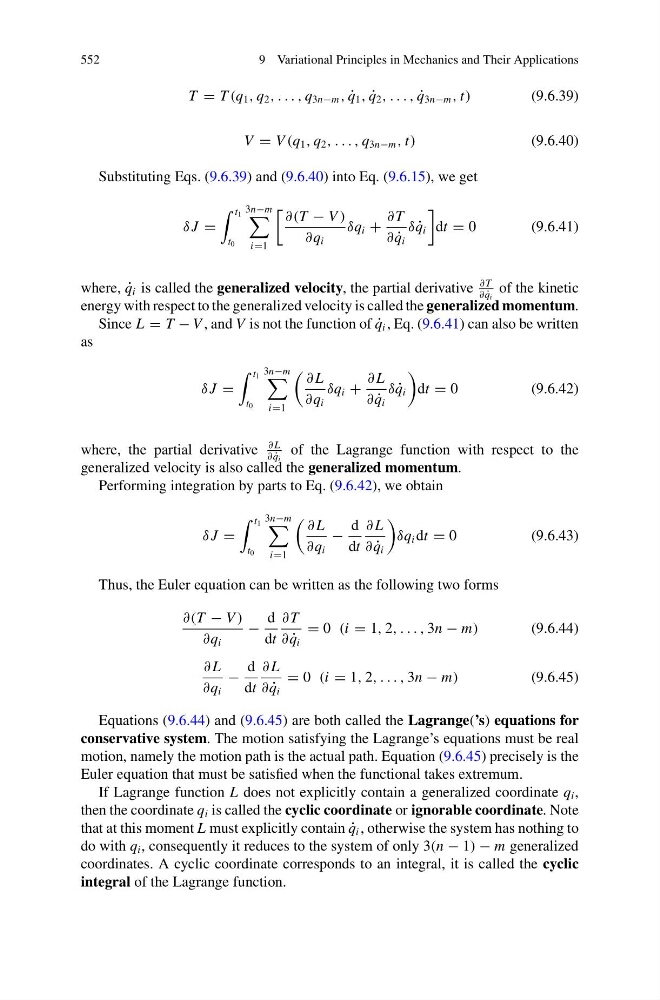
Substituting Eqs. (9.6.39) and (9.6.40) into Eq. (9.6.15), we get
δ J =
t 1
t 0
3n−m
i=1
∂(T − V )
∂q i
δq i +
∂ T
∂ ˙
q i
δ ˙
q i
dt = 0
(9.6.41)
where, ˙
q i is called the generalized velocity, the partial derivative
∂ T
∂ ˙
q i
of the kinetic
energy with respect to the generalized velocity is called the generalized momentum.
Since L = T − V , and V is not the function of ˙
q i , Eq. (9.6.41) can also be written
as
δ J =
t 1
t 0
3n−m
i=1
∂ L
∂q i
δq i +
∂ L
∂ ˙
q i
δ ˙
q i
dt = 0
(9.6.42)
where, the partial derivative
∂ L
∂ ˙
q i
of the Lagrange function with respect to the
generalized velocity is also called the generalized momentum.
Performing integration by parts to Eq. (9.6.42), we obtain
δ J =
t 1
t 0
3n−m
i=1
∂ L
∂q i
−
d
dt
∂ L
∂ ˙
q i
δq i dt = 0
(9.6.43)
Thus, the Euler equation can be written as the following two forms
∂(T − V )
∂q i
−
d
dt
∂ T
∂ ˙
q i
= 0 (i = 1, 2, . . . , 3n − m)
(9.6.44)
∂ L
∂q i
−
d
dt
∂ L
∂ ˙
q i
= 0 (i = 1, 2, . . . , 3n − m)
(9.6.45)
Equations (9.6.44) and (9.6.45) are both called the Lagrange(’s) equations for
conservative system. The motion satisfying the Lagrange’s equations must be real
motion, namely the motion path is the actual path. Equation (9.6.45) precisely is the
Euler equation that must be satisfied when the functional takes extremum.
If Lagrange function L does not explicitly contain a generalized coordinate q i ,
then the coordinate q i is called the cyclic coordinate or ignorable coordinate. Note
that at this moment L must explicitly contain ˙
q i , otherwise the system has nothing to
do with q i , consequently it reduces to the system of only 3(n − 1) − m generalized
coordinates. A cyclic coordinate corresponds to an integral, it is called the cyclic
integral of the Lagrange function.
9 Variational Principles in Mechanics and Their Applications
T = T (q 1 , q 2 , . . . , q 3n−m , ˙
q 1 , ˙
q 2 , . . . , ˙
q 3n−m , t)
(9.6.39)
V = V (q 1 , q 2 , . . . , q 3n−m , t)
(9.6.40)
Substituting Eqs. (9.6.39) and (9.6.40) into Eq. (9.6.15), we get
δ J =
t 1
t 0
3n−m
i=1
∂(T − V )
∂q i
δq i +
∂ T
∂ ˙
q i
δ ˙
q i
dt = 0
(9.6.41)
where, ˙
q i is called the generalized velocity, the partial derivative
∂ T
∂ ˙
q i
of the kinetic
energy with respect to the generalized velocity is called the generalized momentum.
Since L = T − V , and V is not the function of ˙
q i , Eq. (9.6.41) can also be written
as
δ J =
t 1
t 0
3n−m
i=1
∂ L
∂q i
δq i +
∂ L
∂ ˙
q i
δ ˙
q i
dt = 0
(9.6.42)
where, the partial derivative
∂ L
∂ ˙
q i
of the Lagrange function with respect to the
generalized velocity is also called the generalized momentum.
Performing integration by parts to Eq. (9.6.42), we obtain
δ J =
t 1
t 0
3n−m
i=1
∂ L
∂q i
−
d
dt
∂ L
∂ ˙
q i
δq i dt = 0
(9.6.43)
Thus, the Euler equation can be written as the following two forms
∂(T − V )
∂q i
−
d
dt
∂ T
∂ ˙
q i
= 0 (i = 1, 2, . . . , 3n − m)
(9.6.44)
∂ L
∂q i
−
d
dt
∂ L
∂ ˙
q i
= 0 (i = 1, 2, . . . , 3n − m)
(9.6.45)
Equations (9.6.44) and (9.6.45) are both called the Lagrange(’s) equations for
conservative system. The motion satisfying the Lagrange’s equations must be real
motion, namely the motion path is the actual path. Equation (9.6.45) precisely is the
Euler equation that must be satisfied when the functional takes extremum.
If Lagrange function L does not explicitly contain a generalized coordinate q i ,
then the coordinate q i is called the cyclic coordinate or ignorable coordinate. Note
that at this moment L must explicitly contain ˙
q i , otherwise the system has nothing to
do with q i , consequently it reduces to the system of only 3(n − 1) − m generalized
coordinates. A cyclic coordinate corresponds to an integral, it is called the cyclic
integral of the Lagrange function.