

9.6 The Hamilton Principles and Their Applications
547
t 1
t 0
(δT + δ
W )dt = 0
(9.6.11)
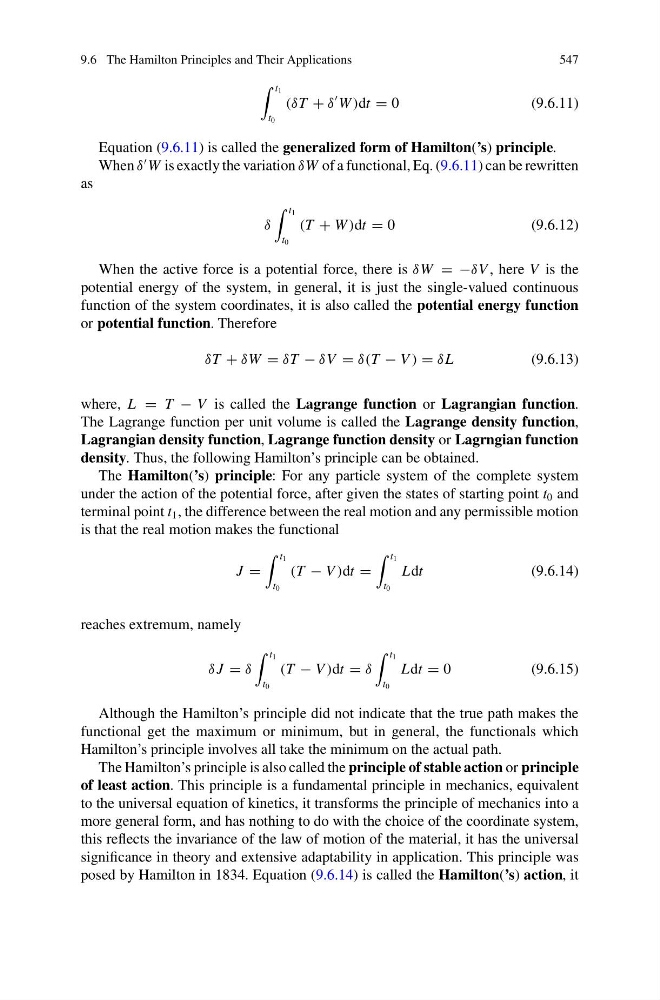
Equation (9.6.11) is called the generalized form of Hamilton(’s) principle.
When δ
W is exactly the variation δW of a functional, Eq. (9.6.11) can be rewritten
as
δ
t 1
t 0
(T + W )dt = 0
(9.6.12)
When the active force is a potential force, there is δW = −δV , here V is the
potential energy of the system, in general, it is just the single-valued continuous
function of the system coordinates, it is also called the potential energy function
or potential function. Therefore
δT + δW = δT − δV = δ(T − V ) = δL
(9.6.13)
where, L = T − V is called the Lagrange function or Lagrangian function.
The Lagrange function per unit volume is called the Lagrange density function,
Lagrangian density function, Lagrange function density or Lagrngian function
density. Thus, the following Hamilton’s principle can be obtained.
The Hamilton(’s) principle: For any particle system of the complete system
under the action of the potential force, after given the states of starting point t 0 and
terminal point t 1 , the difference between the real motion and any permissible motion
is that the real motion makes the functional
J =
t 1
t 0
(T − V )dt =
t 1
t 0
Ldt
(9.6.14)
reaches extremum, namely
δ J = δ
t 1
t 0
(T − V )dt = δ
t 1
t 0
Ldt = 0
(9.6.15)
Although the Hamilton’s principle did not indicate that the true path makes the
functional get the maximum or minimum, but in general, the functionals which
Hamilton’s principle involves all take the minimum on the actual path.
The Hamilton’s principle is also called the principle of stable action or principle
of least action. This principle is a fundamental principle in mechanics, equivalent
to the universal equation of kinetics, it transforms the principle of mechanics into a
more general form, and has nothing to do with the choice of the coordinate system,
this reflects the invariance of the law of motion of the material, it has the universal
significance in theory and extensive adaptability in application. This principle was
posed by Hamilton in 1834. Equation (9.6.14) is called the Hamilton(’s) action, it
547
t 1
t 0
(δT + δ
W )dt = 0
(9.6.11)
Equation (9.6.11) is called the generalized form of Hamilton(’s) principle.
When δ
W is exactly the variation δW of a functional, Eq. (9.6.11) can be rewritten
as
δ
t 1
t 0
(T + W )dt = 0
(9.6.12)
When the active force is a potential force, there is δW = −δV , here V is the
potential energy of the system, in general, it is just the single-valued continuous
function of the system coordinates, it is also called the potential energy function
or potential function. Therefore
δT + δW = δT − δV = δ(T − V ) = δL
(9.6.13)
where, L = T − V is called the Lagrange function or Lagrangian function.
The Lagrange function per unit volume is called the Lagrange density function,
Lagrangian density function, Lagrange function density or Lagrngian function
density. Thus, the following Hamilton’s principle can be obtained.
The Hamilton(’s) principle: For any particle system of the complete system
under the action of the potential force, after given the states of starting point t 0 and
terminal point t 1 , the difference between the real motion and any permissible motion
is that the real motion makes the functional
J =
t 1
t 0
(T − V )dt =
t 1
t 0
Ldt
(9.6.14)
reaches extremum, namely
δ J = δ
t 1
t 0
(T − V )dt = δ
t 1
t 0
Ldt = 0
(9.6.15)
Although the Hamilton’s principle did not indicate that the true path makes the
functional get the maximum or minimum, but in general, the functionals which
Hamilton’s principle involves all take the minimum on the actual path.
The Hamilton’s principle is also called the principle of stable action or principle
of least action. This principle is a fundamental principle in mechanics, equivalent
to the universal equation of kinetics, it transforms the principle of mechanics into a
more general form, and has nothing to do with the choice of the coordinate system,
this reflects the invariance of the law of motion of the material, it has the universal
significance in theory and extensive adaptability in application. This principle was
posed by Hamilton in 1834. Equation (9.6.14) is called the Hamilton(’s) action, it