

488
8 Direct Methods of Variational Problems
eigenelement or characteristic element, the corresponding nonzero solutions u n
are called the eigenfunction, characteristic function, eigenvector or characteristic vector of the operator T corresponding to λ n . The characteristic function satisfying the condition (u, u) = 1 is called the normal characteristic function or
normal eigenfunction. The number of linearly independent characteristic function
corresponding to the characteristic value is called the rank of characteristic value.
The rank of characteristic value can have an unlimited number. The problem of the
nonzero solution of finding operator equation is called the eigenvalue problem or
characteristic value problem. A set {λ n } of all the eigenvalues is called the eigenspectrum or spectrum of operator equation, it is called the spectrum for short. If
λ n are countable, then {λ n } is called the discrete spectrum. If λ n are uncountable,
then {λ n } is called the continuous spectrum. Traditionally, the characteristic values
are arranged in order from small to large, namely
λ 1 < λ 2 < · · · < λ n < · · · < ∞
here, λ 1 is called the minimal eigenvalue, smallest eigenvalue or first eigenvalue,
the rest may be inferred. Starting from n = 2, every eigenvalue is called the next
eigenvalue of the eigenvalue before it.
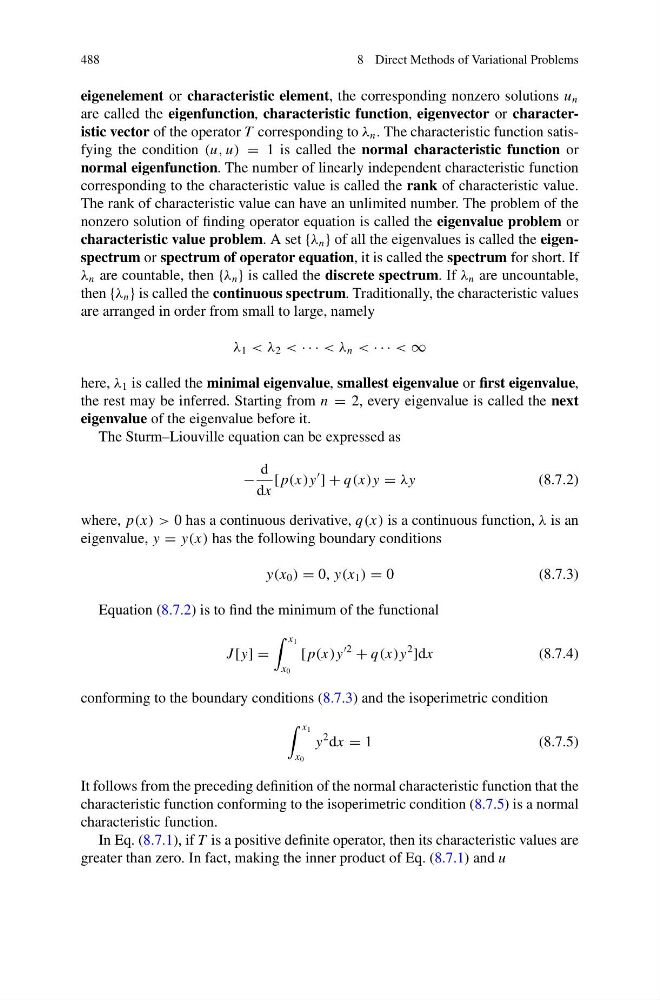
The Sturm–Liouville equation can be expressed as
−
d
dx
[ p(x)y
] + q(x)y = λy
(8.7.2)
where, p(x) > 0 has a continuous derivative, q(x) is a continuous function, λ is an
eigenvalue, y = y(x) has the following boundary conditions
y(x 0 ) = 0, y(x 1 ) = 0
(8.7.3)
Equation (8.7.2) is to find the minimum of the functional
J [y] =
x 1
x 0
[ p(x)y
2
+ q(x)y
2
]dx
(8.7.4)
conforming to the boundary conditions (8.7.3) and the isoperimetric condition
x 1
x 0
y
2 dx = 1
(8.7.5)
It follows from the preceding definition of the normal characteristic function that the
characteristic function conforming to the isoperimetric condition (8.7.5) is a normal
characteristic function.
In Eq. (8.7.1), if T is a positive definite operator, then its characteristic values are
greater than zero. In fact, making the inner product of Eq. (8.7.1) and u
8 Direct Methods of Variational Problems
eigenelement or characteristic element, the corresponding nonzero solutions u n
are called the eigenfunction, characteristic function, eigenvector or characteristic vector of the operator T corresponding to λ n . The characteristic function satisfying the condition (u, u) = 1 is called the normal characteristic function or
normal eigenfunction. The number of linearly independent characteristic function
corresponding to the characteristic value is called the rank of characteristic value.
The rank of characteristic value can have an unlimited number. The problem of the
nonzero solution of finding operator equation is called the eigenvalue problem or
characteristic value problem. A set {λ n } of all the eigenvalues is called the eigenspectrum or spectrum of operator equation, it is called the spectrum for short. If
λ n are countable, then {λ n } is called the discrete spectrum. If λ n are uncountable,
then {λ n } is called the continuous spectrum. Traditionally, the characteristic values
are arranged in order from small to large, namely
λ 1 < λ 2 < · · · < λ n < · · · < ∞
here, λ 1 is called the minimal eigenvalue, smallest eigenvalue or first eigenvalue,
the rest may be inferred. Starting from n = 2, every eigenvalue is called the next
eigenvalue of the eigenvalue before it.
The Sturm–Liouville equation can be expressed as
−
d
dx
[ p(x)y
] + q(x)y = λy
(8.7.2)
where, p(x) > 0 has a continuous derivative, q(x) is a continuous function, λ is an
eigenvalue, y = y(x) has the following boundary conditions
y(x 0 ) = 0, y(x 1 ) = 0
(8.7.3)
Equation (8.7.2) is to find the minimum of the functional
J [y] =
x 1
x 0
[ p(x)y
2
+ q(x)y
2
]dx
(8.7.4)
conforming to the boundary conditions (8.7.3) and the isoperimetric condition
x 1
x 0
y
2 dx = 1
(8.7.5)
It follows from the preceding definition of the normal characteristic function that the
characteristic function conforming to the isoperimetric condition (8.7.5) is a normal
characteristic function.
In Eq. (8.7.1), if T is a positive definite operator, then its characteristic values are
greater than zero. In fact, making the inner product of Eq. (8.7.1) and u