

486
8 Direct Methods of Variational Problems
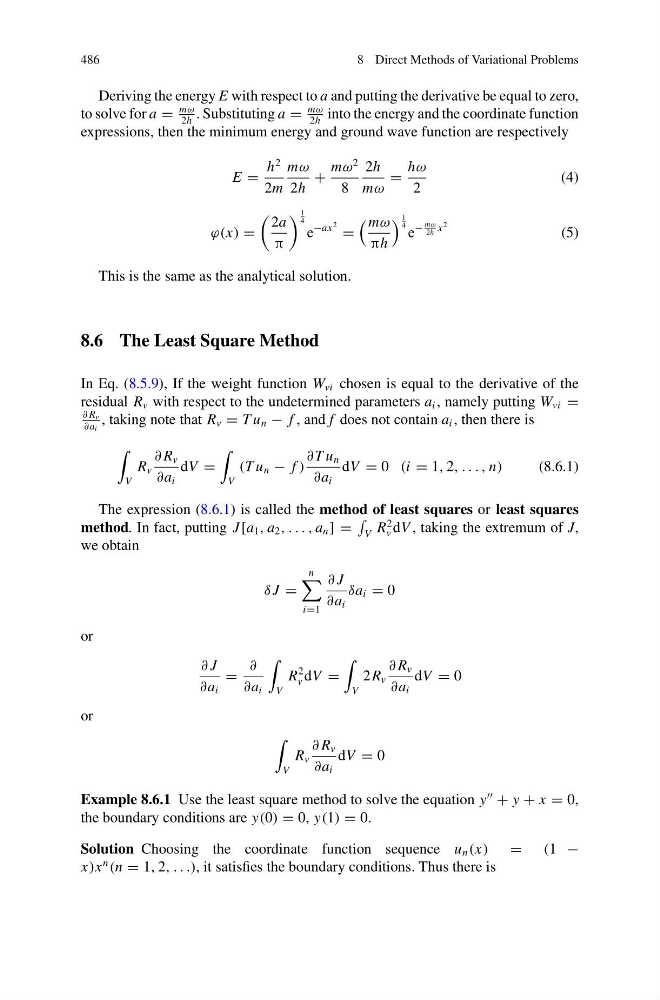
Deriving the energy E with respect to a and putting the derivative be equal to zero,
to solve for a =
mω
2h
. Substituting a =
mω
2h
into the energy and the coordinate function
expressions, then the minimum energy and ground wave function are respectively
E =
h
2
2m
mω
2h
+
mω
2
8
2h
mω
=
hω
2
(4)
ϕ(x) =
2a
π
1
4
e
−ax
2 =
mω
πh
1
4 e
−
mω
2h x
2
(5)
This is the same as the analytical solution.
8.6 The Least Square Method
In Eq. (8.5.9), If the weight function W vi chosen is equal to the derivative of the
residual R v with respect to the undetermined parameters a i , namely putting W vi =
∂ R v
∂a i
, taking note that R v = T u n − f , and f does not contain a i , then there is
V
R v
∂ R v
∂a i
dV =
V
(T u n − f )
∂ T u n
∂a i
dV = 0 (i = 1, 2, . . . , n)
(8.6.1)
The expression (8.6.1) is called the method of least squares or least squares
method. In fact, putting J [a 1 , a 2 , . . . , a n ] =
V R
2
v dV , taking the extremum of J,
we obtain
δ J =
n
i=1
∂ J
∂a i
δa i = 0
or
∂ J
∂a i
=
∂
∂a i
V
R
2
v dV =
V
2R v
∂ R v
∂a i
dV = 0
or
V
R v
∂ R v
∂a i
dV = 0
Example 8.6.1 Use the least square method to solve the equation y
+ y + x = 0,
the boundary conditions are y(0) = 0, y(1) = 0.
Solution Choosing the coordinate function sequence u n (x) = (1 −
x)x
n
(n = 1, 2, . . .), it satisfies the boundary conditions. Thus there is
8 Direct Methods of Variational Problems
Deriving the energy E with respect to a and putting the derivative be equal to zero,
to solve for a =
mω
2h
. Substituting a =
mω
2h
into the energy and the coordinate function
expressions, then the minimum energy and ground wave function are respectively
E =
h
2
2m
mω
2h
+
mω
2
8
2h
mω
=
hω
2
(4)
ϕ(x) =
2a
π
1
4
e
−ax
2 =
mω
πh
1
4 e
−
mω
2h x
2
(5)
This is the same as the analytical solution.
8.6 The Least Square Method
In Eq. (8.5.9), If the weight function W vi chosen is equal to the derivative of the
residual R v with respect to the undetermined parameters a i , namely putting W vi =
∂ R v
∂a i
, taking note that R v = T u n − f , and f does not contain a i , then there is
V
R v
∂ R v
∂a i
dV =
V
(T u n − f )
∂ T u n
∂a i
dV = 0 (i = 1, 2, . . . , n)
(8.6.1)
The expression (8.6.1) is called the method of least squares or least squares
method. In fact, putting J [a 1 , a 2 , . . . , a n ] =
V R
2
v dV , taking the extremum of J,
we obtain
δ J =
n
i=1
∂ J
∂a i
δa i = 0
or
∂ J
∂a i
=
∂
∂a i
V
R
2
v dV =
V
2R v
∂ R v
∂a i
dV = 0
or
V
R v
∂ R v
∂a i
dV = 0
Example 8.6.1 Use the least square method to solve the equation y
+ y + x = 0,
the boundary conditions are y(0) = 0, y(1) = 0.
Solution Choosing the coordinate function sequence u n (x) = (1 −
x)x
n
(n = 1, 2, . . .), it satisfies the boundary conditions. Thus there is