

8.5 The Galerkin Method
479
32
45
(a
2
+ b
2
)a 1 +
64
225
b
2 a
2
+
32
315
(a
4
+ b
4
)
a 2 =
4
9
m
64
225
b
2 a
2
+
32
315
(a
4
+ b
4
)
a 1 +
416
1575
(a
4 b
2
+ a
2 b
4
) +
32
945
(a
6
+ b
6
)
a 2
=
4
45
(a
2
+ b
2
)m
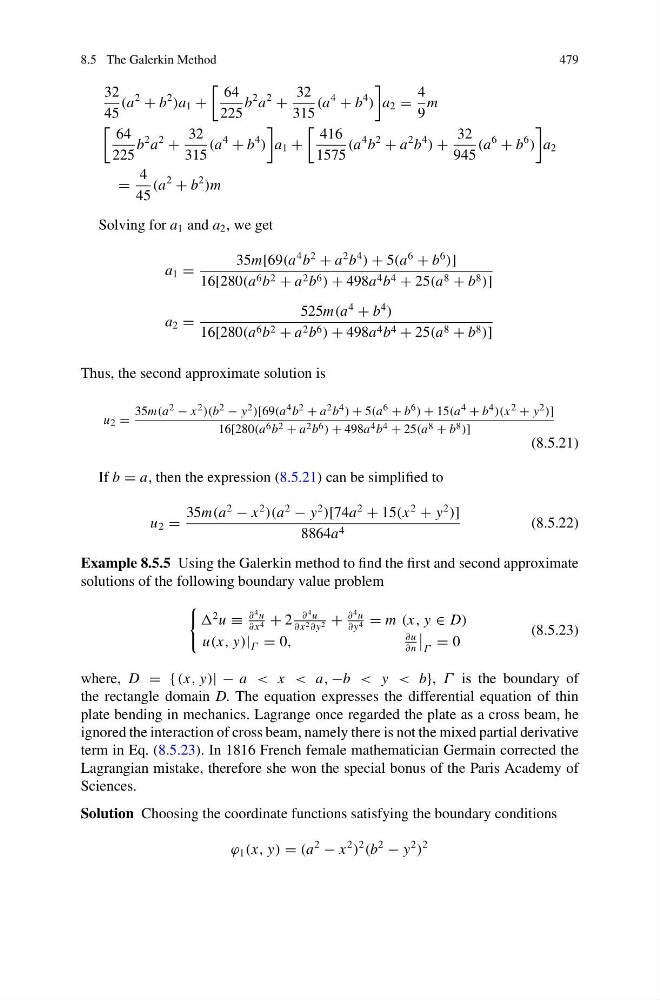
Solving for a 1 and a 2 , we get
a 1 =
35m[69(a
4 b
2
+ a
2 b
4
) + 5(a
6
+ b
6
)]
16[280(a 6 b 2 + a 2 b 6 ) + 498a 4 b 4 + 25(a 8 + b 8 )]
a 2 =
525m(a
4
+ b
4
)
16[280(a 6 b 2 + a 2 b 6 ) + 498a 4 b 4 + 25(a 8 + b 8 )]
Thus, the second approximate solution is
u 2 =
35m(a 2 − x 2 )(b 2 − y 2 )[69(a 4 b 2 + a 2 b 4 ) + 5(a 6 + b 6 ) + 15(a 4 + b 4 )(x 2 + y 2 )]
16[280(a 6 b 2 + a 2 b 6 ) + 498a 4 b 4 + 25(a 8 + b 8 )]
(8.5.21)
If b = a, then the expression (8.5.21) can be simplified to
u 2 =
35m(a
2
− x
2
)(a
2
− y
2
)[74a
2
+ 15(x
2
+ y
2
)]
8864a 4
(8.5.22)
Example 8.5.5 Using the Galerkin method to find the first and second approximate
solutions of the following boundary value problem
2 u ≡
∂
4 u
∂ x 4 + 2
∂
4 u
∂ x 2 ∂ y 2 +
∂
4 u
∂ y 4 = m (x, y ∈ D)
u(x, y)| Γ = 0,
∂u
∂n
Γ
= 0
(8.5.23)
where, D = {(x, y)| − a < x < a, −b < y < b}, Γ is the boundary of
the rectangle domain D. The equation expresses the differential equation of thin
plate bending in mechanics. Lagrange once regarded the plate as a cross beam, he
ignored the interaction of cross beam, namely there is not the mixed partial derivative
term in Eq. (8.5.23). In 1816 French female mathematician Germain corrected the
Lagrangian mistake, therefore she won the special bonus of the Paris Academy of
Sciences.
Solution Choosing the coordinate functions satisfying the boundary conditions
ϕ 1 (x, y) = (a
2
− x
2
)
2
(b
2
− y
2
)
2
479
32
45
(a
2
+ b
2
)a 1 +
64
225
b
2 a
2
+
32
315
(a
4
+ b
4
)
a 2 =
4
9
m
64
225
b
2 a
2
+
32
315
(a
4
+ b
4
)
a 1 +
416
1575
(a
4 b
2
+ a
2 b
4
) +
32
945
(a
6
+ b
6
)
a 2
=
4
45
(a
2
+ b
2
)m
Solving for a 1 and a 2 , we get
a 1 =
35m[69(a
4 b
2
+ a
2 b
4
) + 5(a
6
+ b
6
)]
16[280(a 6 b 2 + a 2 b 6 ) + 498a 4 b 4 + 25(a 8 + b 8 )]
a 2 =
525m(a
4
+ b
4
)
16[280(a 6 b 2 + a 2 b 6 ) + 498a 4 b 4 + 25(a 8 + b 8 )]
Thus, the second approximate solution is
u 2 =
35m(a 2 − x 2 )(b 2 − y 2 )[69(a 4 b 2 + a 2 b 4 ) + 5(a 6 + b 6 ) + 15(a 4 + b 4 )(x 2 + y 2 )]
16[280(a 6 b 2 + a 2 b 6 ) + 498a 4 b 4 + 25(a 8 + b 8 )]
(8.5.21)
If b = a, then the expression (8.5.21) can be simplified to
u 2 =
35m(a
2
− x
2
)(a
2
− y
2
)[74a
2
+ 15(x
2
+ y
2
)]
8864a 4
(8.5.22)
Example 8.5.5 Using the Galerkin method to find the first and second approximate
solutions of the following boundary value problem
2 u ≡
∂
4 u
∂ x 4 + 2
∂
4 u
∂ x 2 ∂ y 2 +
∂
4 u
∂ y 4 = m (x, y ∈ D)
u(x, y)| Γ = 0,
∂u
∂n
Γ
= 0
(8.5.23)
where, D = {(x, y)| − a < x < a, −b < y < b}, Γ is the boundary of
the rectangle domain D. The equation expresses the differential equation of thin
plate bending in mechanics. Lagrange once regarded the plate as a cross beam, he
ignored the interaction of cross beam, namely there is not the mixed partial derivative
term in Eq. (8.5.23). In 1816 French female mathematician Germain corrected the
Lagrangian mistake, therefore she won the special bonus of the Paris Academy of
Sciences.
Solution Choosing the coordinate functions satisfying the boundary conditions
ϕ 1 (x, y) = (a
2
− x
2
)
2
(b
2
− y
2
)
2