

476
8 Direct Methods of Variational Problems
y n =
n
k=1
a k ϕ k (x)
(8.5.14)
y
n =
n
k=1
a k ϕ
k (x)
(8.5.15)
where, ϕ k (x)(k = 1, 2, . . . , n) satisfy the boundary conditions.
Substituting Eqs. (8.5.14) and (8.5.15) into the functional (8.5.13), we obtain
J [a 1 , a 2 , . . . , a n ] =
x 1
x 0
F(x, y n , y
n )dx
(8.5.16)
Integrating the functional (8.5.16) with respect to a k , the equations of solving the
boundary value problem with the Ritz method are
∂ J
∂a k
=
x 1
x 0
(F y n ϕ k + F y
n
ϕ
k )dx = 0 (k = 1, 2, . . . , n)
(8.5.17)
Performing the integration by parts to Eq. (8.5.17), we get
x 1
x 0
(F y n ϕ k + F y
n
ϕ
k )dx = F y
n
ϕ k
x 1
x 0
+
x 1
x 0
F y n −
d
dx
F y
n
ϕ k dx
=
x 1
x 0
F y n −
d
dx
F y
n
ϕ k dx = 0
or
x 1
x 0
F y n −
d
dx
F y
n
ϕ k dx = 0 (k = 1, 2, . . . , n)
(8.5.18)
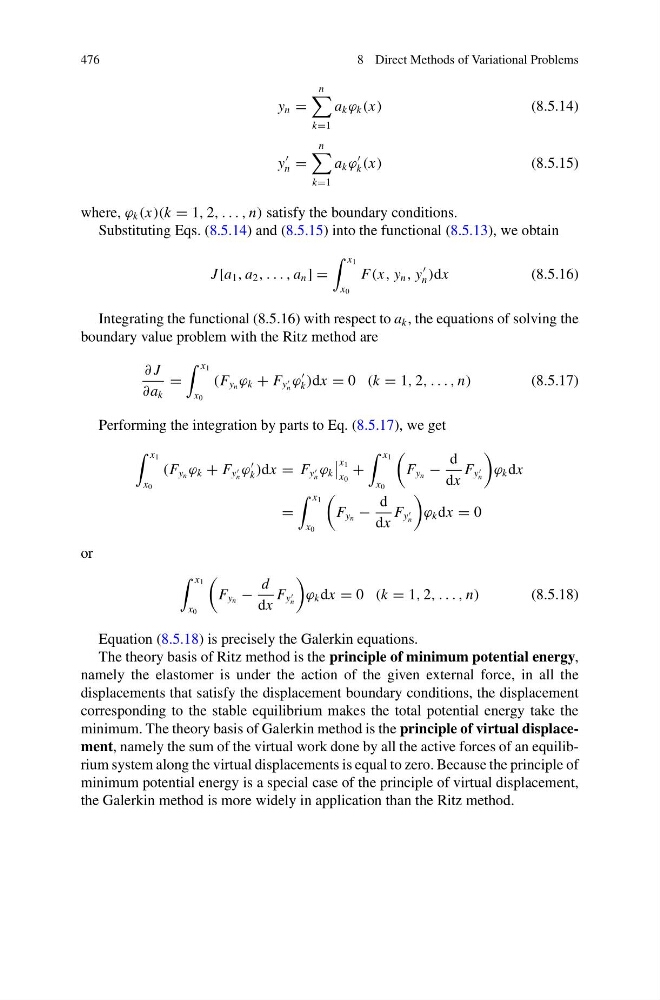
Equation (8.5.18) is precisely the Galerkin equations.
The theory basis of Ritz method is the principle of minimum potential energy,
namely the elastomer is under the action of the given external force, in all the
displacements that satisfy the displacement boundary conditions, the displacement
corresponding to the stable equilibrium makes the total potential energy take the
minimum. The theory basis of Galerkin method is the principle of virtual displacement, namely the sum of the virtual work done by all the active forces of an equilibrium system along the virtual displacements is equal to zero. Because the principle of
minimum potential energy is a special case of the principle of virtual displacement,
the Galerkin method is more widely in application than the Ritz method.
8 Direct Methods of Variational Problems
y n =
n
k=1
a k ϕ k (x)
(8.5.14)
y
n =
n
k=1
a k ϕ
k (x)
(8.5.15)
where, ϕ k (x)(k = 1, 2, . . . , n) satisfy the boundary conditions.
Substituting Eqs. (8.5.14) and (8.5.15) into the functional (8.5.13), we obtain
J [a 1 , a 2 , . . . , a n ] =
x 1
x 0
F(x, y n , y
n )dx
(8.5.16)
Integrating the functional (8.5.16) with respect to a k , the equations of solving the
boundary value problem with the Ritz method are
∂ J
∂a k
=
x 1
x 0
(F y n ϕ k + F y
n
ϕ
k )dx = 0 (k = 1, 2, . . . , n)
(8.5.17)
Performing the integration by parts to Eq. (8.5.17), we get
x 1
x 0
(F y n ϕ k + F y
n
ϕ
k )dx = F y
n
ϕ k
x 1
x 0
+
x 1
x 0
F y n −
d
dx
F y
n
ϕ k dx
=
x 1
x 0
F y n −
d
dx
F y
n
ϕ k dx = 0
or
x 1
x 0
F y n −
d
dx
F y
n
ϕ k dx = 0 (k = 1, 2, . . . , n)
(8.5.18)
Equation (8.5.18) is precisely the Galerkin equations.
The theory basis of Ritz method is the principle of minimum potential energy,
namely the elastomer is under the action of the given external force, in all the
displacements that satisfy the displacement boundary conditions, the displacement
corresponding to the stable equilibrium makes the total potential energy take the
minimum. The theory basis of Galerkin method is the principle of virtual displacement, namely the sum of the virtual work done by all the active forces of an equilibrium system along the virtual displacements is equal to zero. Because the principle of
minimum potential energy is a special case of the principle of virtual displacement,
the Galerkin method is more widely in application than the Ritz method.