

8.5 The Galerkin Method
475
where, β is an undetermined constant.
Substituting Eq. (1) into the functional expression, and using the Euler equation,
we give
(−aβ
2
+ b)(c + βm)m
2
= 0
( 2 )
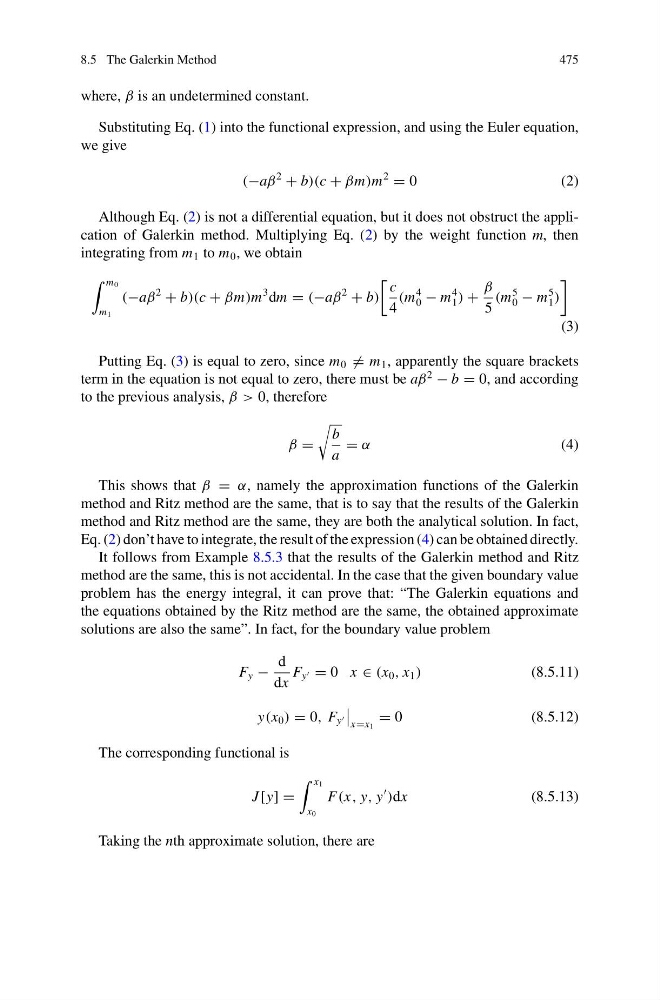
Although Eq. (2) is not a differential equation, but it does not obstruct the application of Galerkin method. Multiplying Eq. (2) by the weight function m, then
integrating from m 1 to m 0 , we obtain
m 0
m 1
(−aβ
2
+ b)(c + βm)m
3 dm = (−aβ
2
+ b)
c
4
(m
4
0 − m
4
1 ) +
β
5
(m
5
0 − m
5
1 )
(3)
Putting Eq. (3) is equal to zero, since m 0 = m 1 , apparently the square brackets
term in the equation is not equal to zero, there must be aβ
2
− b = 0, and according
to the previous analysis, β > 0, therefore
β =
b
a
= α
(4)
This shows that β = α, namely the approximation functions of the Galerkin
method and Ritz method are the same, that is to say that the results of the Galerkin
method and Ritz method are the same, they are both the analytical solution. In fact,
Eq. (2) don’t have to integrate, the result of the expression (4) can be obtained directly.
It follows from Example 8.5.3 that the results of the Galerkin method and Ritz
method are the same, this is not accidental. In the case that the given boundary value
problem has the energy integral, it can prove that: “The Galerkin equations and
the equations obtained by the Ritz method are the same, the obtained approximate
solutions are also the same”. In fact, for the boundary value problem
F y −
d
dx
F y = 0 x ∈ (x 0 , x 1 )
(8.5.11)
y(x 0 ) = 0, F y
x=x 1
= 0
(8.5.12)
The corresponding functional is
J [y] =
x 1
x 0
F(x, y, y
)dx
(8.5.13)
Taking the nth approximate solution, there are
475
where, β is an undetermined constant.
Substituting Eq. (1) into the functional expression, and using the Euler equation,
we give
(−aβ
2
+ b)(c + βm)m
2
= 0
( 2 )
Although Eq. (2) is not a differential equation, but it does not obstruct the application of Galerkin method. Multiplying Eq. (2) by the weight function m, then
integrating from m 1 to m 0 , we obtain
m 0
m 1
(−aβ
2
+ b)(c + βm)m
3 dm = (−aβ
2
+ b)
c
4
(m
4
0 − m
4
1 ) +
β
5
(m
5
0 − m
5
1 )
(3)
Putting Eq. (3) is equal to zero, since m 0 = m 1 , apparently the square brackets
term in the equation is not equal to zero, there must be aβ
2
− b = 0, and according
to the previous analysis, β > 0, therefore
β =
b
a
= α
(4)
This shows that β = α, namely the approximation functions of the Galerkin
method and Ritz method are the same, that is to say that the results of the Galerkin
method and Ritz method are the same, they are both the analytical solution. In fact,
Eq. (2) don’t have to integrate, the result of the expression (4) can be obtained directly.
It follows from Example 8.5.3 that the results of the Galerkin method and Ritz
method are the same, this is not accidental. In the case that the given boundary value
problem has the energy integral, it can prove that: “The Galerkin equations and
the equations obtained by the Ritz method are the same, the obtained approximate
solutions are also the same”. In fact, for the boundary value problem
F y −
d
dx
F y = 0 x ∈ (x 0 , x 1 )
(8.5.11)
y(x 0 ) = 0, F y
x=x 1
= 0
(8.5.12)
The corresponding functional is
J [y] =
x 1
x 0
F(x, y, y
)dx
(8.5.13)
Taking the nth approximate solution, there are