

7.9 The Friedrichs Inequality and Poincaré Inequality
443
[
x 1
x 0
u
(x)dx]
2
x 1
x 0
1
2 dx
x 1
x 0
u
2
(x)dx
(7.9.41)
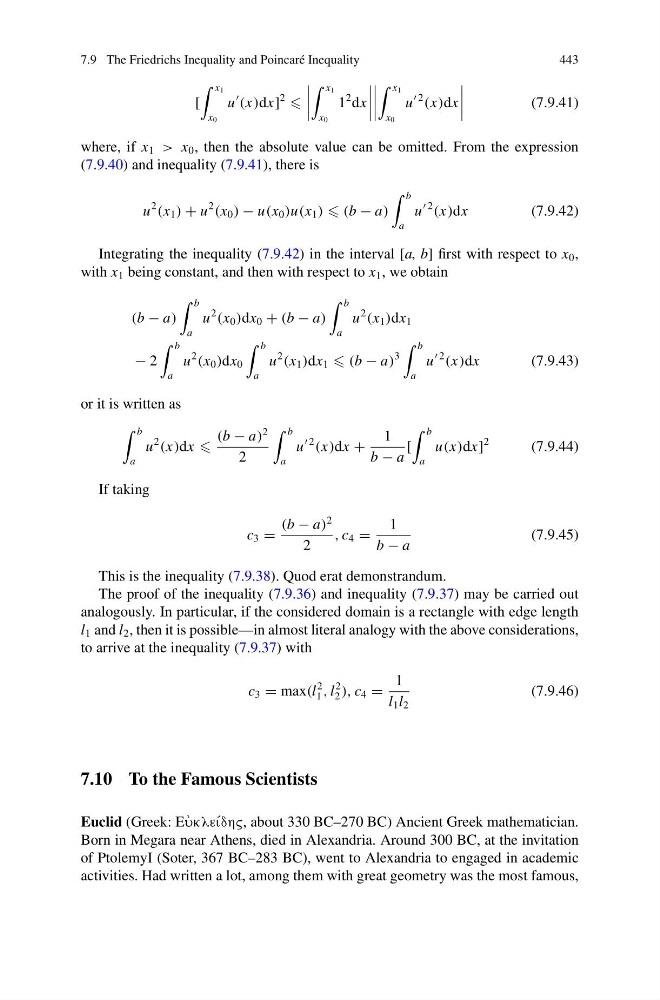
where, if x 1 > x 0 , then the absolute value can be omitted. From the expression
(7.9.40) and inequality (7.9.41), there is
u
2
(x 1 ) + u
2
(x 0 ) − u(x 0 )u(x 1 ) (b − a)
b
a
u
2
(x)dx
(7.9.42)
Integrating the inequality (7.9.42) in the interval [a, b] first with respect to x 0 ,
with x 1 being constant, and then with respect to x 1 , we obtain
(b − a)
b
a
u
2
(x 0 )dx 0 + (b − a)
b
a
u
2
(x 1 )dx 1
− 2
b
a
u
2
(x 0 )dx 0
b
a
u
2
(x 1 )dx 1 (b − a)
3
b
a
u
2
(x)dx
(7.9.43)
or it is written as
b
a
u
2
(x)dx
(b − a)
2
2
b
a
u
2
(x)dx +
1
b − a
[
b
a
u(x)dx]
2
(7.9.44)
If taking
c 3 =
(b − a)
2
2
, c 4 =
1
b − a
(7.9.45)
This is the inequality (7.9.38). Quod erat demonstrandum.
The proof of the inequality (7.9.36) and inequality (7.9.37) may be carried out
analogously. In particular, if the considered domain is a rectangle with edge length
l 1 and l 2 , then it is possible—in almost literal analogy with the above considerations,
to arrive at the inequality (7.9.37) with
c 3 = max(l
2
1 , l
2
2 ), c 4 =
1
l 1 l 2
(7.9.46)
7.10 To the Famous Scientists
Euclid (Greek: EÙκλε´ ιδης, about 330 BC–270 BC) Ancient Greek mathematician.
Born in Megara near Athens, died in Alexandria. Around 300 BC, at the invitation
of PtolemyI (Soter, 367 BC–283 BC), went to Alexandria to engaged in academic
activities. Had written a lot, among them with great geometry was the most famous,
443
[
x 1
x 0
u
(x)dx]
2
x 1
x 0
1
2 dx
x 1
x 0
u
2
(x)dx
(7.9.41)
where, if x 1 > x 0 , then the absolute value can be omitted. From the expression
(7.9.40) and inequality (7.9.41), there is
u
2
(x 1 ) + u
2
(x 0 ) − u(x 0 )u(x 1 ) (b − a)
b
a
u
2
(x)dx
(7.9.42)
Integrating the inequality (7.9.42) in the interval [a, b] first with respect to x 0 ,
with x 1 being constant, and then with respect to x 1 , we obtain
(b − a)
b
a
u
2
(x 0 )dx 0 + (b − a)
b
a
u
2
(x 1 )dx 1
− 2
b
a
u
2
(x 0 )dx 0
b
a
u
2
(x 1 )dx 1 (b − a)
3
b
a
u
2
(x)dx
(7.9.43)
or it is written as
b
a
u
2
(x)dx
(b − a)
2
2
b
a
u
2
(x)dx +
1
b − a
[
b
a
u(x)dx]
2
(7.9.44)
If taking
c 3 =
(b − a)
2
2
, c 4 =
1
b − a
(7.9.45)
This is the inequality (7.9.38). Quod erat demonstrandum.
The proof of the inequality (7.9.36) and inequality (7.9.37) may be carried out
analogously. In particular, if the considered domain is a rectangle with edge length
l 1 and l 2 , then it is possible—in almost literal analogy with the above considerations,
to arrive at the inequality (7.9.37) with
c 3 = max(l
2
1 , l
2
2 ), c 4 =
1
l 1 l 2
(7.9.46)
7.10 To the Famous Scientists
Euclid (Greek: EÙκλε´ ιδης, about 330 BC–270 BC) Ancient Greek mathematician.
Born in Megara near Athens, died in Alexandria. Around 300 BC, at the invitation
of PtolemyI (Soter, 367 BC–283 BC), went to Alexandria to engaged in academic
activities. Had written a lot, among them with great geometry was the most famous,