

442
7 Variational Principles
At this point it need only to take c = max(c 1 , c 2 ).
In the same way, the proof of inequality in other case can also be obtained.
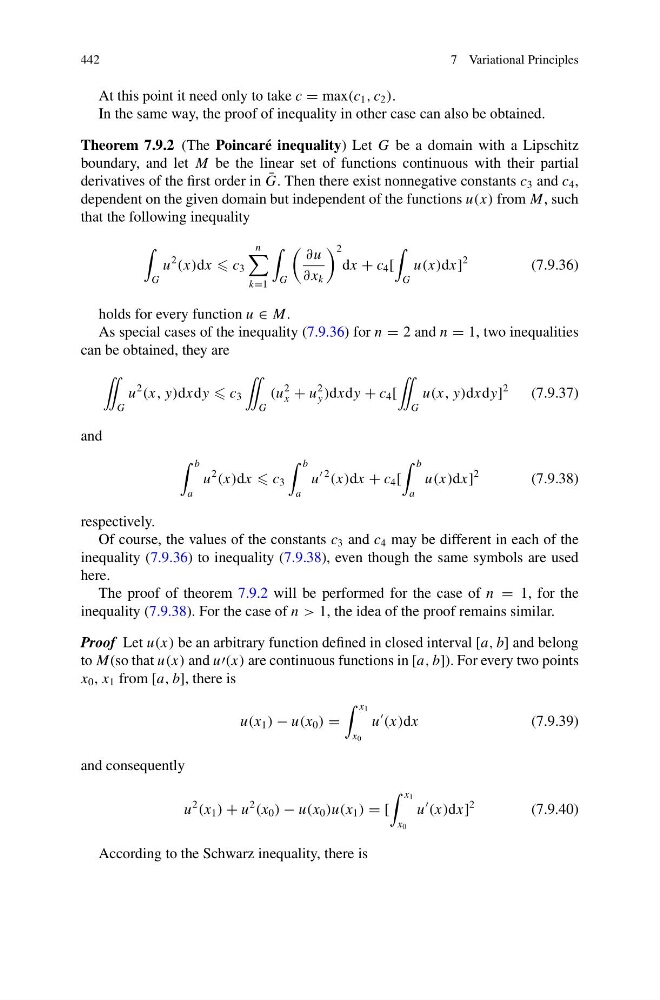
Theorem 7.9.2 (The Poincaré inequality) Let G be a domain with a Lipschitz
boundary, and let M be the linear set of functions continuous with their partial
derivatives of the first order in ¯
G. Then there exist nonnegative constants c 3 and c 4 ,
dependent on the given domain but independent of the functions u(x) from M, such
that the following inequality
G
u
2
(x)dx c 3
n
k=1
G
∂u
∂ x k
2
dx + c 4 [
G
u(x)dx]
2
(7.9.36)
holds for every function u ∈ M.
As special cases of the inequality (7.9.36) for n = 2 and n = 1, two inequalities
can be obtained, they are
¨
G
u
2
(x, y)dxdy c 3
¨
G
(u
2
x + u
2
y )dxdy + c 4 [
¨
G
u(x, y)dxdy]
2
(7.9.37)
and
b
a
u
2
(x)dx c 3
b
a
u
2
(x)dx + c 4 [
b
a
u(x)dx]
2
(7.9.38)
respectively.
Of course, the values of the constants c 3 and c 4 may be different in each of the
inequality (7.9.36) to inequality (7.9.38), even though the same symbols are used
here.
The proof of theorem 7.9.2 will be performed for the case of n = 1, for the
inequality (7.9.38). For the case of n > 1, the idea of the proof remains similar.
Proof Let u(x) be an arbitrary function defined in closed interval [a, b] and belong
to M(so that u(x) and u(x) are continuous functions in [a, b]). For every two points
x 0 , x 1 from [a, b], there is
u(x 1 ) − u(x 0 ) =
x 1
x 0
u
(x)dx
(7.9.39)
and consequently
u
2
(x 1 ) + u
2
(x 0 ) − u(x 0 )u(x 1 ) = [
x 1
x 0
u
(x)dx]
2
(7.9.40)
According to the Schwarz inequality, there is
7 Variational Principles
At this point it need only to take c = max(c 1 , c 2 ).
In the same way, the proof of inequality in other case can also be obtained.
Theorem 7.9.2 (The Poincaré inequality) Let G be a domain with a Lipschitz
boundary, and let M be the linear set of functions continuous with their partial
derivatives of the first order in ¯
G. Then there exist nonnegative constants c 3 and c 4 ,
dependent on the given domain but independent of the functions u(x) from M, such
that the following inequality
G
u
2
(x)dx c 3
n
k=1
G
∂u
∂ x k
2
dx + c 4 [
G
u(x)dx]
2
(7.9.36)
holds for every function u ∈ M.
As special cases of the inequality (7.9.36) for n = 2 and n = 1, two inequalities
can be obtained, they are
¨
G
u
2
(x, y)dxdy c 3
¨
G
(u
2
x + u
2
y )dxdy + c 4 [
¨
G
u(x, y)dxdy]
2
(7.9.37)
and
b
a
u
2
(x)dx c 3
b
a
u
2
(x)dx + c 4 [
b
a
u(x)dx]
2
(7.9.38)
respectively.
Of course, the values of the constants c 3 and c 4 may be different in each of the
inequality (7.9.36) to inequality (7.9.38), even though the same symbols are used
here.
The proof of theorem 7.9.2 will be performed for the case of n = 1, for the
inequality (7.9.38). For the case of n > 1, the idea of the proof remains similar.
Proof Let u(x) be an arbitrary function defined in closed interval [a, b] and belong
to M(so that u(x) and u(x) are continuous functions in [a, b]). For every two points
x 0 , x 1 from [a, b], there is
u(x 1 ) − u(x 0 ) =
x 1
x 0
u
(x)dx
(7.9.39)
and consequently
u
2
(x 1 ) + u
2
(x 0 ) − u(x 0 )u(x 1 ) = [
x 1
x 0
u
(x)dx]
2
(7.9.40)
According to the Schwarz inequality, there is