

28
1 Preliminaries
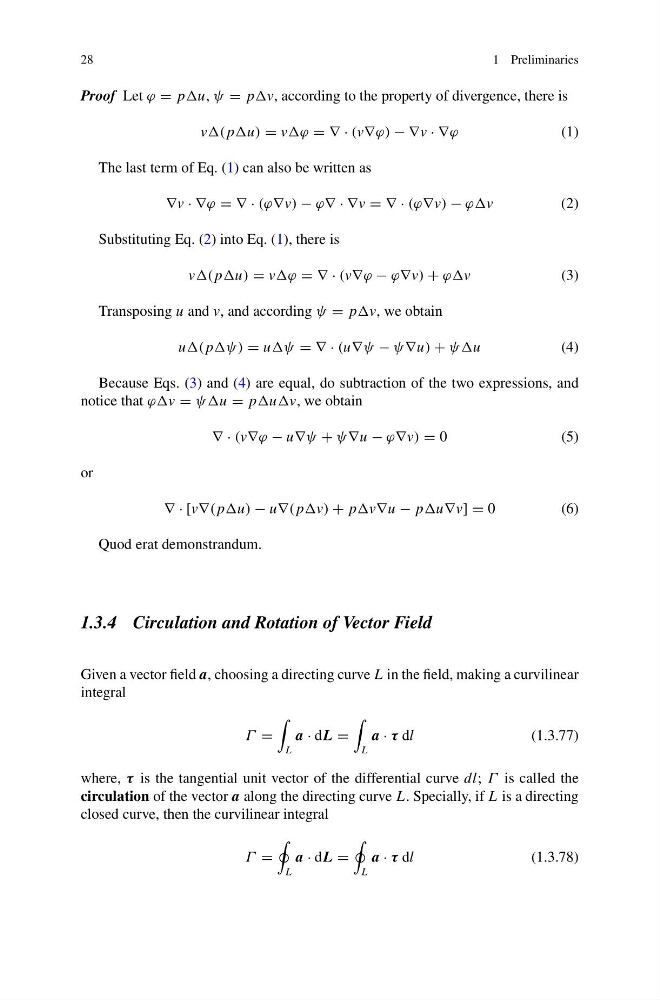
Proof Let ϕ = pu, ψ = pv, according to the property of divergence, there is
v( pu) = vϕ = ∇ · (v∇ϕ) − ∇v · ∇ϕ
(1)
The last term of Eq. (1) can also be written as
∇v · ∇ϕ = ∇ · (ϕ∇v) − ϕ∇ · ∇v = ∇ · (ϕ∇v) − ϕϕv
(2)
Substituting Eq. (2) into Eq. (1), there is
v( pu) = vϕ = ∇ · (v∇ϕ − ϕ∇v) + ϕϕv
(3)
Transposing u and v, and according ψ = pv, we obtain
u( p = uψ = ∇ · (u∇ψ − ψ∇u) + ψψu
(4)
Because Eqs. (3) and (4) are equal, do subtraction of the two expressions, and
notice that ϕϕv = ψψu = puv, we obtain
∇ · (v∇ϕ − u∇ψ + ψ∇u − ϕ∇v) = 0
( 5 )
or
∇ · [v∇( pu) − u∇( pv) + pv∇u − pu∇v] = 0
( 6 )
Quod erat demonstrandum.
1.3.4 Circulation and Rotation of Vector Field
Given a vector field a, choosing a directing curve L in the field, making a curvilinear
integral
Γ =
L
a · dL =
L
a · τ dl
(1.3.77)
where, τ is the tangential unit vector of the differential curve dl; Γ is called the
circulation of the vector a along the directing curve L. Specially, if L is a directing
closed curve, then the curvilinear integral
Γ =
L
a · dL =
L
a · τ dl
(1.3.78)
1 Preliminaries
Proof Let ϕ = pu, ψ = pv, according to the property of divergence, there is
v( pu) = vϕ = ∇ · (v∇ϕ) − ∇v · ∇ϕ
(1)
The last term of Eq. (1) can also be written as
∇v · ∇ϕ = ∇ · (ϕ∇v) − ϕ∇ · ∇v = ∇ · (ϕ∇v) − ϕϕv
(2)
Substituting Eq. (2) into Eq. (1), there is
v( pu) = vϕ = ∇ · (v∇ϕ − ϕ∇v) + ϕϕv
(3)
Transposing u and v, and according ψ = pv, we obtain
u( p = uψ = ∇ · (u∇ψ − ψ∇u) + ψψu
(4)
Because Eqs. (3) and (4) are equal, do subtraction of the two expressions, and
notice that ϕϕv = ψψu = puv, we obtain
∇ · (v∇ϕ − u∇ψ + ψ∇u − ϕ∇v) = 0
( 5 )
or
∇ · [v∇( pu) − u∇( pv) + pv∇u − pu∇v] = 0
( 6 )
Quod erat demonstrandum.
1.3.4 Circulation and Rotation of Vector Field
Given a vector field a, choosing a directing curve L in the field, making a curvilinear
integral
Γ =
L
a · dL =
L
a · τ dl
(1.3.77)
where, τ is the tangential unit vector of the differential curve dl; Γ is called the
circulation of the vector a along the directing curve L. Specially, if L is a directing
closed curve, then the curvilinear integral
Γ =
L
a · dL =
L
a · τ dl
(1.3.78)