

426
7 Variational Principles
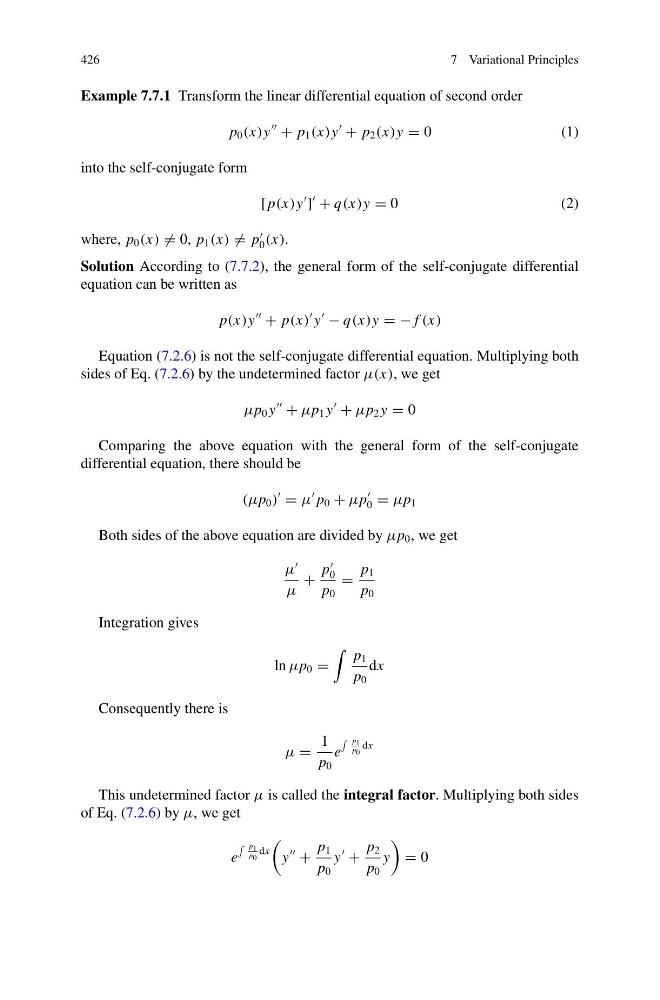
Example 7.7.1 Transform the linear differential equation of second order
p 0 (x)y
+ p 1 (x)y
+ p 2 (x)y = 0
( 1 )
into the self-conjugate form
[ p(x)y
]
+ q(x)y = 0
( 2 )
where, p 0 (x) = 0, p 1 (x) = p
0 (x).
Solution According to (7.7.2), the general form of the self-conjugate differential
equation can be written as
p(x)y
+ p(x)
y
− q(x)y = − f (x)
Equation (7.2.6) is not the self-conjugate differential equation. Multiplying both
sides of Eq. (7.2.6) by the undetermined factor μ(x), we get
μp 0 y
+ μp 1 y
+ μp 2 y = 0
Comparing the above equation with the general form of the self-conjugate
differential equation, there should be
(μp 0 )
= μ
p 0 + μp
0 = μp 1
Both sides of the above equation are divided by μp 0 , we get
μ
μ
+
p
0
p 0
=
p 1
p 0
Integration gives
ln μp 0 =
p 1
p 0
dx
Consequently there is
μ =
1
p 0
e
p 1
p 0
dx
This undetermined factor μ is called the integral factor. Multiplying both sides
of Eq. (7.2.6) by μ, we get
e
p 1
p 0
dx
y
+
p 1
p 0
y
+
p 2
p 0
y
= 0
7 Variational Principles
Example 7.7.1 Transform the linear differential equation of second order
p 0 (x)y
+ p 1 (x)y
+ p 2 (x)y = 0
( 1 )
into the self-conjugate form
[ p(x)y
]
+ q(x)y = 0
( 2 )
where, p 0 (x) = 0, p 1 (x) = p
0 (x).
Solution According to (7.7.2), the general form of the self-conjugate differential
equation can be written as
p(x)y
+ p(x)
y
− q(x)y = − f (x)
Equation (7.2.6) is not the self-conjugate differential equation. Multiplying both
sides of Eq. (7.2.6) by the undetermined factor μ(x), we get
μp 0 y
+ μp 1 y
+ μp 2 y = 0
Comparing the above equation with the general form of the self-conjugate
differential equation, there should be
(μp 0 )
= μ
p 0 + μp
0 = μp 1
Both sides of the above equation are divided by μp 0 , we get
μ
μ
+
p
0
p 0
=
p 1
p 0
Integration gives
ln μp 0 =
p 1
p 0
dx
Consequently there is
μ =
1
p 0
e
p 1
p 0
dx
This undetermined factor μ is called the integral factor. Multiplying both sides
of Eq. (7.2.6) by μ, we get
e
p 1
p 0
dx
y
+
p 1
p 0
y
+
p 2
p 0
y
= 0