

7.7 Variational Problems of Equivalence with Boundary Value Problem …
425
=
2σ
γ
p(x 1 )[δy(x 1 )]
2
+
2β
α
p(x 0 )[δy(x 0 )]
2
0
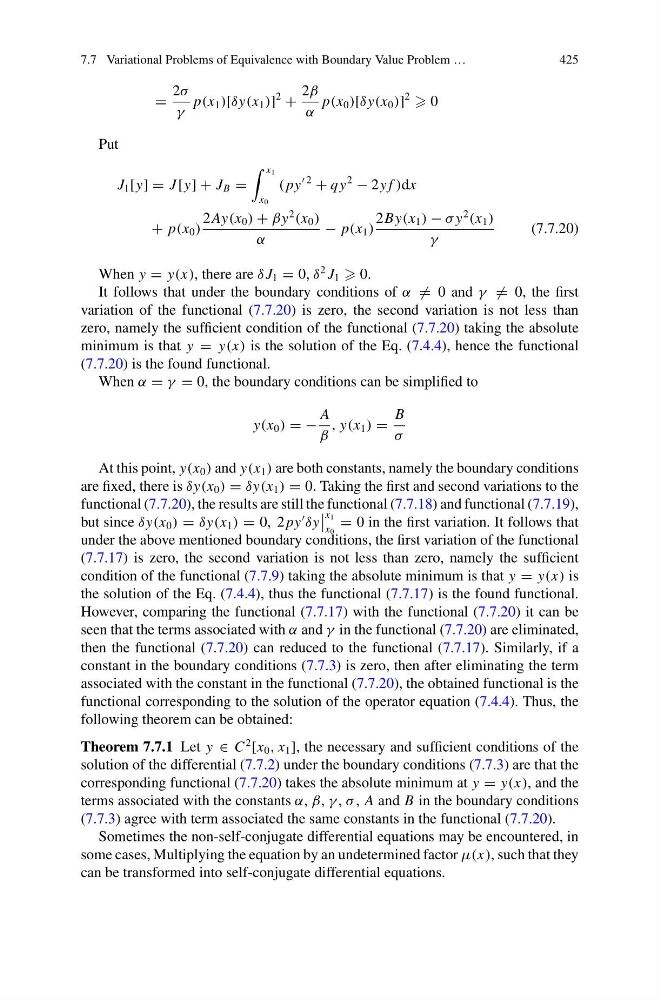
Put
J 1 [y] = J [y] + J B =
x 1
x 0
( py
2
+ qy
2
− 2y f )dx
+ p(x 0 )
2 Ay(x 0 ) + βy
2
(x 0 )
α
− p(x 1 )
2By(x 1 ) − σ y
2
(x 1 )
γ
(7.7.20)
When y = y(x), there are δ J 1 = 0, δ
2 J 1 0.
It follows that under the boundary conditions of α = 0 and γ = 0, the first
variation of the functional (7.7.20) is zero, the second variation is not less than
zero, namely the sufficient condition of the functional (7.7.20) taking the absolute
minimum is that y = y(x) is the solution of the Eq. (7.4.4), hence the functional
(7.7.20) is the found functional.
When α = γ = 0, the boundary conditions can be simplified to
y(x 0 ) = −
A
β
, y(x 1 ) =
B
σ
At this point, y(x 0 ) and y(x 1 ) are both constants, namely the boundary conditions
are fixed, there is δy(x 0 ) = δy(x 1 ) = 0. Taking the first and second variations to the
functional (7.7.20), the results are still the functional (7.7.18) and functional (7.7.19),
but since δy(x 0 ) = δy(x 1 ) = 0, 2 py
δy
x 1
x 0
= 0 in the first variation. It follows that
under the above mentioned boundary conditions, the first variation of the functional
(7.7.17) is zero, the second variation is not less than zero, namely the sufficient
condition of the functional (7.7.9) taking the absolute minimum is that y = y(x) is
the solution of the Eq. (7.4.4), thus the functional (7.7.17) is the found functional.
However, comparing the functional (7.7.17) with the functional (7.7.20) it can be
seen that the terms associated with α and γ in the functional (7.7.20) are eliminated,
then the functional (7.7.20) can reduced to the functional (7.7.17). Similarly, if a
constant in the boundary conditions (7.7.3) is zero, then after eliminating the term
associated with the constant in the functional (7.7.20), the obtained functional is the
functional corresponding to the solution of the operator equation (7.4.4). Thus, the
following theorem can be obtained:
Theorem 7.7.1 Let y ∈ C
2
[x 0 , x 1 ], the necessary and sufficient conditions of the
solution of the differential (7.7.2) under the boundary conditions (7.7.3) are that the
corresponding functional (7.7.20) takes the absolute minimum at y = y(x), and the
terms associated with the constants α, β, γ , σ , A and B in the boundary conditions
(7.7.3) agree with term associated the same constants in the functional (7.7.20).
Sometimes the non-self-conjugate differential equations may be encountered, in
some cases, Multiplying the equation by an undetermined factor μ(x), such that they
can be transformed into self-conjugate differential equations.
425
=
2σ
γ
p(x 1 )[δy(x 1 )]
2
+
2β
α
p(x 0 )[δy(x 0 )]
2
0
Put
J 1 [y] = J [y] + J B =
x 1
x 0
( py
2
+ qy
2
− 2y f )dx
+ p(x 0 )
2 Ay(x 0 ) + βy
2
(x 0 )
α
− p(x 1 )
2By(x 1 ) − σ y
2
(x 1 )
γ
(7.7.20)
When y = y(x), there are δ J 1 = 0, δ
2 J 1 0.
It follows that under the boundary conditions of α = 0 and γ = 0, the first
variation of the functional (7.7.20) is zero, the second variation is not less than
zero, namely the sufficient condition of the functional (7.7.20) taking the absolute
minimum is that y = y(x) is the solution of the Eq. (7.4.4), hence the functional
(7.7.20) is the found functional.
When α = γ = 0, the boundary conditions can be simplified to
y(x 0 ) = −
A
β
, y(x 1 ) =
B
σ
At this point, y(x 0 ) and y(x 1 ) are both constants, namely the boundary conditions
are fixed, there is δy(x 0 ) = δy(x 1 ) = 0. Taking the first and second variations to the
functional (7.7.20), the results are still the functional (7.7.18) and functional (7.7.19),
but since δy(x 0 ) = δy(x 1 ) = 0, 2 py
δy
x 1
x 0
= 0 in the first variation. It follows that
under the above mentioned boundary conditions, the first variation of the functional
(7.7.17) is zero, the second variation is not less than zero, namely the sufficient
condition of the functional (7.7.9) taking the absolute minimum is that y = y(x) is
the solution of the Eq. (7.4.4), thus the functional (7.7.17) is the found functional.
However, comparing the functional (7.7.17) with the functional (7.7.20) it can be
seen that the terms associated with α and γ in the functional (7.7.20) are eliminated,
then the functional (7.7.20) can reduced to the functional (7.7.17). Similarly, if a
constant in the boundary conditions (7.7.3) is zero, then after eliminating the term
associated with the constant in the functional (7.7.20), the obtained functional is the
functional corresponding to the solution of the operator equation (7.4.4). Thus, the
following theorem can be obtained:
Theorem 7.7.1 Let y ∈ C
2
[x 0 , x 1 ], the necessary and sufficient conditions of the
solution of the differential (7.7.2) under the boundary conditions (7.7.3) are that the
corresponding functional (7.7.20) takes the absolute minimum at y = y(x), and the
terms associated with the constants α, β, γ , σ , A and B in the boundary conditions
(7.7.3) agree with term associated the same constants in the functional (7.7.20).
Sometimes the non-self-conjugate differential equations may be encountered, in
some cases, Multiplying the equation by an undetermined factor μ(x), such that they
can be transformed into self-conjugate differential equations.