

7.4 Operators and Functionals
413
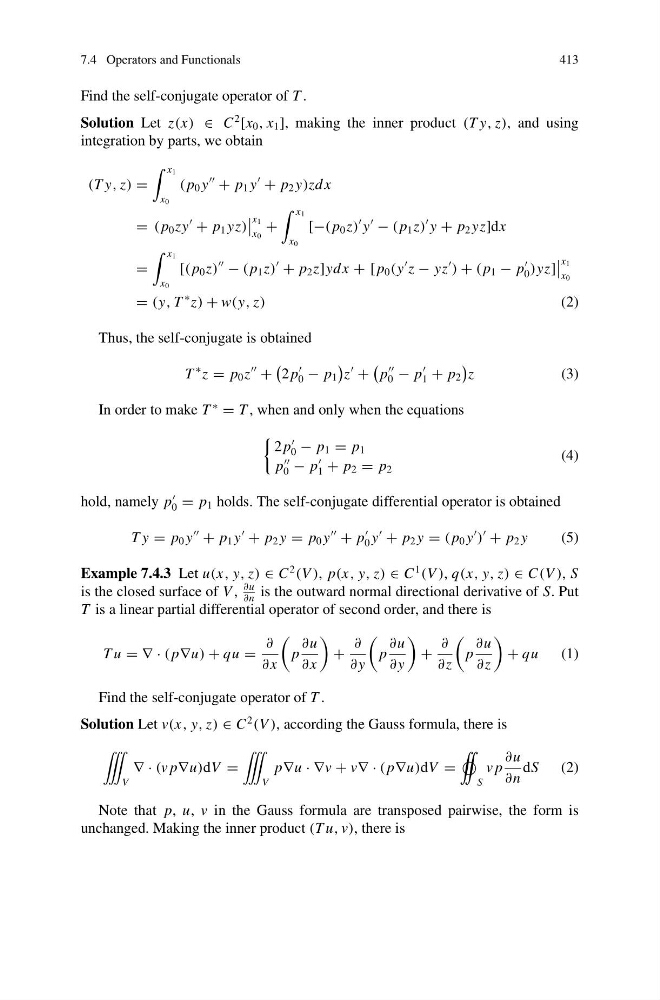
Find the self-conjugate operator of T .
Solution Let z(x) ∈ C
2
[x 0 , x 1 ], making the inner product (T y, z), and using
integration by parts, we obtain
(T y, z) =
x 1
x 0
( p 0 y
+ p 1 y
+ p 2 y)zdx
= ( p 0 zy
+ p 1 yz)
x 1
x 0
+
x 1
x 0
[−( p 0 z)
y
− ( p 1 z)
y + p 2 yz]dx
=
x 1
x 0
[( p 0 z)
− ( p 1 z)
+ p 2 z]ydx + [p 0 (y
z − yz
) + ( p 1 − p
0 )yz]
x 1
x 0
= (y, T
∗ z) + w(y, z)
(2)
Thus, the self-conjugate is obtained
T
∗ z = p 0 z
+
2 p
0 − p 1
z
+
p
0 − p
1 + p 2
z
(3)
In order to make T
∗
= T , when and only when the equations
2 p
0 − p 1 = p 1
p
0 − p
1 + p 2 = p 2
(4)
hold, namely p
0 = p 1 holds. The self-conjugate differential operator is obtained
T y = p 0 y
+ p 1 y
+ p 2 y = p 0 y
+ p
0 y
+ p 2 y = ( p 0 y
)
+ p 2 y
(5)
Example 7.4.3 Let u(x, y, z) ∈ C
2
(V ), p(x, y, z) ∈ C
1
(V ), q(x, y, z) ∈ C(V ), S
is the closed surface of V ,
∂u
∂n
is the outward normal directional derivative of S. Put
T is a linear partial differential operator of second order, and there is
T u = ∇ · ( p∇u) + qu =
∂
∂ x
p
∂u
∂ x
+
∂
∂ y
p
∂u
∂ y
+
∂
∂z
p
∂u
∂z
+ qu
(1)
Find the self-conjugate operator of T .
Solution Let v(x, y, z) ∈ C
2
(V ), according the Gauss formula, there is
˚
V
∇ · (v p∇u)dV =
˚
V
p∇u · ∇v + v∇ · ( p∇u)dV =
S
v p
∂u
∂n
dS
(2)
Note that p, u, v in the Gauss formula are transposed pairwise, the form is
unchanged. Making the inner product (T u, v), there is
413
Find the self-conjugate operator of T .
Solution Let z(x) ∈ C
2
[x 0 , x 1 ], making the inner product (T y, z), and using
integration by parts, we obtain
(T y, z) =
x 1
x 0
( p 0 y
+ p 1 y
+ p 2 y)zdx
= ( p 0 zy
+ p 1 yz)
x 1
x 0
+
x 1
x 0
[−( p 0 z)
y
− ( p 1 z)
y + p 2 yz]dx
=
x 1
x 0
[( p 0 z)
− ( p 1 z)
+ p 2 z]ydx + [p 0 (y
z − yz
) + ( p 1 − p
0 )yz]
x 1
x 0
= (y, T
∗ z) + w(y, z)
(2)
Thus, the self-conjugate is obtained
T
∗ z = p 0 z
+
2 p
0 − p 1
z
+
p
0 − p
1 + p 2
z
(3)
In order to make T
∗
= T , when and only when the equations
2 p
0 − p 1 = p 1
p
0 − p
1 + p 2 = p 2
(4)
hold, namely p
0 = p 1 holds. The self-conjugate differential operator is obtained
T y = p 0 y
+ p 1 y
+ p 2 y = p 0 y
+ p
0 y
+ p 2 y = ( p 0 y
)
+ p 2 y
(5)
Example 7.4.3 Let u(x, y, z) ∈ C
2
(V ), p(x, y, z) ∈ C
1
(V ), q(x, y, z) ∈ C(V ), S
is the closed surface of V ,
∂u
∂n
is the outward normal directional derivative of S. Put
T is a linear partial differential operator of second order, and there is
T u = ∇ · ( p∇u) + qu =
∂
∂ x
p
∂u
∂ x
+
∂
∂ y
p
∂u
∂ y
+
∂
∂z
p
∂u
∂z
+ qu
(1)
Find the self-conjugate operator of T .
Solution Let v(x, y, z) ∈ C
2
(V ), according the Gauss formula, there is
˚
V
∇ · (v p∇u)dV =
˚
V
p∇u · ∇v + v∇ · ( p∇u)dV =
S
v p
∂u
∂n
dS
(2)
Note that p, u, v in the Gauss formula are transposed pairwise, the form is
unchanged. Making the inner product (T u, v), there is