

7.2 Sets and Spaces
399
Lemma 7.2.1 pointed out the continuity of the inner product.
It can be seen from Theorem 7.2.3 that norm of every inner product space can be
induced by the inner, the space of the norm induced by the inner product becomes
a normed linear space. Conversely, whether can the inner product of every normed
linear space be determined by the norm, such that the norm induced by the inner
product is same as the original norm? The answer is not necessarily. It can be seen
from the following lemma that the norm induced by inner product must satisfy the
parallelogram formula.
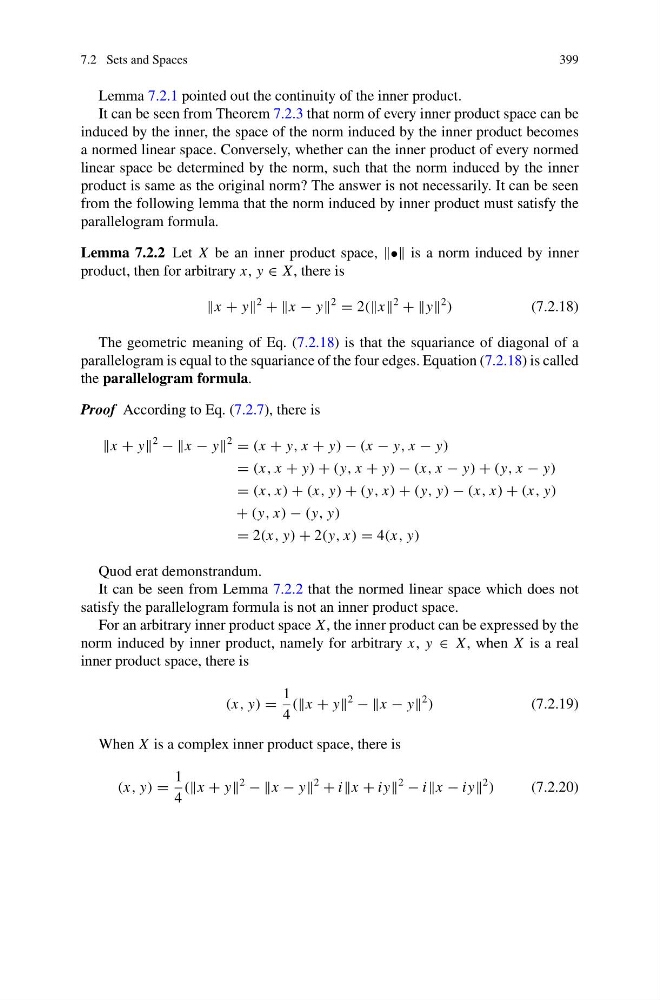
Lemma 7.2.2 Let X be an inner product space, • is a norm induced by inner
product, then for arbitrary x, y ∈ X , there is
x + y
2
+ x − y
2
= 2(x
2
+ y
2
)
(7.2.18)
The geometric meaning of Eq. (7.2.18) is that the squariance of diagonal of a
parallelogram is equal to the squariance of the four edges. Equation (7.2.18) is called
the parallelogram formula.
Proof According to Eq. (7.2.7), there is
x + y
2
− x − y
2
= (x + y, x + y) − (x − y, x − y)
= (x, x + y) + (y, x + y) − (x, x − y) + (y, x − y)
= (x, x) + (x, y) + (y, x) + (y, y) − (x, x) + (x, y)
+ (y, x) − (y, y)
= 2(x, y) + 2(y, x) = 4(x, y)
Quod erat demonstrandum.
It can be seen from Lemma 7.2.2 that the normed linear space which does not
satisfy the parallelogram formula is not an inner product space.
For an arbitrary inner product space X , the inner product can be expressed by the
norm induced by inner product, namely for arbitrary x, y ∈ X , when X is a real
inner product space, there is
(x, y) =
1
4
(x + y
2
− x − y
2
)
(7.2.19)
When X is a complex inner product space, there is
(x, y) =
1
4
(x + y
2
− x − y
2
+ ix + iy
2
− ix − iy
2
)
(7.2.20)
399
Lemma 7.2.1 pointed out the continuity of the inner product.
It can be seen from Theorem 7.2.3 that norm of every inner product space can be
induced by the inner, the space of the norm induced by the inner product becomes
a normed linear space. Conversely, whether can the inner product of every normed
linear space be determined by the norm, such that the norm induced by the inner
product is same as the original norm? The answer is not necessarily. It can be seen
from the following lemma that the norm induced by inner product must satisfy the
parallelogram formula.
Lemma 7.2.2 Let X be an inner product space, • is a norm induced by inner
product, then for arbitrary x, y ∈ X , there is
x + y
2
+ x − y
2
= 2(x
2
+ y
2
)
(7.2.18)
The geometric meaning of Eq. (7.2.18) is that the squariance of diagonal of a
parallelogram is equal to the squariance of the four edges. Equation (7.2.18) is called
the parallelogram formula.
Proof According to Eq. (7.2.7), there is
x + y
2
− x − y
2
= (x + y, x + y) − (x − y, x − y)
= (x, x + y) + (y, x + y) − (x, x − y) + (y, x − y)
= (x, x) + (x, y) + (y, x) + (y, y) − (x, x) + (x, y)
+ (y, x) − (y, y)
= 2(x, y) + 2(y, x) = 4(x, y)
Quod erat demonstrandum.
It can be seen from Lemma 7.2.2 that the normed linear space which does not
satisfy the parallelogram formula is not an inner product space.
For an arbitrary inner product space X , the inner product can be expressed by the
norm induced by inner product, namely for arbitrary x, y ∈ X , when X is a real
inner product space, there is
(x, y) =
1
4
(x + y
2
− x − y
2
)
(7.2.19)
When X is a complex inner product space, there is
(x, y) =
1
4
(x + y
2
− x − y
2
+ ix + iy
2
− ix − iy
2
)
(7.2.20)