

398
7 Variational Principles
Similarly there is
(y − x) + x y − x + x = x − y + x
(4)
We get
y − x x − y
(5)
Thus, inequality (7.2.17) ban be obtained directly by inequality (3) and inequality
(5). Quod erat demonstrandum.
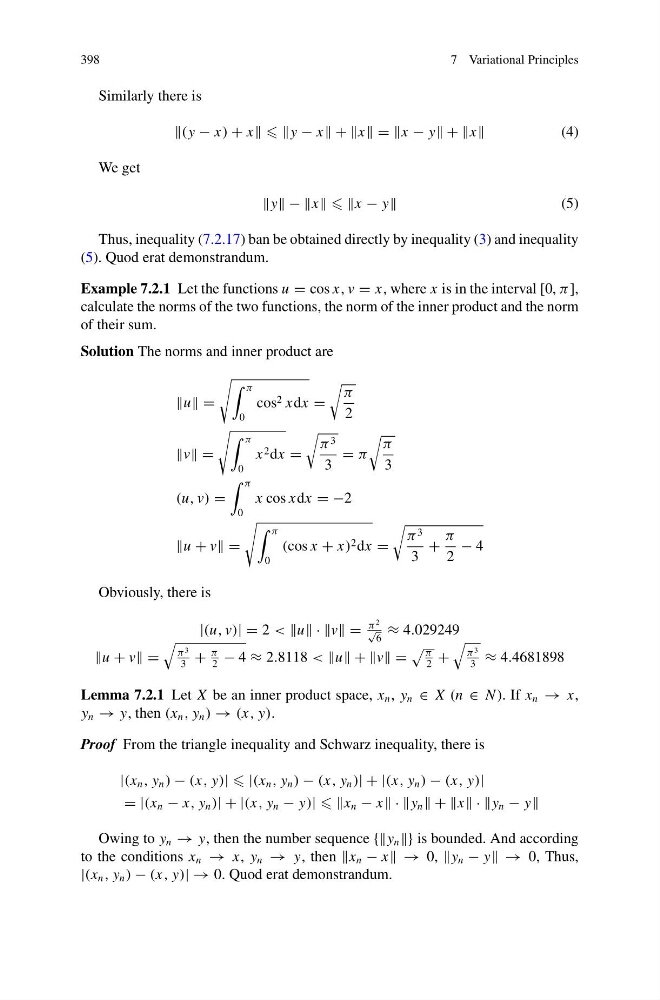
Example 7.2.1 Let the functions u = cos x, v = x, where x is in the interval [0, π ],
calculate the norms of the two functions, the norm of the inner product and the norm
of their sum.
Solution The norms and inner product are
u =
π
0
cos 2 xdx =
π
2
v =
π
0
x 2 dx =
π 3
3
= π
π
3
(u, v) =
π
0
x cos xdx = −2
u + v =
π
0
(cos x + x) 2 dx =
π 3
3
+
π
2
− 4
Obviously, there is
|(u, v)| = 2 < u · v =
π
2
√
6
≈ 4.029249
u + v =
π 3
3
+
π
2
− 4 ≈ 2.8118 < u + v =
π
2
+
π 3
3
≈ 4.4681898
Lemma 7.2.1 Let X be an inner product space, x n , y n ∈ X (n ∈ N ). If x n → x,
y n → y, then (x n , y n ) → (x, y).
Proof From the triangle inequality and Schwarz inequality, there is
|(x n , y n ) − (x, y)| |(x n , y n ) − (x, y n )| + |(x, y n ) − (x, y)|
= |(x n − x, y n )| + |(x, y n − y)| x n − x · y n + x · y n − y
Owing to y n → y, then the number sequence {y n } is bounded. And according
to the conditions x n → x, y n → y, then x n − x → 0, y n − y → 0, Thus,
|(x n , y n ) − (x, y)| → 0. Quod erat demonstrandum.
7 Variational Principles
Similarly there is
(y − x) + x y − x + x = x − y + x
(4)
We get
y − x x − y
(5)
Thus, inequality (7.2.17) ban be obtained directly by inequality (3) and inequality
(5). Quod erat demonstrandum.
Example 7.2.1 Let the functions u = cos x, v = x, where x is in the interval [0, π ],
calculate the norms of the two functions, the norm of the inner product and the norm
of their sum.
Solution The norms and inner product are
u =
π
0
cos 2 xdx =
π
2
v =
π
0
x 2 dx =
π 3
3
= π
π
3
(u, v) =
π
0
x cos xdx = −2
u + v =
π
0
(cos x + x) 2 dx =
π 3
3
+
π
2
− 4
Obviously, there is
|(u, v)| = 2 < u · v =
π
2
√
6
≈ 4.029249
u + v =
π 3
3
+
π
2
− 4 ≈ 2.8118 < u + v =
π
2
+
π 3
3
≈ 4.4681898
Lemma 7.2.1 Let X be an inner product space, x n , y n ∈ X (n ∈ N ). If x n → x,
y n → y, then (x n , y n ) → (x, y).
Proof From the triangle inequality and Schwarz inequality, there is
|(x n , y n ) − (x, y)| |(x n , y n ) − (x, y n )| + |(x, y n ) − (x, y)|
= |(x n − x, y n )| + |(x, y n − y)| x n − x · y n + x · y n − y
Owing to y n → y, then the number sequence {y n } is bounded. And according
to the conditions x n → x, y n → y, then x n − x → 0, y n − y → 0, Thus,
|(x n , y n ) − (x, y)| → 0. Quod erat demonstrandum.