

6.2 Isoperimetric Problems in Parametric Forms and Geodesic Line
369
⎧
⎪ ⎨
⎪ ⎩
F x −
d
dt
F ˙
x = 0
F y −
d
dt
F ˙
y = 0
(6.2.1)
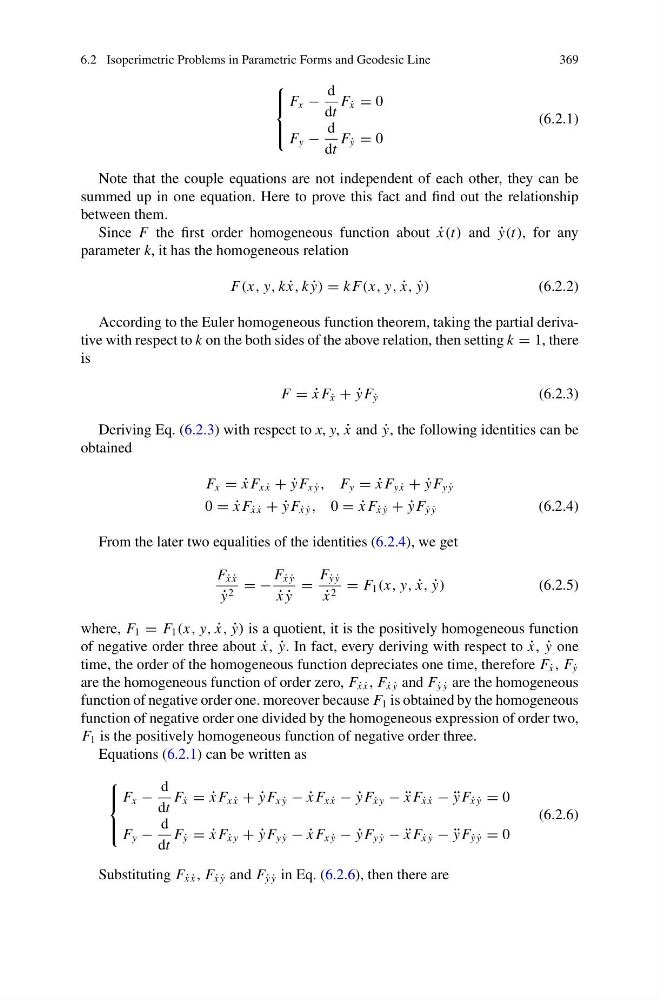
Note that the couple equations are not independent of each other, they can be
summed up in one equation. Here to prove this fact and find out the relationship
between them.
Since F the first order homogeneous function about ˙
x(t) and ˙
y(t), for any
parameter k, it has the homogeneous relation
F(x, y, k ˙
x, k ˙
y) = k F(x, y, ˙
x, ˙
y)
(6.2.2)
According to the Euler homogeneous function theorem, taking the partial derivative with respect to k on the both sides of the above relation, then setting k = 1, there
is
F = ˙
x F ˙
x + ˙
y F ˙
y
(6.2.3)
Deriving Eq. (6.2.3) with respect to x, y, ˙
x and ˙
y, the following identities can be
obtained
F x = ˙
x F x ˙
x + ˙
y F x ˙
y , F y = ˙
x F y ˙
x + ˙
y F y ˙
y
0 = ˙
x F ˙
x ˙
x + ˙
y F ˙
x ˙
y , 0 = ˙
x F ˙
x ˙
y + ˙
y F ˙
y ˙
y
(6.2.4)
From the later two equalities of the identities (6.2.4), we get
F ˙
x ˙
x
˙
y 2 = −
F ˙
x ˙
y
˙
x ˙
y
=
F ˙
y ˙
y
˙
x 2 = F 1 (x, y, ˙
x, ˙
y)
(6.2.5)
where, F 1 = F 1 (x, y, ˙
x, ˙
y) is a quotient, it is the positively homogeneous function
of negative order three about ˙
x, ˙
y. In fact, every deriving with respect to ˙
x, ˙
y one
time, the order of the homogeneous function depreciates one time, therefore F ˙
x , F ˙
y
are the homogeneous function of order zero, F ˙
x ˙
x , F ˙
x ˙
y and F ˙
y ˙
y are the homogeneous
function of negative order one. moreover because F 1 is obtained by the homogeneous
function of negative order one divided by the homogeneous expression of order two,
F 1 is the positively homogeneous function of negative order three.
Equations (6.2.1) can be written as
⎧
⎪ ⎨
⎪ ⎩
F x −
d
dt
F ˙
x = ˙
x F x ˙
x + ˙
y F x ˙
y − ˙
x F x ˙
x − ˙
y F ˙
x y − ¨
x F ˙
x ˙
x − ¨
y F ˙
x ˙
y = 0
F y −
d
dt
F ˙
y = ˙
x F ˙
x y + ˙
y F y ˙
y − ˙
x F x ˙
y − ˙
y F y ˙
y − ¨
x F ˙
x ˙
y − ¨
y F ˙
y ˙
y = 0
(6.2.6)
Substituting F ˙
x ˙
x , F ˙
x ˙
y and F ˙
y ˙
y in Eq. (6.2.6), then there are
369
⎧
⎪ ⎨
⎪ ⎩
F x −
d
dt
F ˙
x = 0
F y −
d
dt
F ˙
y = 0
(6.2.1)
Note that the couple equations are not independent of each other, they can be
summed up in one equation. Here to prove this fact and find out the relationship
between them.
Since F the first order homogeneous function about ˙
x(t) and ˙
y(t), for any
parameter k, it has the homogeneous relation
F(x, y, k ˙
x, k ˙
y) = k F(x, y, ˙
x, ˙
y)
(6.2.2)
According to the Euler homogeneous function theorem, taking the partial derivative with respect to k on the both sides of the above relation, then setting k = 1, there
is
F = ˙
x F ˙
x + ˙
y F ˙
y
(6.2.3)
Deriving Eq. (6.2.3) with respect to x, y, ˙
x and ˙
y, the following identities can be
obtained
F x = ˙
x F x ˙
x + ˙
y F x ˙
y , F y = ˙
x F y ˙
x + ˙
y F y ˙
y
0 = ˙
x F ˙
x ˙
x + ˙
y F ˙
x ˙
y , 0 = ˙
x F ˙
x ˙
y + ˙
y F ˙
y ˙
y
(6.2.4)
From the later two equalities of the identities (6.2.4), we get
F ˙
x ˙
x
˙
y 2 = −
F ˙
x ˙
y
˙
x ˙
y
=
F ˙
y ˙
y
˙
x 2 = F 1 (x, y, ˙
x, ˙
y)
(6.2.5)
where, F 1 = F 1 (x, y, ˙
x, ˙
y) is a quotient, it is the positively homogeneous function
of negative order three about ˙
x, ˙
y. In fact, every deriving with respect to ˙
x, ˙
y one
time, the order of the homogeneous function depreciates one time, therefore F ˙
x , F ˙
y
are the homogeneous function of order zero, F ˙
x ˙
x , F ˙
x ˙
y and F ˙
y ˙
y are the homogeneous
function of negative order one. moreover because F 1 is obtained by the homogeneous
function of negative order one divided by the homogeneous expression of order two,
F 1 is the positively homogeneous function of negative order three.
Equations (6.2.1) can be written as
⎧
⎪ ⎨
⎪ ⎩
F x −
d
dt
F ˙
x = ˙
x F x ˙
x + ˙
y F x ˙
y − ˙
x F x ˙
x − ˙
y F ˙
x y − ¨
x F ˙
x ˙
x − ¨
y F ˙
x ˙
y = 0
F y −
d
dt
F ˙
y = ˙
x F ˙
x y + ˙
y F y ˙
y − ˙
x F x ˙
y − ˙
y F y ˙
y − ¨
x F ˙
x ˙
y − ¨
y F ˙
y ˙
y = 0
(6.2.6)
Substituting F ˙
x ˙
x , F ˙
x ˙
y and F ˙
y ˙
y in Eq. (6.2.6), then there are