

5.4 Extremal Problems of Mixed Type Functionals
359
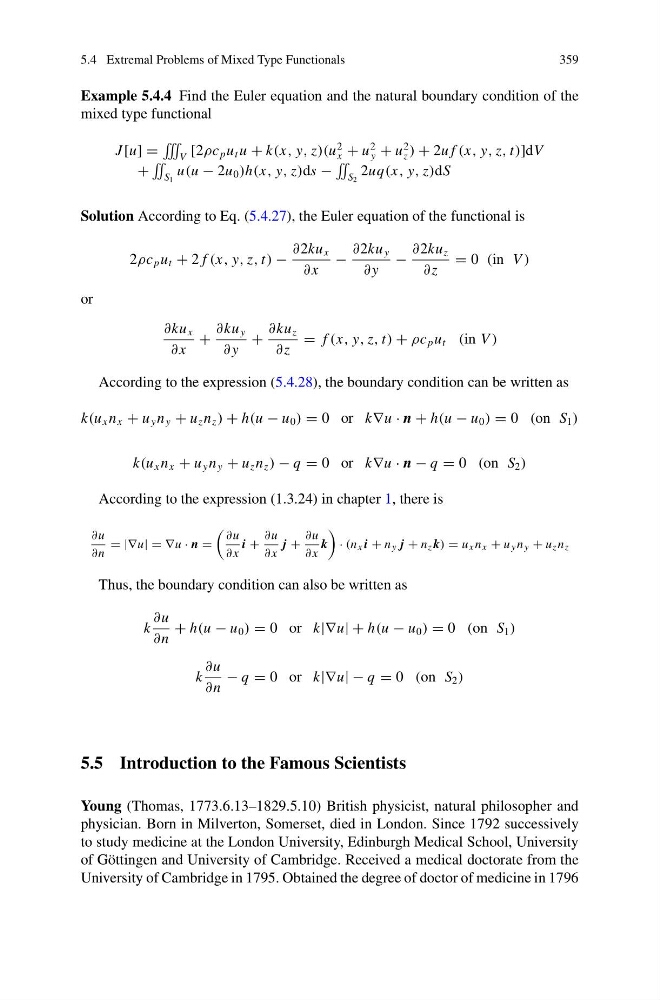
Example 5.4.4 Find the Euler equation and the natural boundary condition of the
mixed type functional
J [u] =
˝
V [2ρc p u t u + k(x, y, z)(u
2
x + u
2
y + u
2
z ) + 2u f (x, y, z, t)]dV
+
˜
S 1
u(u − 2u 0 )h(x, y, z)ds −
˜
S 2
2uq(x, y, z)dS
Solution According to Eq. (5.4.27), the Euler equation of the functional is
2ρc p u t + 2 f (x, y, z, t) −
∂2ku x
∂ x
−
∂2ku y
∂ y
−
∂2ku z
∂z
= 0 (in V )
or
∂ku x
∂ x
+
∂ku y
∂ y
+
∂ku z
∂z
= f (x, y, z, t) + ρc p u t (in V )
According to the expression (5.4.28), the boundary condition can be written as
k(u x n x + u y n y + u z n z ) + h(u − u 0 ) = 0 or k∇u · n + h(u − u 0 ) = 0 (on S 1 )
k(u x n x + u y n y + u z n z ) − q = 0 or k∇u · n − q = 0 (on S 2 )
According to the expression (1.3.24) in chapter 1, there is
∂u
∂n
= |∇u| = ∇u · n =
∂u
∂ x
i +
∂u
∂ x
j +
∂u
∂ x
k
· (n x i + n y j + n z k) = u x n x + u y n y + u z n z
Thus, the boundary condition can also be written as
k
∂u
∂n
+ h(u − u 0 ) = 0 or k|∇u| + h(u − u 0 ) = 0 (on S 1 )
k
∂u
∂n
− q = 0 or k|∇u| − q = 0 (on S 2 )
5.5 Introduction to the Famous Scientists
Young (Thomas, 1773.6.13–1829.5.10) British physicist, natural philosopher and
physician. Born in Milverton, Somerset, died in London. Since 1792 successively
to study medicine at the London University, Edinburgh Medical School, University
of Göttingen and University of Cambridge. Received a medical doctorate from the
University of Cambridge in 1795. Obtained the degree of doctor of medicine in 1796
359
Example 5.4.4 Find the Euler equation and the natural boundary condition of the
mixed type functional
J [u] =
˝
V [2ρc p u t u + k(x, y, z)(u
2
x + u
2
y + u
2
z ) + 2u f (x, y, z, t)]dV
+
˜
S 1
u(u − 2u 0 )h(x, y, z)ds −
˜
S 2
2uq(x, y, z)dS
Solution According to Eq. (5.4.27), the Euler equation of the functional is
2ρc p u t + 2 f (x, y, z, t) −
∂2ku x
∂ x
−
∂2ku y
∂ y
−
∂2ku z
∂z
= 0 (in V )
or
∂ku x
∂ x
+
∂ku y
∂ y
+
∂ku z
∂z
= f (x, y, z, t) + ρc p u t (in V )
According to the expression (5.4.28), the boundary condition can be written as
k(u x n x + u y n y + u z n z ) + h(u − u 0 ) = 0 or k∇u · n + h(u − u 0 ) = 0 (on S 1 )
k(u x n x + u y n y + u z n z ) − q = 0 or k∇u · n − q = 0 (on S 2 )
According to the expression (1.3.24) in chapter 1, there is
∂u
∂n
= |∇u| = ∇u · n =
∂u
∂ x
i +
∂u
∂ x
j +
∂u
∂ x
k
· (n x i + n y j + n z k) = u x n x + u y n y + u z n z
Thus, the boundary condition can also be written as
k
∂u
∂n
+ h(u − u 0 ) = 0 or k|∇u| + h(u − u 0 ) = 0 (on S 1 )
k
∂u
∂n
− q = 0 or k|∇u| − q = 0 (on S 2 )
5.5 Introduction to the Famous Scientists
Young (Thomas, 1773.6.13–1829.5.10) British physicist, natural philosopher and
physician. Born in Milverton, Somerset, died in London. Since 1792 successively
to study medicine at the London University, Edinburgh Medical School, University
of Göttingen and University of Cambridge. Received a medical doctorate from the
University of Cambridge in 1795. Obtained the degree of doctor of medicine in 1796