

356
5 Variational Problems of Conditional Extrema
¨
D
∂ Q
∂ x
+
∂ P
∂ y
d x d y =
Γ
(Qd y − Pd x) =
Γ
(F u x d y − F u y d x)δu
(5.4.19)
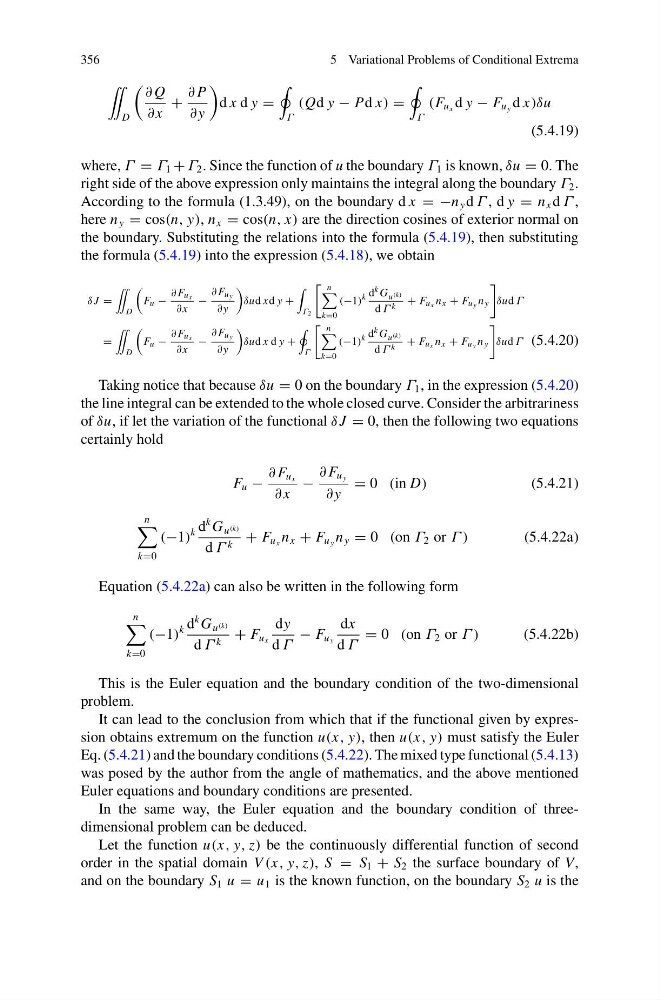
where, Γ = Γ 1 + Γ 2 . Since the function of u the boundary Γ 1 is known, δu = 0. The
right side of the above expression only maintains the integral along the boundary Γ 2 .
According to the formula (1.3.49), on the boundary d x = −n y d Γ , d y = n x d Γ ,
here n y = cos(n, y), n x = cos(n, x) are the direction cosines of exterior normal on
the boundary. Substituting the relations into the formula (5.4.19), then substituting
the formula (5.4.19) into the expression (5.4.18), we obtain
δ J =
¨
D
F u −
∂ F ux
∂ x
−
∂ F u y
∂ y
δud xd y +
Γ2
n
k=0
(−1)
k d k G u (k)
d Γ k + F ux n x + F u y n y
δud Γ
=
¨
D
F u −
∂ F ux
∂ x
−
∂ F u y
∂ y
δud x d y +
Γ
n
k=0
(−1)
k d k G u (k)
d Γ k + F ux n x + F u y n y
δud Γ (5.4.20)
Taking notice that because δu = 0 on the boundary Γ 1 , in the expression (5.4.20)
the line integral can be extended to the whole closed curve. Consider the arbitrariness
of δu, if let the variation of the functional δ J = 0, then the following two equations
certainly hold
F u −
∂ F u x
∂ x
−
∂ F u y
∂ y
= 0 (in D)
(5.4.21)
n
k=0
(−1)
k d
k G u (k)
d Γ k + F u x n x + F u y n y = 0 (on Γ 2 or Γ )
(5.4.22a)
Equation (5.4.22a) can also be written in the following form
n
k=0
(−1)
k d
k G u (k)
d Γ k + F u x
dy
d Γ
− F u y
dx
d Γ
= 0 (on Γ 2 or Γ )
(5.4.22b)
This is the Euler equation and the boundary condition of the two-dimensional
problem.
It can lead to the conclusion from which that if the functional given by expression obtains extremum on the function u(x, y), then u(x, y) must satisfy the Euler
Eq. (5.4.21) and the boundary conditions (5.4.22). The mixed type functional (5.4.13)
was posed by the author from the angle of mathematics, and the above mentioned
Euler equations and boundary conditions are presented.
In the same way, the Euler equation and the boundary condition of threedimensional problem can be deduced.
Let the function u(x, y, z) be the continuously differential function of second
order in the spatial domain V (x, y, z), S = S 1 + S 2 the surface boundary of V,
and on the boundary S 1 u = u 1 is the known function, on the boundary S 2 u is the
5 Variational Problems of Conditional Extrema
¨
D
∂ Q
∂ x
+
∂ P
∂ y
d x d y =
Γ
(Qd y − Pd x) =
Γ
(F u x d y − F u y d x)δu
(5.4.19)
where, Γ = Γ 1 + Γ 2 . Since the function of u the boundary Γ 1 is known, δu = 0. The
right side of the above expression only maintains the integral along the boundary Γ 2 .
According to the formula (1.3.49), on the boundary d x = −n y d Γ , d y = n x d Γ ,
here n y = cos(n, y), n x = cos(n, x) are the direction cosines of exterior normal on
the boundary. Substituting the relations into the formula (5.4.19), then substituting
the formula (5.4.19) into the expression (5.4.18), we obtain
δ J =
¨
D
F u −
∂ F ux
∂ x
−
∂ F u y
∂ y
δud xd y +
Γ2
n
k=0
(−1)
k d k G u (k)
d Γ k + F ux n x + F u y n y
δud Γ
=
¨
D
F u −
∂ F ux
∂ x
−
∂ F u y
∂ y
δud x d y +
Γ
n
k=0
(−1)
k d k G u (k)
d Γ k + F ux n x + F u y n y
δud Γ (5.4.20)
Taking notice that because δu = 0 on the boundary Γ 1 , in the expression (5.4.20)
the line integral can be extended to the whole closed curve. Consider the arbitrariness
of δu, if let the variation of the functional δ J = 0, then the following two equations
certainly hold
F u −
∂ F u x
∂ x
−
∂ F u y
∂ y
= 0 (in D)
(5.4.21)
n
k=0
(−1)
k d
k G u (k)
d Γ k + F u x n x + F u y n y = 0 (on Γ 2 or Γ )
(5.4.22a)
Equation (5.4.22a) can also be written in the following form
n
k=0
(−1)
k d
k G u (k)
d Γ k + F u x
dy
d Γ
− F u y
dx
d Γ
= 0 (on Γ 2 or Γ )
(5.4.22b)
This is the Euler equation and the boundary condition of the two-dimensional
problem.
It can lead to the conclusion from which that if the functional given by expression obtains extremum on the function u(x, y), then u(x, y) must satisfy the Euler
Eq. (5.4.21) and the boundary conditions (5.4.22). The mixed type functional (5.4.13)
was posed by the author from the angle of mathematics, and the above mentioned
Euler equations and boundary conditions are presented.
In the same way, the Euler equation and the boundary condition of threedimensional problem can be deduced.
Let the function u(x, y, z) be the continuously differential function of second
order in the spatial domain V (x, y, z), S = S 1 + S 2 the surface boundary of V,
and on the boundary S 1 u = u 1 is the known function, on the boundary S 2 u is the