

322
5 Variational Problems of Conditional Extrema
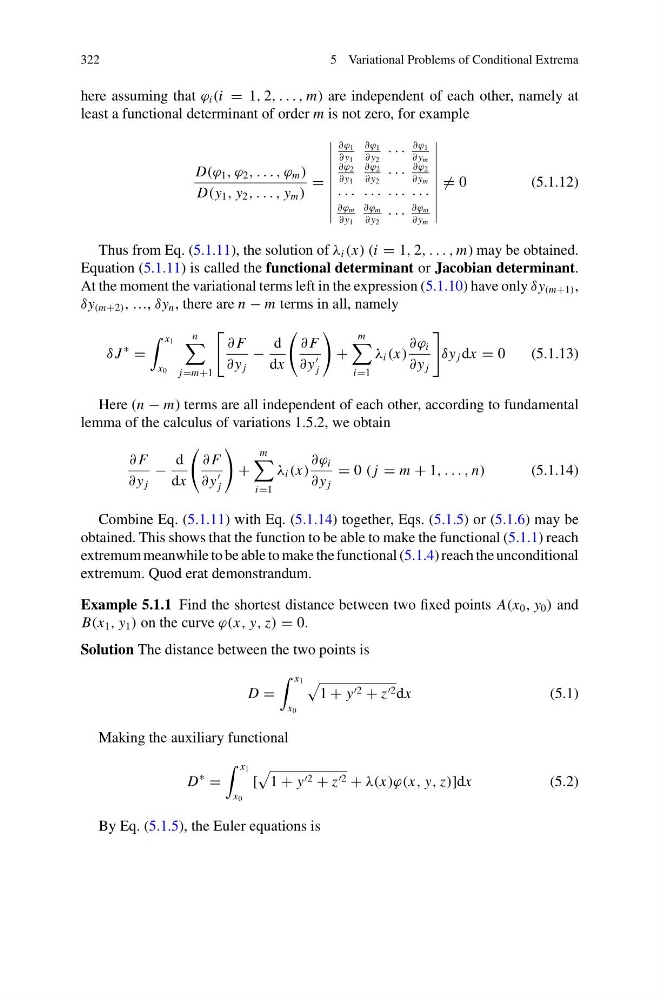
here assuming that ϕ i (i = 1, 2, . . . , m) are independent of each other, namely at
least a functional determinant of order m is not zero, for example
D(ϕ 1 , ϕ 2 , . . . , ϕ m )
D(y 1 , y 2 , . . . , y m )
=
∂ϕ 1
∂ y 1
∂ϕ 1
∂ y 2
· · ·
∂ϕ 1
∂ y m
∂ϕ 2
∂ y 1
∂ϕ 2
∂ y 2
· · ·
∂ϕ 2
∂ y m
· · · · · · · · · · · ·
∂ϕ m
∂ y 1
∂ϕ m
∂ y 2
· · ·
∂ϕ m
∂ y m
= 0
(5.1.12)
Thus from Eq. (5.1.11), the solution of λ i (x) (i = 1, 2, . . . , m) may be obtained.
Equation (5.1.11) is called the functional determinant or Jacobian determinant.
At the moment the variational terms left in the expression (5.1.10) have only δy (m+1) ,
δy (m+2) , …, δy n , there are n − m terms in all, namely
δ J
∗
=
x 1
x 0
n
j=m+1
∂ F
∂ y j
−
d
dx
∂ F
∂ y
j
+
m
i=1
λ i (x)
∂ϕ i
∂ y j
δy j dx = 0
(5.1.13)
Here (n − m) terms are all independent of each other, according to fundamental
lemma of the calculus of variations 1.5.2, we obtain
∂ F
∂ y j
−
d
dx
∂ F
∂ y
j
+
m
i=1
λ i (x)
∂ϕ i
∂ y j
= 0 ( j = m + 1, . . . , n)
(5.1.14)
Combine Eq. (5.1.11) with Eq. (5.1.14) together, Eqs. (5.1.5) or (5.1.6) may be
obtained. This shows that the function to be able to make the functional (5.1.1) reach
extremum meanwhile to be able to make the functional (5.1.4) reach the unconditional
extremum. Quod erat demonstrandum.
Example 5.1.1 Find the shortest distance between two fixed points A(x 0 , y 0 ) and
B(x 1 , y 1 ) on the curve ϕ(x, y, z) = 0.
Solution The distance between the two points is
D =
x 1
x 0
1 + y 2 + z 2 dx
(5.1)
Making the auxiliary functional
D
∗
=
x 1
x 0
[
1 + y 2 + z 2 + λ(x)ϕ(x, y, z)]dx
(5.2)
By Eq. (5.1.5), the Euler equations is
5 Variational Problems of Conditional Extrema
here assuming that ϕ i (i = 1, 2, . . . , m) are independent of each other, namely at
least a functional determinant of order m is not zero, for example
D(ϕ 1 , ϕ 2 , . . . , ϕ m )
D(y 1 , y 2 , . . . , y m )
=
∂ϕ 1
∂ y 1
∂ϕ 1
∂ y 2
· · ·
∂ϕ 1
∂ y m
∂ϕ 2
∂ y 1
∂ϕ 2
∂ y 2
· · ·
∂ϕ 2
∂ y m
· · · · · · · · · · · ·
∂ϕ m
∂ y 1
∂ϕ m
∂ y 2
· · ·
∂ϕ m
∂ y m
= 0
(5.1.12)
Thus from Eq. (5.1.11), the solution of λ i (x) (i = 1, 2, . . . , m) may be obtained.
Equation (5.1.11) is called the functional determinant or Jacobian determinant.
At the moment the variational terms left in the expression (5.1.10) have only δy (m+1) ,
δy (m+2) , …, δy n , there are n − m terms in all, namely
δ J
∗
=
x 1
x 0
n
j=m+1
∂ F
∂ y j
−
d
dx
∂ F
∂ y
j
+
m
i=1
λ i (x)
∂ϕ i
∂ y j
δy j dx = 0
(5.1.13)
Here (n − m) terms are all independent of each other, according to fundamental
lemma of the calculus of variations 1.5.2, we obtain
∂ F
∂ y j
−
d
dx
∂ F
∂ y
j
+
m
i=1
λ i (x)
∂ϕ i
∂ y j
= 0 ( j = m + 1, . . . , n)
(5.1.14)
Combine Eq. (5.1.11) with Eq. (5.1.14) together, Eqs. (5.1.5) or (5.1.6) may be
obtained. This shows that the function to be able to make the functional (5.1.1) reach
extremum meanwhile to be able to make the functional (5.1.4) reach the unconditional
extremum. Quod erat demonstrandum.
Example 5.1.1 Find the shortest distance between two fixed points A(x 0 , y 0 ) and
B(x 1 , y 1 ) on the curve ϕ(x, y, z) = 0.
Solution The distance between the two points is
D =
x 1
x 0
1 + y 2 + z 2 dx
(5.1)
Making the auxiliary functional
D
∗
=
x 1
x 0
[
1 + y 2 + z 2 + λ(x)ϕ(x, y, z)]dx
(5.2)
By Eq. (5.1.5), the Euler equations is