

302
4 Problems with Variable Boundaries
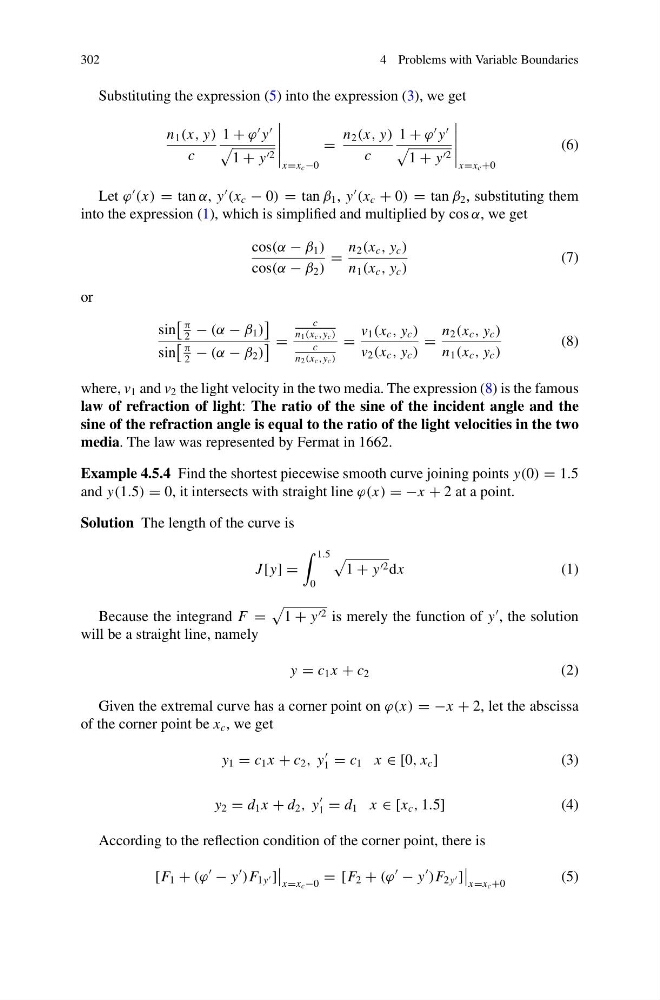
Substituting the expression (5) into the expression (3), we get
n 1 (x, y)
c
1 + ϕ
y
1 + y 2
x=x c −0
=
n 2 (x, y)
c
1 + ϕ
y
1 + y 2
x=x c +0
(6)
Let ϕ
(x) = tan α, y
(x c − 0) = tan β 1 , y
(x c + 0) = tan β 2 , substituting them
into the expression (1), which is simplified and multiplied by cos α, we get
cos(α − β 1 )
cos(α − β 2 )
=
n 2 (x c , y c )
n 1 (x c , y c )
(7)
or
sin
π
2
− (α − β 1 )
sin
π
2
− (α − β 2 )
=
c
n 1 (x c ,y c )
c
n 2 (x c ,y c )
=
v 1 (x c , y c )
v 2 (x c , y c )
=
n 2 (x c , y c )
n 1 (x c , y c )
(8)
where, v 1 and v 2 the light velocity in the two media. The expression (8) is the famous
law of refraction of light: The ratio of the sine of the incident angle and the
sine of the refraction angle is equal to the ratio of the light velocities in the two
media. The law was represented by Fermat in 1662.
Example 4.5.4 Find the shortest piecewise smooth curve joining points y(0) = 1.5
and y(1.5) = 0, it intersects with straight line ϕ(x) = −x + 2 at a point.
Solution The length of the curve is
J [y] =
1.5
0
1 + y 2 dx
(1)
Because the integrand F =
1 + y 2 is merely the function of y
, the solution
will be a straight line, namely
y = c 1 x + c 2
(2)
Given the extremal curve has a corner point on ϕ(x) = −x + 2, let the abscissa
of the corner point be x c , we get
y 1 = c 1 x + c 2 , y
1 = c 1 x ∈ [0, x c ]
(3)
y 2 = d 1 x + d 2 , y
1 = d 1 x ∈ [x c , 1.5]
(4)
According to the reflection condition of the corner point, there is
[F 1 + (ϕ
− y
)F 1y ]
x=x c −0
= [F 2 + (ϕ
− y
)F 2y ]
x=x c +0
(5)
4 Problems with Variable Boundaries
Substituting the expression (5) into the expression (3), we get
n 1 (x, y)
c
1 + ϕ
y
1 + y 2
x=x c −0
=
n 2 (x, y)
c
1 + ϕ
y
1 + y 2
x=x c +0
(6)
Let ϕ
(x) = tan α, y
(x c − 0) = tan β 1 , y
(x c + 0) = tan β 2 , substituting them
into the expression (1), which is simplified and multiplied by cos α, we get
cos(α − β 1 )
cos(α − β 2 )
=
n 2 (x c , y c )
n 1 (x c , y c )
(7)
or
sin
π
2
− (α − β 1 )
sin
π
2
− (α − β 2 )
=
c
n 1 (x c ,y c )
c
n 2 (x c ,y c )
=
v 1 (x c , y c )
v 2 (x c , y c )
=
n 2 (x c , y c )
n 1 (x c , y c )
(8)
where, v 1 and v 2 the light velocity in the two media. The expression (8) is the famous
law of refraction of light: The ratio of the sine of the incident angle and the
sine of the refraction angle is equal to the ratio of the light velocities in the two
media. The law was represented by Fermat in 1662.
Example 4.5.4 Find the shortest piecewise smooth curve joining points y(0) = 1.5
and y(1.5) = 0, it intersects with straight line ϕ(x) = −x + 2 at a point.
Solution The length of the curve is
J [y] =
1.5
0
1 + y 2 dx
(1)
Because the integrand F =
1 + y 2 is merely the function of y
, the solution
will be a straight line, namely
y = c 1 x + c 2
(2)
Given the extremal curve has a corner point on ϕ(x) = −x + 2, let the abscissa
of the corner point be x c , we get
y 1 = c 1 x + c 2 , y
1 = c 1 x ∈ [0, x c ]
(3)
y 2 = d 1 x + d 2 , y
1 = d 1 x ∈ [x c , 1.5]
(4)
According to the reflection condition of the corner point, there is
[F 1 + (ϕ
− y
)F 1y ]
x=x c −0
= [F 2 + (ϕ
− y
)F 2y ]
x=x c +0
(5)