

286
4 Problems with Variable Boundaries
⎧
⎪ ⎪ ⎪ ⎪ ⎪ ⎪ ⎪ ⎪ ⎪ ⎪ ⎪ ⎪ ⎪ ⎪ ⎪ ⎪ ⎪ ⎪ ⎪ ⎪ ⎪ ⎪ ⎪ ⎪ ⎪ ⎪ ⎪ ⎪ ⎪ ⎪ ⎨
⎪ ⎪ ⎪ ⎪ ⎪ ⎪ ⎪ ⎪ ⎪ ⎪ ⎪ ⎪ ⎪ ⎪ ⎪ ⎪ ⎪ ⎪ ⎪ ⎪ ⎪ ⎪ ⎪ ⎪ ⎪ ⎪ ⎪ ⎪ ⎪ ⎪ ⎩
F − y
i
F y
i
+
n i −1
k=1
(−1)
k
d
k F
y
(k+1)
i
dx k
− y
i
F y
i
+
n i −2
k=1
(−1)
k
d
k F
y
(k+2)
i
dx k
− · · · −
y
( j)
i
F y
( j)
i
+
n i − j
k=1
(−1)
k
d
k F
y
(k+ j)
i
dx k
− · · · −
y
(n i −1)
i
F y
(n i −1)
i
−
dF
y
(n i )
i
dx
−
y
(n i )
i
+
g x
g
y
(n i −1)
i
F y
(n i )
i
x=x 1
= 0
F y
i
+
n i −1
k=1
(−1)
k
d
k F
y
(k+1)
i
dx k
−
g y i
g
y
(n i −1)
i
F y
(n i )
i
x=x 1
= 0
F y
i
+
n i −2
k=1
(−1)
k
d
k F
y
(k+2)
i
dx k
−
g y
i
g
y
(n i −1)
i
F y
(n i )
i
x=x 1
= 0
. . .
F y
( j)
i
+
n i − j
k=1
(−1)
k
d
k F
y
(k+ j)
i
dx k
−
g
y
( j−1)
i
g
y
(n i −1)
i
F y
(n i )
i
x=x 1
= 0
. . .
F y
(n i −1)
i
−
dF
y
(n i )
i
dx
−
g
y
(n i −2)
i
g
y
(n i −1)
i
F y
(n i )
i
x=x 1
= 0
(4.3.45)
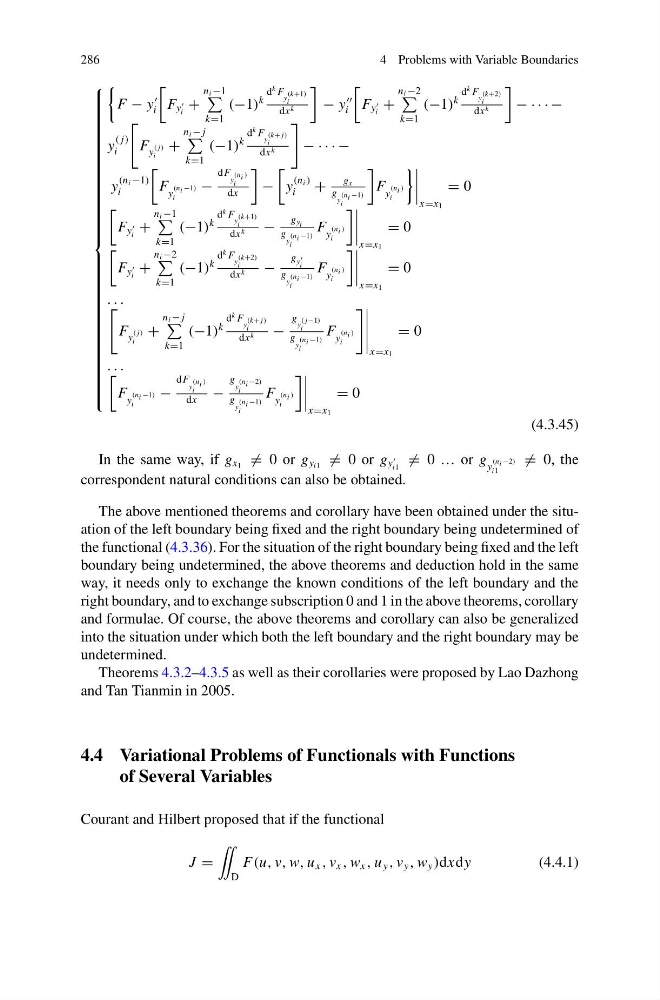
In the same way, if g x 1 = 0 or g y i1 = 0 or g y
i1
= 0 … or g y
(n i −2)
i1
= 0, the
correspondent natural conditions can also be obtained.
The above mentioned theorems and corollary have been obtained under the situation of the left boundary being fixed and the right boundary being undetermined of
the functional (4.3.36). For the situation of the right boundary being fixed and the left
boundary being undetermined, the above theorems and deduction hold in the same
way, it needs only to exchange the known conditions of the left boundary and the
right boundary, and to exchange subscription 0 and 1 in the above theorems, corollary
and formulae. Of course, the above theorems and corollary can also be generalized
into the situation under which both the left boundary and the right boundary may be
undetermined.
Theorems 4.3.2–4.3.5 as well as their corollaries were proposed by Lao Dazhong
and Tan Tianmin in 2005.
4.4 Variational Problems of Functionals with Functions
of Several Variables
Courant and Hilbert proposed that if the functional
J =
¨
D
F(u, v, w, u x , v x , w x , u y , v y , w y )dxdy
(4.4.1)
4 Problems with Variable Boundaries
⎧
⎪ ⎪ ⎪ ⎪ ⎪ ⎪ ⎪ ⎪ ⎪ ⎪ ⎪ ⎪ ⎪ ⎪ ⎪ ⎪ ⎪ ⎪ ⎪ ⎪ ⎪ ⎪ ⎪ ⎪ ⎪ ⎪ ⎪ ⎪ ⎪ ⎪ ⎨
⎪ ⎪ ⎪ ⎪ ⎪ ⎪ ⎪ ⎪ ⎪ ⎪ ⎪ ⎪ ⎪ ⎪ ⎪ ⎪ ⎪ ⎪ ⎪ ⎪ ⎪ ⎪ ⎪ ⎪ ⎪ ⎪ ⎪ ⎪ ⎪ ⎪ ⎩
F − y
i
F y
i
+
n i −1
k=1
(−1)
k
d
k F
y
(k+1)
i
dx k
− y
i
F y
i
+
n i −2
k=1
(−1)
k
d
k F
y
(k+2)
i
dx k
− · · · −
y
( j)
i
F y
( j)
i
+
n i − j
k=1
(−1)
k
d
k F
y
(k+ j)
i
dx k
− · · · −
y
(n i −1)
i
F y
(n i −1)
i
−
dF
y
(n i )
i
dx
−
y
(n i )
i
+
g x
g
y
(n i −1)
i
F y
(n i )
i
x=x 1
= 0
F y
i
+
n i −1
k=1
(−1)
k
d
k F
y
(k+1)
i
dx k
−
g y i
g
y
(n i −1)
i
F y
(n i )
i
x=x 1
= 0
F y
i
+
n i −2
k=1
(−1)
k
d
k F
y
(k+2)
i
dx k
−
g y
i
g
y
(n i −1)
i
F y
(n i )
i
x=x 1
= 0
. . .
F y
( j)
i
+
n i − j
k=1
(−1)
k
d
k F
y
(k+ j)
i
dx k
−
g
y
( j−1)
i
g
y
(n i −1)
i
F y
(n i )
i
x=x 1
= 0
. . .
F y
(n i −1)
i
−
dF
y
(n i )
i
dx
−
g
y
(n i −2)
i
g
y
(n i −1)
i
F y
(n i )
i
x=x 1
= 0
(4.3.45)
In the same way, if g x 1 = 0 or g y i1 = 0 or g y
i1
= 0 … or g y
(n i −2)
i1
= 0, the
correspondent natural conditions can also be obtained.
The above mentioned theorems and corollary have been obtained under the situation of the left boundary being fixed and the right boundary being undetermined of
the functional (4.3.36). For the situation of the right boundary being fixed and the left
boundary being undetermined, the above theorems and deduction hold in the same
way, it needs only to exchange the known conditions of the left boundary and the
right boundary, and to exchange subscription 0 and 1 in the above theorems, corollary
and formulae. Of course, the above theorems and corollary can also be generalized
into the situation under which both the left boundary and the right boundary may be
undetermined.
Theorems 4.3.2–4.3.5 as well as their corollaries were proposed by Lao Dazhong
and Tan Tianmin in 2005.
4.4 Variational Problems of Functionals with Functions
of Several Variables
Courant and Hilbert proposed that if the functional
J =
¨
D
F(u, v, w, u x , v x , w x , u y , v y , w y )dxdy
(4.4.1)