

4.3 Variational Problems of Functionals with Higher Order Derivatives
283
It is observed that the integral term in the above formula should be zero, therefore
the formula (4.3.37) holds.
Taking after the analysis of Sect. 4.3.2, a theorem of the variational problem of
the functional depending on an argument, multiple unknown functions and their
derivatives of higher order can be obtained, it can be stated as follows:
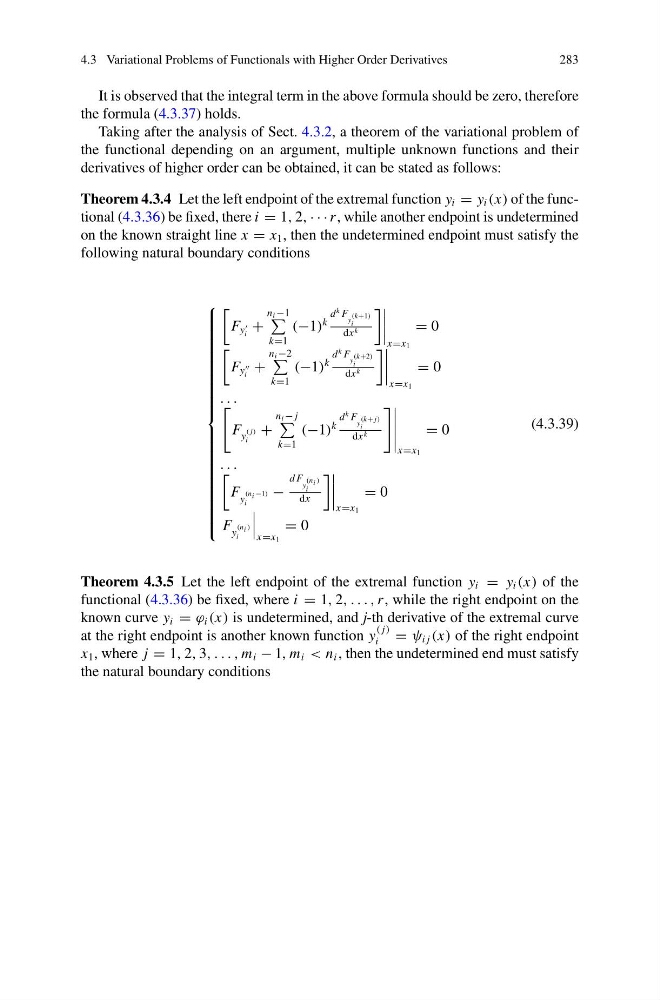
Theorem 4.3.4 Let the left endpoint of the extremal function y i = y i (x) of the functional (4.3.36) be fixed, there i = 1, 2, · · · r , while another endpoint is undetermined
on the known straight line x = x 1 , then the undetermined endpoint must satisfy the
following natural boundary conditions
⎧
⎪ ⎪ ⎪ ⎪ ⎪ ⎪ ⎪ ⎪ ⎪ ⎪ ⎪ ⎪ ⎪ ⎪ ⎪ ⎪ ⎪ ⎪ ⎪ ⎪ ⎨
⎪ ⎪ ⎪ ⎪ ⎪ ⎪ ⎪ ⎪ ⎪ ⎪ ⎪ ⎪ ⎪ ⎪ ⎪ ⎪ ⎪ ⎪ ⎪ ⎪ ⎩
F y
i
+
n i −1
k=1
(−1)
k
d
k F
y
(k+1)
i
dx k
x=x 1
= 0
F y
i
+
n i −2
k=1
(−1)
k
d
k F
y
(k+2)
i
dx k
x=x 1
= 0
. . .
F y
( j)
i
+
n i − j
k=1
(−1)
k
d
k F
y
(k+ j)
i
dx k
x=x 1
= 0
. . .
F y
(n i −1)
i
−
d F
y
(n i )
i
dx
x=x 1
= 0
F y
(n i )
i
x=x 1
= 0
(4.3.39)
Theorem 4.3.5 Let the left endpoint of the extremal function y i = y i (x) of the
functional (4.3.36) be fixed, where i = 1, 2, . . . , r , while the right endpoint on the
known curve y i = ϕ i (x) is undetermined, and j-th derivative of the extremal curve
at the right endpoint is another known function y
( j)
i
= ψ i j (x) of the right endpoint
x 1 , where j = 1, 2, 3, . . . , m i − 1, m i < n i , then the undetermined end must satisfy
the natural boundary conditions
283
It is observed that the integral term in the above formula should be zero, therefore
the formula (4.3.37) holds.
Taking after the analysis of Sect. 4.3.2, a theorem of the variational problem of
the functional depending on an argument, multiple unknown functions and their
derivatives of higher order can be obtained, it can be stated as follows:
Theorem 4.3.4 Let the left endpoint of the extremal function y i = y i (x) of the functional (4.3.36) be fixed, there i = 1, 2, · · · r , while another endpoint is undetermined
on the known straight line x = x 1 , then the undetermined endpoint must satisfy the
following natural boundary conditions
⎧
⎪ ⎪ ⎪ ⎪ ⎪ ⎪ ⎪ ⎪ ⎪ ⎪ ⎪ ⎪ ⎪ ⎪ ⎪ ⎪ ⎪ ⎪ ⎪ ⎪ ⎨
⎪ ⎪ ⎪ ⎪ ⎪ ⎪ ⎪ ⎪ ⎪ ⎪ ⎪ ⎪ ⎪ ⎪ ⎪ ⎪ ⎪ ⎪ ⎪ ⎪ ⎩
F y
i
+
n i −1
k=1
(−1)
k
d
k F
y
(k+1)
i
dx k
x=x 1
= 0
F y
i
+
n i −2
k=1
(−1)
k
d
k F
y
(k+2)
i
dx k
x=x 1
= 0
. . .
F y
( j)
i
+
n i − j
k=1
(−1)
k
d
k F
y
(k+ j)
i
dx k
x=x 1
= 0
. . .
F y
(n i −1)
i
−
d F
y
(n i )
i
dx
x=x 1
= 0
F y
(n i )
i
x=x 1
= 0
(4.3.39)
Theorem 4.3.5 Let the left endpoint of the extremal function y i = y i (x) of the
functional (4.3.36) be fixed, where i = 1, 2, . . . , r , while the right endpoint on the
known curve y i = ϕ i (x) is undetermined, and j-th derivative of the extremal curve
at the right endpoint is another known function y
( j)
i
= ψ i j (x) of the right endpoint
x 1 , where j = 1, 2, 3, . . . , m i − 1, m i < n i , then the undetermined end must satisfy
the natural boundary conditions