

4.3 Variational Problems of Functionals with Higher Order Derivatives
281
⎧
⎪ ⎪ ⎪ ⎪ ⎪ ⎪ ⎪ ⎪ ⎪ ⎪ ⎪ ⎪ ⎪ ⎪ ⎪ ⎪ ⎪ ⎪ ⎪ ⎪ ⎪ ⎪ ⎪ ⎪ ⎪ ⎪ ⎪ ⎪ ⎨
⎪ ⎪ ⎪ ⎪ ⎪ ⎪ ⎪ ⎪ ⎪ ⎪ ⎪ ⎪ ⎪ ⎪ ⎪ ⎪ ⎪ ⎪ ⎪ ⎪ ⎪ ⎪ ⎪ ⎪ ⎪ ⎪ ⎪ ⎪ ⎩
F − y
F y +
n−1
k=1
(−1)
k d
k F y (k+1)
dx k
− · · · − y
F y +
n−2
k=1
(−1)
k d
k F y (k+2)
dx k
−
y
( j)
F y ( j) +
n− j
k=1
(−1)
k d
k F y (k+ j)
dx k
− · · · −
y
(n−1)
F y (n−1) −
d F y (n)
dx
−
y
(n)
+
g x
g y (n−1)
F y (n)
x=x 1
= 0
F y +
n−1
k=1
(−1)
k d
k F y (k+1)
dx k
−
g y
g y (n−1)
F y (n)
x=x 1
= 0
F y +
n−2
k=1
(−1)
k d
k F y (k+2)
dx k
−
g y
g y (n−1)
F y (n)
x=x 1
= 0
. . .
F y ( j) +
n− j
k=1
(−1)
k d
k F y (k+ j)
dx k
−
g y ( j−1)
g y (n−1)
F y (n)
x=x 1
= 0
. . .
F y (n−1) −
d F y (n)
dx
−
g y (n−2)
g y (n−1)
F y (n)
x=x 1
= 0
(4.3.35)
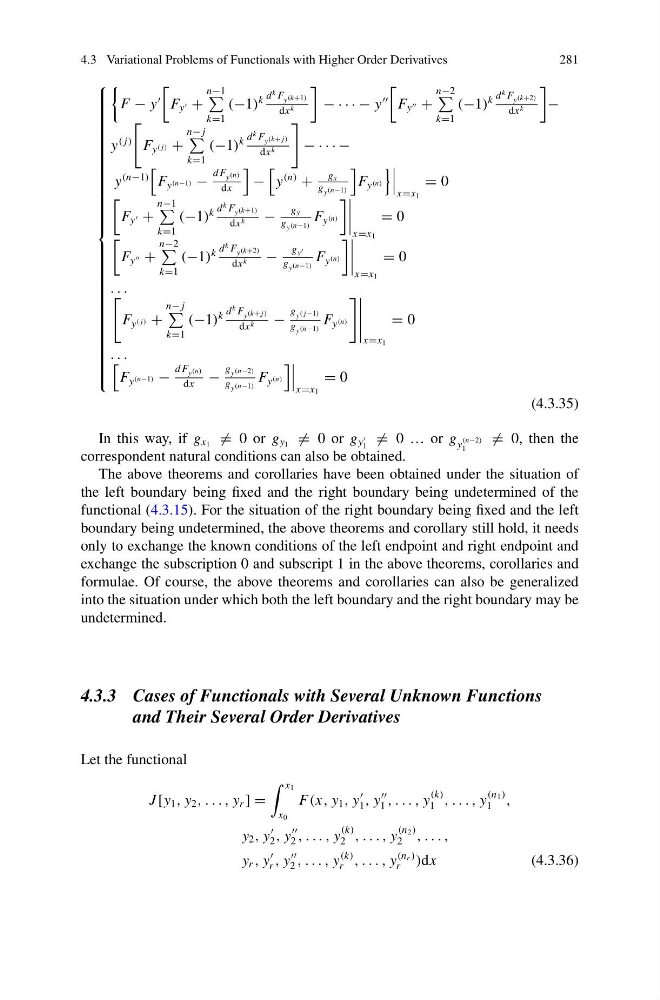
In this way, if g x 1 = 0 or g y 1 = 0 or g y
1
= 0 … or g y
(n−2)
1
= 0, then the
correspondent natural conditions can also be obtained.
The above theorems and corollaries have been obtained under the situation of
the left boundary being fixed and the right boundary being undetermined of the
functional (4.3.15). For the situation of the right boundary being fixed and the left
boundary being undetermined, the above theorems and corollary still hold, it needs
only to exchange the known conditions of the left endpoint and right endpoint and
exchange the subscription 0 and subscript 1 in the above theorems, corollaries and
formulae. Of course, the above theorems and corollaries can also be generalized
into the situation under which both the left boundary and the right boundary may be
undetermined.
4.3.3 Cases of Functionals with Several Unknown Functions
and Their Several Order Derivatives
Let the functional
J [y 1 , y 2 , . . . , y r ] =
x 1
x 0
F(x, y 1 , y
1 , y
1 , . . . , y
(k)
1 , . . . , y
(n 1 )
1 ,
y 2 , y
2 , y
2 , . . . , y
(k)
2 , . . . , y
(n 2 )
2 , . . . ,
y r , y
r , y
2 , . . . , y
(k)
r , . . . , y
(n r )
r )dx
(4.3.36)
281
⎧
⎪ ⎪ ⎪ ⎪ ⎪ ⎪ ⎪ ⎪ ⎪ ⎪ ⎪ ⎪ ⎪ ⎪ ⎪ ⎪ ⎪ ⎪ ⎪ ⎪ ⎪ ⎪ ⎪ ⎪ ⎪ ⎪ ⎪ ⎪ ⎨
⎪ ⎪ ⎪ ⎪ ⎪ ⎪ ⎪ ⎪ ⎪ ⎪ ⎪ ⎪ ⎪ ⎪ ⎪ ⎪ ⎪ ⎪ ⎪ ⎪ ⎪ ⎪ ⎪ ⎪ ⎪ ⎪ ⎪ ⎪ ⎩
F − y
F y +
n−1
k=1
(−1)
k d
k F y (k+1)
dx k
− · · · − y
F y +
n−2
k=1
(−1)
k d
k F y (k+2)
dx k
−
y
( j)
F y ( j) +
n− j
k=1
(−1)
k d
k F y (k+ j)
dx k
− · · · −
y
(n−1)
F y (n−1) −
d F y (n)
dx
−
y
(n)
+
g x
g y (n−1)
F y (n)
x=x 1
= 0
F y +
n−1
k=1
(−1)
k d
k F y (k+1)
dx k
−
g y
g y (n−1)
F y (n)
x=x 1
= 0
F y +
n−2
k=1
(−1)
k d
k F y (k+2)
dx k
−
g y
g y (n−1)
F y (n)
x=x 1
= 0
. . .
F y ( j) +
n− j
k=1
(−1)
k d
k F y (k+ j)
dx k
−
g y ( j−1)
g y (n−1)
F y (n)
x=x 1
= 0
. . .
F y (n−1) −
d F y (n)
dx
−
g y (n−2)
g y (n−1)
F y (n)
x=x 1
= 0
(4.3.35)
In this way, if g x 1 = 0 or g y 1 = 0 or g y
1
= 0 … or g y
(n−2)
1
= 0, then the
correspondent natural conditions can also be obtained.
The above theorems and corollaries have been obtained under the situation of
the left boundary being fixed and the right boundary being undetermined of the
functional (4.3.15). For the situation of the right boundary being fixed and the left
boundary being undetermined, the above theorems and corollary still hold, it needs
only to exchange the known conditions of the left endpoint and right endpoint and
exchange the subscription 0 and subscript 1 in the above theorems, corollaries and
formulae. Of course, the above theorems and corollaries can also be generalized
into the situation under which both the left boundary and the right boundary may be
undetermined.
4.3.3 Cases of Functionals with Several Unknown Functions
and Their Several Order Derivatives
Let the functional
J [y 1 , y 2 , . . . , y r ] =
x 1
x 0
F(x, y 1 , y
1 , y
1 , . . . , y
(k)
1 , . . . , y
(n 1 )
1 ,
y 2 , y
2 , y
2 , . . . , y
(k)
2 , . . . , y
(n 2 )
2 , . . . ,
y r , y
r , y
2 , . . . , y
(k)
r , . . . , y
(n r )
r )dx
(4.3.36)