

278
4 Problems with Variable Boundaries
− y
( j)
⎡
⎣ F y ( j) +
n− j
k=1
(−1)
k
d k F y (k+ j)
dx k
⎤
⎦ − · · · − y
(n−1)
F y (n−1) −
d F y (n)
dx
− y
(n) F y (n)
x=x1
δx 1
+
F y +
n−1
k=1
(−1)
k
d k F y (k+1)
dx k
x=x1
δy 1 +
F y +
n−2
k=1
(−1)
k
d k F y (k+2)
dx k
x=x1
δy
1 + · · ·
+
⎡
⎣ F y ( j) +
n− j
k=1
(−1)
k
d k F y (k+ j)
dx k
⎤
⎦
x=x1
δy
( j−1)
1
+ · · ·
+
F y (n−1) −
d F y (n)
dx
x=x1
δy
(n−2)
1
+ F y (n)
x=x1
δy
(n−1)
1
= 0
(4.3.25)
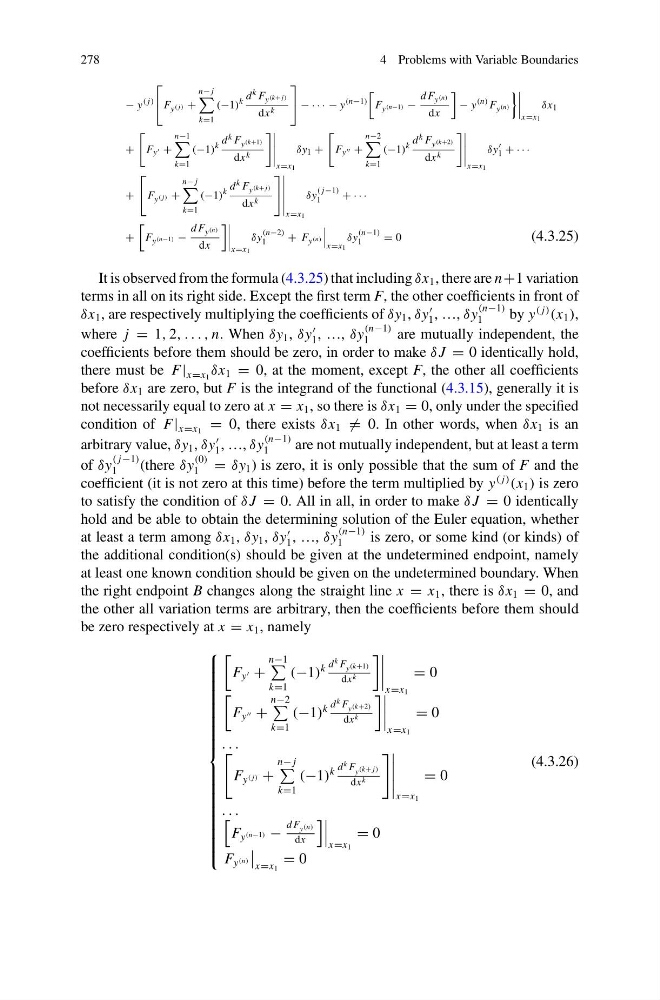
It is observed from the formula (4.3.25) that including δx 1 , there are n+1 variation
terms in all on its right side. Except the first term F, the other coefficients in front of
δx 1 , are respectively multiplying the coefficients of δy 1 , δy
1 , …, δy
(n−1)
1
by y
( j)
(x 1 ),
where j = 1, 2, . . . , n. When δy 1 , δy
1 , …, δy
(n−1)
1
are mutually independent, the
coefficients before them should be zero, in order to make δ J = 0 identically hold,
there must be F| x=x 1 δx 1 = 0, at the moment, except F, the other all coefficients
before δx 1 are zero, but F is the integrand of the functional (4.3.15), generally it is
not necessarily equal to zero at x = x 1 , so there is δx 1 = 0, only under the specified
condition of F| x=x 1 = 0, there exists δx 1 = 0. In other words, when δx 1 is an
arbitrary value, δy 1 , δy
1 , …, δy
(n−1)
1
are not mutually independent, but at least a term
of δy
( j−1)
1
(there δy
(0)
1 = δy 1 ) is zero, it is only possible that the sum of F and the
coefficient (it is not zero at this time) before the term multiplied by y
( j)
(x 1 ) is zero
to satisfy the condition of δ J = 0. All in all, in order to make δ J = 0 identically
hold and be able to obtain the determining solution of the Euler equation, whether
at least a term among δx 1 , δy 1 , δy
1 , …, δy
(n−1)
1
is zero, or some kind (or kinds) of
the additional condition(s) should be given at the undetermined endpoint, namely
at least one known condition should be given on the undetermined boundary. When
the right endpoint B changes along the straight line x = x 1 , there is δx 1 = 0, and
the other all variation terms are arbitrary, then the coefficients before them should
be zero respectively at x = x 1 , namely
⎧
⎪ ⎪ ⎪ ⎪ ⎪ ⎪ ⎪ ⎪ ⎪ ⎪ ⎪ ⎪ ⎪ ⎪ ⎪ ⎪ ⎪ ⎪ ⎨
⎪ ⎪ ⎪ ⎪ ⎪ ⎪ ⎪ ⎪ ⎪ ⎪ ⎪ ⎪ ⎪ ⎪ ⎪ ⎪ ⎪ ⎪ ⎩
F y +
n−1
k=1
(−1)
k d
k F y (k+1)
dx k
x=x 1
= 0
F y +
n−2
k=1
(−1)
k d
k F y (k+2)
dx k
x=x 1
= 0
. . .
F y ( j) +
n− j
k=1
(−1)
k d
k F y (k+ j)
dx k
x=x 1
= 0
. . .
F y (n−1) −
d F y (n)
dx
x=x 1
= 0
F y (n)
x=x 1
= 0
(4.3.26)
4 Problems with Variable Boundaries
− y
( j)
⎡
⎣ F y ( j) +
n− j
k=1
(−1)
k
d k F y (k+ j)
dx k
⎤
⎦ − · · · − y
(n−1)
F y (n−1) −
d F y (n)
dx
− y
(n) F y (n)
x=x1
δx 1
+
F y +
n−1
k=1
(−1)
k
d k F y (k+1)
dx k
x=x1
δy 1 +
F y +
n−2
k=1
(−1)
k
d k F y (k+2)
dx k
x=x1
δy
1 + · · ·
+
⎡
⎣ F y ( j) +
n− j
k=1
(−1)
k
d k F y (k+ j)
dx k
⎤
⎦
x=x1
δy
( j−1)
1
+ · · ·
+
F y (n−1) −
d F y (n)
dx
x=x1
δy
(n−2)
1
+ F y (n)
x=x1
δy
(n−1)
1
= 0
(4.3.25)
It is observed from the formula (4.3.25) that including δx 1 , there are n+1 variation
terms in all on its right side. Except the first term F, the other coefficients in front of
δx 1 , are respectively multiplying the coefficients of δy 1 , δy
1 , …, δy
(n−1)
1
by y
( j)
(x 1 ),
where j = 1, 2, . . . , n. When δy 1 , δy
1 , …, δy
(n−1)
1
are mutually independent, the
coefficients before them should be zero, in order to make δ J = 0 identically hold,
there must be F| x=x 1 δx 1 = 0, at the moment, except F, the other all coefficients
before δx 1 are zero, but F is the integrand of the functional (4.3.15), generally it is
not necessarily equal to zero at x = x 1 , so there is δx 1 = 0, only under the specified
condition of F| x=x 1 = 0, there exists δx 1 = 0. In other words, when δx 1 is an
arbitrary value, δy 1 , δy
1 , …, δy
(n−1)
1
are not mutually independent, but at least a term
of δy
( j−1)
1
(there δy
(0)
1 = δy 1 ) is zero, it is only possible that the sum of F and the
coefficient (it is not zero at this time) before the term multiplied by y
( j)
(x 1 ) is zero
to satisfy the condition of δ J = 0. All in all, in order to make δ J = 0 identically
hold and be able to obtain the determining solution of the Euler equation, whether
at least a term among δx 1 , δy 1 , δy
1 , …, δy
(n−1)
1
is zero, or some kind (or kinds) of
the additional condition(s) should be given at the undetermined endpoint, namely
at least one known condition should be given on the undetermined boundary. When
the right endpoint B changes along the straight line x = x 1 , there is δx 1 = 0, and
the other all variation terms are arbitrary, then the coefficients before them should
be zero respectively at x = x 1 , namely
⎧
⎪ ⎪ ⎪ ⎪ ⎪ ⎪ ⎪ ⎪ ⎪ ⎪ ⎪ ⎪ ⎪ ⎪ ⎪ ⎪ ⎪ ⎪ ⎨
⎪ ⎪ ⎪ ⎪ ⎪ ⎪ ⎪ ⎪ ⎪ ⎪ ⎪ ⎪ ⎪ ⎪ ⎪ ⎪ ⎪ ⎪ ⎩
F y +
n−1
k=1
(−1)
k d
k F y (k+1)
dx k
x=x 1
= 0
F y +
n−2
k=1
(−1)
k d
k F y (k+2)
dx k
x=x 1
= 0
. . .
F y ( j) +
n− j
k=1
(−1)
k d
k F y (k+ j)
dx k
x=x 1
= 0
. . .
F y (n−1) −
d F y (n)
dx
x=x 1
= 0
F y (n)
x=x 1
= 0
(4.3.26)