

276
4 Problems with Variable Boundaries
B is variable, x 1 is also undetermined, therefore 2n + 1 arbitrary constants need to be
determined in all. Because the left endpoint A is fixed, n arbitrary constants of the
general solution of the Euler-Poisson equation can be determined by the boundary
conditions y(x 0 ) = y 0 , y
(x 0 ) = y
0 , y
(x 0 ) = y
0 , …, y
(n−1)
(x 0 ) = y
(n−1)
0
. In order
to determine the unique solution, it is necessary to find out other n + 1 equations
to determine the rest n + 1 undetermined constants, the n + 1 equations can be got
by means of the necessary condition of the functional obtaining extremum, namely
δ J = 0. Here the general case is discussed, first the increment J of the functional
(4.3.15) is calculated, and then its main linear part δ J is separated out.
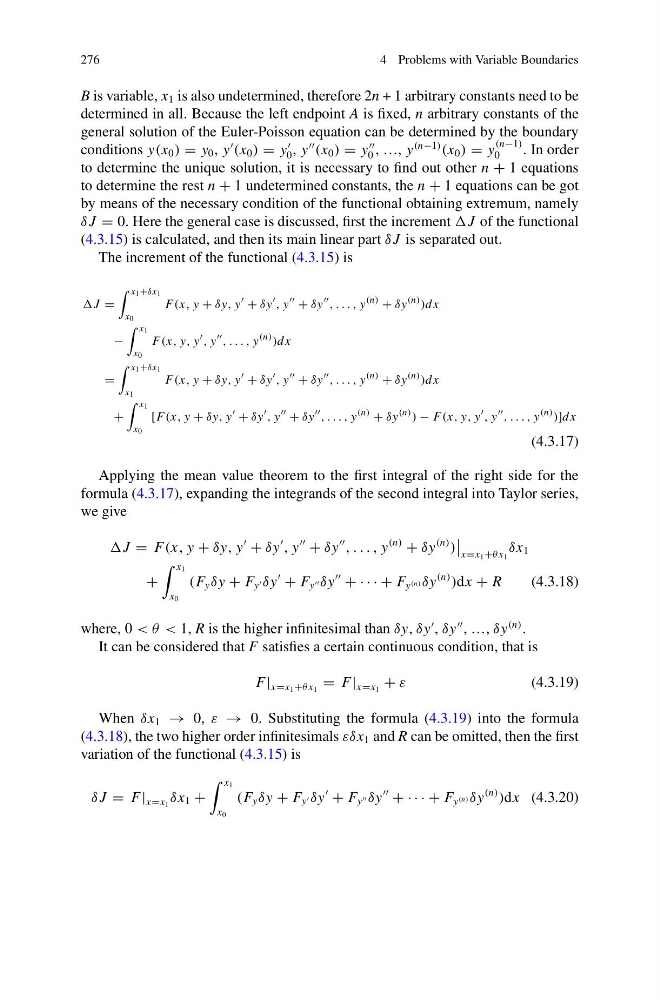
The increment of the functional (4.3.15) is
J =
x1+δx1
x0
F(x, y + δy, y
+ δy
, y
+ δy
, . . . , y
(n) + δy
(n) )dx
−
x1
x0
F(x, y, y
, y
, . . . , y
(n) )dx
=
x1+δx1
x1
F(x, y + δy, y
+ δy
, y
+ δy
, . . . , y
(n) + δy
(n) )dx
+
x1
x0
[F(x, y + δy, y
+ δy
, y
+ δy
, . . . , y
(n) + δy
(n) ) − F(x, y, y
, y
, . . . , y
(n) )]dx
(4.3.17)
Applying the mean value theorem to the first integral of the right side for the
formula (4.3.17), expanding the integrands of the second integral into Taylor series,
we give
J = F(x, y + δy, y
+ δy
, y
+ δy
, . . . , y
(n)
+ δy
(n)
)
x=x 1 +θ x 1
δx 1
+
x 1
x 0
(F y δy + F y δy
+ F y δy
+ · · · + F y (n) δy
(n)
)dx + R
(4.3.18)
where, 0 < θ < 1, R is the higher infinitesimal than δy, δy
, δy
, …, δy
(n) .
It can be considered that F satisfies a certain continuous condition, that is
F| x=x 1 +θ x 1 = F| x=x 1 + ε
(4.3.19)
When δx 1 → 0, ε → 0. Substituting the formula (4.3.19) into the formula
(4.3.18), the two higher order infinitesimals εδx 1 and R can be omitted, then the first
variation of the functional (4.3.15) is
δ J = F| x=x 1 δx 1 +
x 1
x 0
(F y δy + F y δy
+ F y δy
+ · · · + F y (n) δy
(n)
)dx (4.3.20)
4 Problems with Variable Boundaries
B is variable, x 1 is also undetermined, therefore 2n + 1 arbitrary constants need to be
determined in all. Because the left endpoint A is fixed, n arbitrary constants of the
general solution of the Euler-Poisson equation can be determined by the boundary
conditions y(x 0 ) = y 0 , y
(x 0 ) = y
0 , y
(x 0 ) = y
0 , …, y
(n−1)
(x 0 ) = y
(n−1)
0
. In order
to determine the unique solution, it is necessary to find out other n + 1 equations
to determine the rest n + 1 undetermined constants, the n + 1 equations can be got
by means of the necessary condition of the functional obtaining extremum, namely
δ J = 0. Here the general case is discussed, first the increment J of the functional
(4.3.15) is calculated, and then its main linear part δ J is separated out.
The increment of the functional (4.3.15) is
J =
x1+δx1
x0
F(x, y + δy, y
+ δy
, y
+ δy
, . . . , y
(n) + δy
(n) )dx
−
x1
x0
F(x, y, y
, y
, . . . , y
(n) )dx
=
x1+δx1
x1
F(x, y + δy, y
+ δy
, y
+ δy
, . . . , y
(n) + δy
(n) )dx
+
x1
x0
[F(x, y + δy, y
+ δy
, y
+ δy
, . . . , y
(n) + δy
(n) ) − F(x, y, y
, y
, . . . , y
(n) )]dx
(4.3.17)
Applying the mean value theorem to the first integral of the right side for the
formula (4.3.17), expanding the integrands of the second integral into Taylor series,
we give
J = F(x, y + δy, y
+ δy
, y
+ δy
, . . . , y
(n)
+ δy
(n)
)
x=x 1 +θ x 1
δx 1
+
x 1
x 0
(F y δy + F y δy
+ F y δy
+ · · · + F y (n) δy
(n)
)dx + R
(4.3.18)
where, 0 < θ < 1, R is the higher infinitesimal than δy, δy
, δy
, …, δy
(n) .
It can be considered that F satisfies a certain continuous condition, that is
F| x=x 1 +θ x 1 = F| x=x 1 + ε
(4.3.19)
When δx 1 → 0, ε → 0. Substituting the formula (4.3.19) into the formula
(4.3.18), the two higher order infinitesimals εδx 1 and R can be omitted, then the first
variation of the functional (4.3.15) is
δ J = F| x=x 1 δx 1 +
x 1
x 0
(F y δy + F y δy
+ F y δy
+ · · · + F y (n) δy
(n)
)dx (4.3.20)