

228
3 Sufficient Conditions of Extrema of Functionals
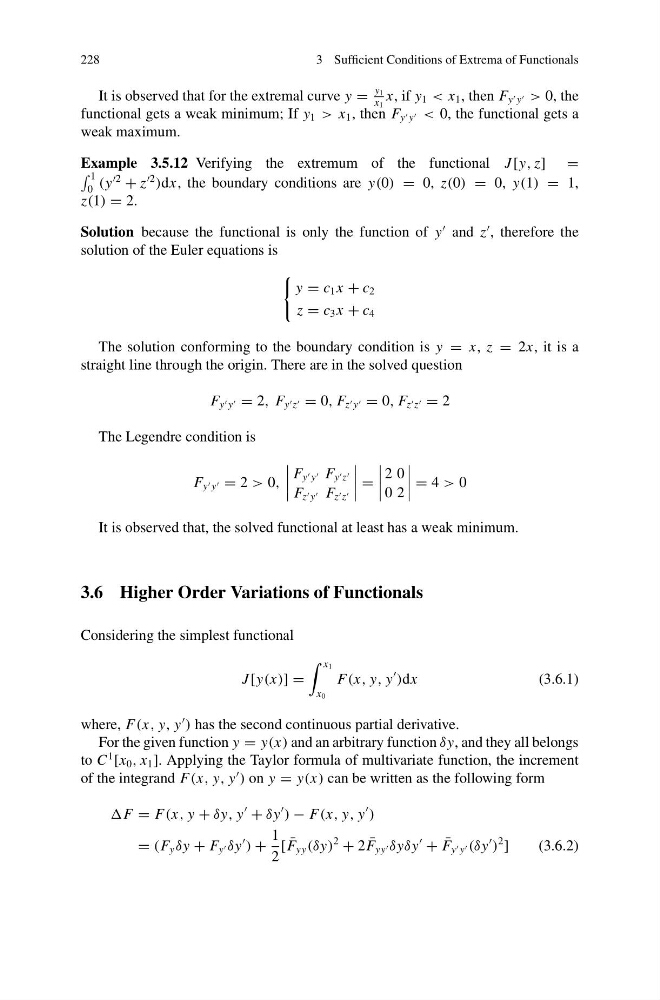
It is observed that for the extremal curve y =
y 1
x 1
x, if y 1 < x 1 , then F y y > 0, the
functional gets a weak minimum; If y 1 > x 1 , then F y y < 0, the functional gets a
weak maximum.
Example 3.5.12 Verifying the extremum of the functional J [y, z] =
1
0 (y
2
+ z
2
)dx, the boundary conditions are y(0) = 0, z(0) = 0, y(1) = 1,
z(1) = 2.
Solution because the functional is only the function of y
and z
, therefore the
solution of the Euler equations is
y = c 1 x + c 2
z = c 3 x + c 4
The solution conforming to the boundary condition is y = x, z = 2x, it is a
straight line through the origin. There are in the solved question
F y y = 2, F y z = 0, F z y = 0, F z z = 2
The Legendre condition is
F y y = 2 > 0,
F y y F y z
F z y F z z
=
2 0
0 2
= 4 > 0
It is observed that, the solved functional at least has a weak minimum.
3.6 Higher Order Variations of Functionals
Considering the simplest functional
J [y(x)] =
x 1
x 0
F(x, y, y
)dx
(3.6.1)
where, F(x, y, y
) has the second continuous partial derivative.
For the given function y = y(x) and an arbitrary function δy, and they all belongs
to C
1
[x 0 , x 1 ]. Applying the Taylor formula of multivariate function, the increment
of the integrand F(x, y, y
) on y = y(x) can be written as the following form
F = F(x, y + δy, y
+ δy
) − F(x, y, y
)
= (F y δy + F y δy
) +
1
2
[ ¯
F yy (δy)
2
+ 2 ¯
F yy δyδy
+ ¯
F y y (δy
)
2
]
(3.6.2)
3 Sufficient Conditions of Extrema of Functionals
It is observed that for the extremal curve y =
y 1
x 1
x, if y 1 < x 1 , then F y y > 0, the
functional gets a weak minimum; If y 1 > x 1 , then F y y < 0, the functional gets a
weak maximum.
Example 3.5.12 Verifying the extremum of the functional J [y, z] =
1
0 (y
2
+ z
2
)dx, the boundary conditions are y(0) = 0, z(0) = 0, y(1) = 1,
z(1) = 2.
Solution because the functional is only the function of y
and z
, therefore the
solution of the Euler equations is
y = c 1 x + c 2
z = c 3 x + c 4
The solution conforming to the boundary condition is y = x, z = 2x, it is a
straight line through the origin. There are in the solved question
F y y = 2, F y z = 0, F z y = 0, F z z = 2
The Legendre condition is
F y y = 2 > 0,
F y y F y z
F z y F z z
=
2 0
0 2
= 4 > 0
It is observed that, the solved functional at least has a weak minimum.
3.6 Higher Order Variations of Functionals
Considering the simplest functional
J [y(x)] =
x 1
x 0
F(x, y, y
)dx
(3.6.1)
where, F(x, y, y
) has the second continuous partial derivative.
For the given function y = y(x) and an arbitrary function δy, and they all belongs
to C
1
[x 0 , x 1 ]. Applying the Taylor formula of multivariate function, the increment
of the integrand F(x, y, y
) on y = y(x) can be written as the following form
F = F(x, y + δy, y
+ δy
) − F(x, y, y
)
= (F y δy + F y δy
) +
1
2
[ ¯
F yy (δy)
2
+ 2 ¯
F yy δyδy
+ ¯
F y y (δy
)
2
]
(3.6.2)