

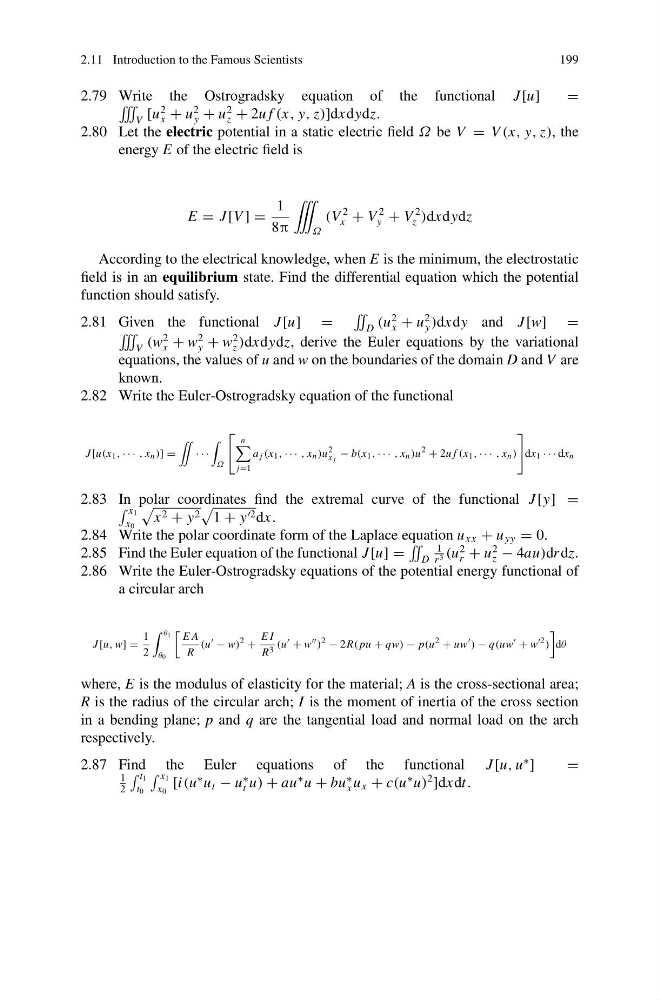
2.11 Introduction to the Famous Scientists
199
2.79 Write the Ostrogradsky equation of the functional J [u]
=
˝
V [u
2
x + u
2
y + u
2
z + 2u f (x, y, z)]dxdydz.
2.80 Let the electric potential in a static electric field Ω be V = V (x, y, z), the
energy E of the electric field is
E = J [V ] =
1
8π
˚
Ω
(V
2
x + V
2
y + V
2
z )dxdydz
According to the electrical knowledge, when E is the minimum, the electrostatic
field is in an equilibrium state. Find the differential equation which the potential
function should satisfy.
2.81 Given the functional J [u] =
˜
D (u
2
x + u
2
y )dxdy and J [w] =
˝
V (w
2
x + w
2
y + w
2
z )dxdydz, derive the Euler equations by the variational
equations, the values of u and w on the boundaries of the domain D and V are
known.
2.82 Write the Euler-Ostrogradsky equation of the functional
J [u(x 1 , · · · , x n )] =
¨
· · ·
Ω
⎡
⎣
n
j=1
a j (x 1 , · · · , x n )u
2
x j
− b(x 1 , · · · , x n )u
2 + 2u f (x 1 , · · · , x n )
⎤
⎦ dx 1 · · · dx n
2.83 In polar coordinates find the extremal curve of the functional J [y] =
x 1
x 0
x 2 + y 2
1 + y 2 dx.
2.84 Write the polar coordinate form of the Laplace equation u xx + u yy = 0.
2.85 Find the Euler equation of the functional J [u] =
˜
D
1
r 3 (u
2
r + u
2
z − 4au)dr dz.
2.86 Write the Euler-Ostrogradsky equations of the potential energy functional of
a circular arch
J [u, w] =
1
2
θ1
θ0
E A
R
(u
− w)
2 +
E I
R 3 (u
+ w
)
2 − 2R( pu + qw) − p(u
2 + uw
) − q(uw
+ w
2 )
dθ
where, E is the modulus of elasticity for the material; A is the cross-sectional area;
R is the radius of the circular arch; I is the moment of inertia of the cross section
in a bending plane; p and q are the tangential load and normal load on the arch
respectively.
2.87 Find the Euler equations of the functional J [u, u
∗
]
=
1
2
t 1
t 0
x 1
x 0
[i(u
∗ u t − u
∗
t u) + au
∗ u + bu
∗
x u x + c(u
∗ u)
2
]dxdt.
199
2.79 Write the Ostrogradsky equation of the functional J [u]
=
˝
V [u
2
x + u
2
y + u
2
z + 2u f (x, y, z)]dxdydz.
2.80 Let the electric potential in a static electric field Ω be V = V (x, y, z), the
energy E of the electric field is
E = J [V ] =
1
8π
˚
Ω
(V
2
x + V
2
y + V
2
z )dxdydz
According to the electrical knowledge, when E is the minimum, the electrostatic
field is in an equilibrium state. Find the differential equation which the potential
function should satisfy.
2.81 Given the functional J [u] =
˜
D (u
2
x + u
2
y )dxdy and J [w] =
˝
V (w
2
x + w
2
y + w
2
z )dxdydz, derive the Euler equations by the variational
equations, the values of u and w on the boundaries of the domain D and V are
known.
2.82 Write the Euler-Ostrogradsky equation of the functional
J [u(x 1 , · · · , x n )] =
¨
· · ·
Ω
⎡
⎣
n
j=1
a j (x 1 , · · · , x n )u
2
x j
− b(x 1 , · · · , x n )u
2 + 2u f (x 1 , · · · , x n )
⎤
⎦ dx 1 · · · dx n
2.83 In polar coordinates find the extremal curve of the functional J [y] =
x 1
x 0
x 2 + y 2
1 + y 2 dx.
2.84 Write the polar coordinate form of the Laplace equation u xx + u yy = 0.
2.85 Find the Euler equation of the functional J [u] =
˜
D
1
r 3 (u
2
r + u
2
z − 4au)dr dz.
2.86 Write the Euler-Ostrogradsky equations of the potential energy functional of
a circular arch
J [u, w] =
1
2
θ1
θ0
E A
R
(u
− w)
2 +
E I
R 3 (u
+ w
)
2 − 2R( pu + qw) − p(u
2 + uw
) − q(uw
+ w
2 )
dθ
where, E is the modulus of elasticity for the material; A is the cross-sectional area;
R is the radius of the circular arch; I is the moment of inertia of the cross section
in a bending plane; p and q are the tangential load and normal load on the arch
respectively.
2.87 Find the Euler equations of the functional J [u, u
∗
]
=
1
2
t 1
t 0
x 1
x 0
[i(u
∗ u t − u
∗
t u) + au
∗ u + bu
∗
x u x + c(u
∗ u)
2
]dxdt.