

2.11 Introduction to the Famous Scientists
197
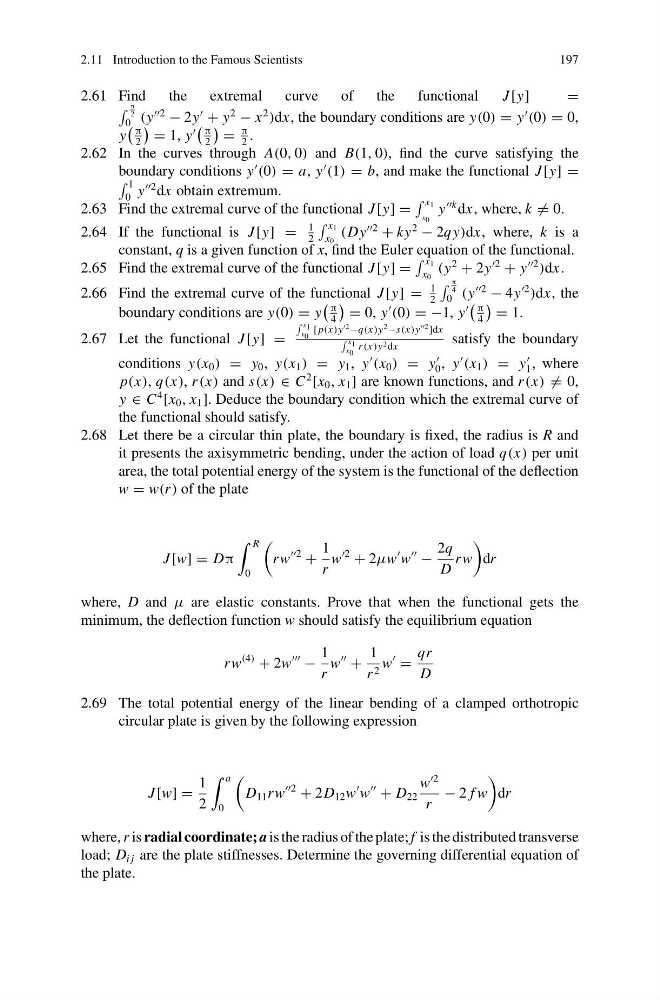
2.61 Find
the
extremal
curve
of
the
functional
J [y]
=
π
2
0 (y
2
− 2y
+ y
2
− x
2
)dx, the boundary conditions are y(0) = y
(0) = 0,
y
π
2
= 1, y
π
2
=
π
2
.
2.62 In the curves through A(0, 0) and B(1, 0), find the curve satisfying the
boundary conditions y
(0) = a, y
(1) = b, and make the functional J [y] =
1
0 y
2 dx obtain extremum.
2.63 Find the extremal curve of the functional J [y] =
x 1
x 0
y
k dx, where, k = 0.
2.64 If the functional is J [y] =
1
2
x 1
x 0
(Dy
2
+ ky
2
− 2qy)dx, where, k is a
constant, q is a given function of x, find the Euler equation of the functional.
2.65 Find the extremal curve of the functional J [y] =
x 1
x 0
(y
2
+ 2y
2
+ y
2
)dx.
2.66 Find the extremal curve of the functional J [y] =
1
2
π
4
0 (y
2
− 4y
2
)dx, the
boundary conditions are y(0) = y
π
4
= 0, y
(0) = −1, y
π
4
= 1.
2.67 Let the functional J [y] =
x 1
x 0
[ p(x)y
2 −q(x)y
2 −s(x)y
2 ]dx
x 1
x 0
r (x)y 2 dx
satisfy the boundary
conditions y(x 0 ) = y 0 , y(x 1 ) = y 1 , y
(x 0 ) = y
0 , y
(x 1 ) = y
1 , where
p(x), q(x), r (x) and s(x) ∈ C
2
[x 0 , x 1 ] are known functions, and r (x) = 0,
y ∈ C
4
[x 0 , x 1 ]. Deduce the boundary condition which the extremal curve of
the functional should satisfy.
2.68 Let there be a circular thin plate, the boundary is fixed, the radius is R and
it presents the axisymmetric bending, under the action of load q(x) per unit
area, the total potential energy of the system is the functional of the deflection
w = w(r ) of the plate
J [w] = Dπ
R
0
rw
2
+
1
r
w
2
+ 2μw
w
−
2q
D
rw
dr
where, D and μ are elastic constants. Prove that when the functional gets the
minimum, the deflection function w should satisfy the equilibrium equation
rw
(4)
+ 2w
−
1
r
w
+
1
r 2 w
=
qr
D
2.69 The total potential energy of the linear bending of a clamped orthotropic
circular plate is given by the following expression
J [w] =
1
2
a
0
D 11 rw
2
+ 2D 12 w
w
+ D 22
w
2
r
− 2 f w
dr
where, r is radial coordinate; a is the radius of the plate; f is the distributed transverse
load; D i j are the plate stiffnesses. Determine the governing differential equation of
the plate.
197
2.61 Find
the
extremal
curve
of
the
functional
J [y]
=
π
2
0 (y
2
− 2y
+ y
2
− x
2
)dx, the boundary conditions are y(0) = y
(0) = 0,
y
π
2
= 1, y
π
2
=
π
2
.
2.62 In the curves through A(0, 0) and B(1, 0), find the curve satisfying the
boundary conditions y
(0) = a, y
(1) = b, and make the functional J [y] =
1
0 y
2 dx obtain extremum.
2.63 Find the extremal curve of the functional J [y] =
x 1
x 0
y
k dx, where, k = 0.
2.64 If the functional is J [y] =
1
2
x 1
x 0
(Dy
2
+ ky
2
− 2qy)dx, where, k is a
constant, q is a given function of x, find the Euler equation of the functional.
2.65 Find the extremal curve of the functional J [y] =
x 1
x 0
(y
2
+ 2y
2
+ y
2
)dx.
2.66 Find the extremal curve of the functional J [y] =
1
2
π
4
0 (y
2
− 4y
2
)dx, the
boundary conditions are y(0) = y
π
4
= 0, y
(0) = −1, y
π
4
= 1.
2.67 Let the functional J [y] =
x 1
x 0
[ p(x)y
2 −q(x)y
2 −s(x)y
2 ]dx
x 1
x 0
r (x)y 2 dx
satisfy the boundary
conditions y(x 0 ) = y 0 , y(x 1 ) = y 1 , y
(x 0 ) = y
0 , y
(x 1 ) = y
1 , where
p(x), q(x), r (x) and s(x) ∈ C
2
[x 0 , x 1 ] are known functions, and r (x) = 0,
y ∈ C
4
[x 0 , x 1 ]. Deduce the boundary condition which the extremal curve of
the functional should satisfy.
2.68 Let there be a circular thin plate, the boundary is fixed, the radius is R and
it presents the axisymmetric bending, under the action of load q(x) per unit
area, the total potential energy of the system is the functional of the deflection
w = w(r ) of the plate
J [w] = Dπ
R
0
rw
2
+
1
r
w
2
+ 2μw
w
−
2q
D
rw
dr
where, D and μ are elastic constants. Prove that when the functional gets the
minimum, the deflection function w should satisfy the equilibrium equation
rw
(4)
+ 2w
−
1
r
w
+
1
r 2 w
=
qr
D
2.69 The total potential energy of the linear bending of a clamped orthotropic
circular plate is given by the following expression
J [w] =
1
2
a
0
D 11 rw
2
+ 2D 12 w
w
+ D 22
w
2
r
− 2 f w
dr
where, r is radial coordinate; a is the radius of the plate; f is the distributed transverse
load; D i j are the plate stiffnesses. Determine the governing differential equation of
the plate.